5 Steps to Maintain Casino Marketing Pipelines
5 Steps to Maintain Casino Marketing Pipelines
IGaming Marketing
May 10, 2026
May 10, 2026
Five-step playbook to keep casino marketing pipelines profitable by fixing metrics, data, ML, automation and testing.
Five-step playbook to keep casino marketing pipelines profitable by fixing metrics, data, ML, automation and testing.

A strong casino marketing pipeline is essential for attracting players, keeping them engaged, and maximizing revenue. Without consistent maintenance, pipelines can become inefficient, leading to inactive leads and wasted marketing budgets. Here’s a quick breakdown of the five steps to keep your pipeline effective:
Set Baseline Metrics and Stages: Map out key player lifecycle stages - Acquisition, Activation, Retention, Reactivation, and VIP Management. Track metrics like Cost Per Lead (CPL), churn rates, and Player Lifetime Value (LTV) to measure success.
Clean and Update Data: Deduplicate records, standardize formats, and enrich missing data weekly. Use the 14/30 rule to manage inactive leads and maintain data accuracy.
Monitor Machine Learning Models: Track performance metrics like uplift and detect model drift using statistical tests. Retrain models every 14 days to ensure accuracy.
Automate Activity Tracking: Set clear goals for each pipeline stage and use tools like Enreach for automated outreach, saving time while improving efficiency.
Review and Adjust: Regularly analyze results to identify bottlenecks and test new tactics like behavior-driven nudges or multi-channel fallback strategies.
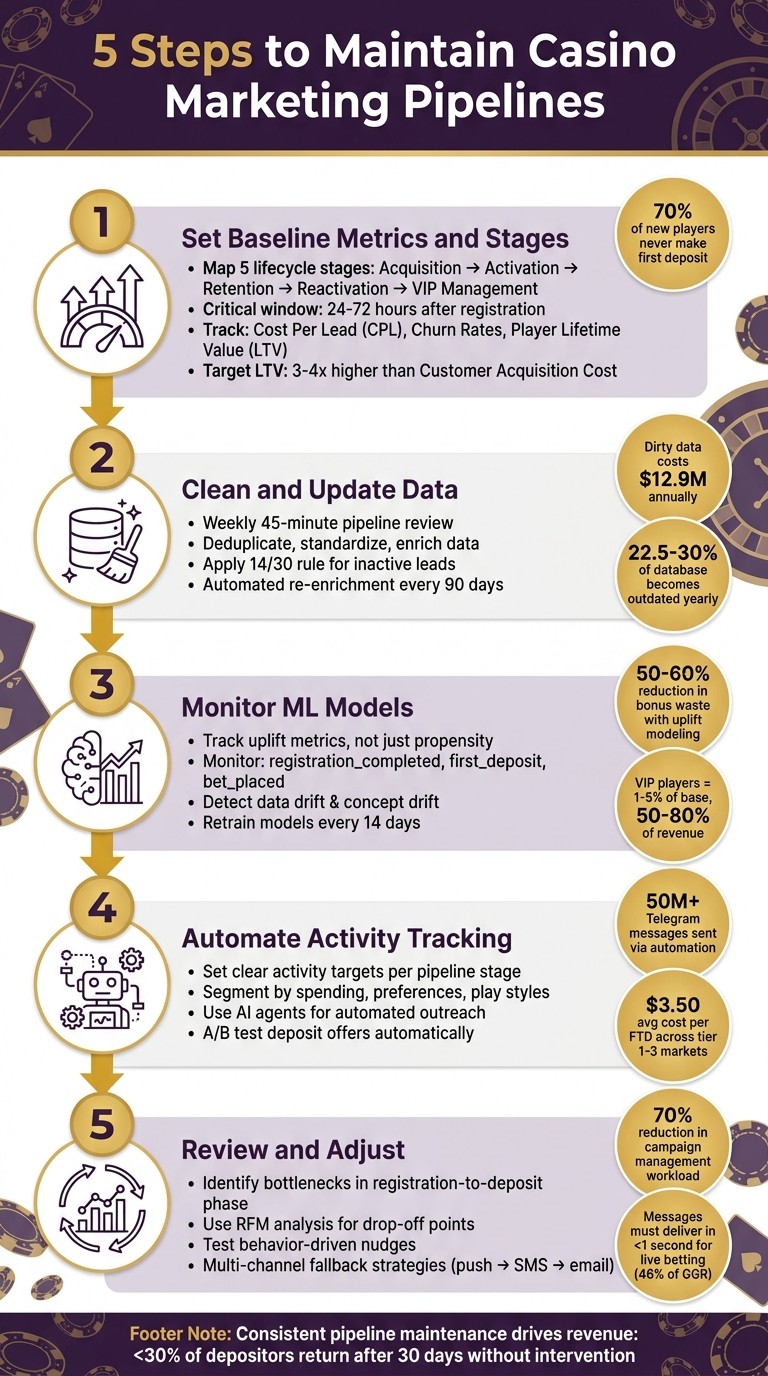
5 Steps to Maintain Casino Marketing Pipelines
Step 1: Set Up Baseline Metrics and Pipeline Stages
Map Out Your Pipeline Stages
To build an effective casino marketing strategy, structure your pipeline around the player lifecycle. Focus on five key stages: Acquisition (bringing in new players), Activation (first deposit), Retention (encouraging consistent play), Reactivation (winning back inactive players), and VIP Management (catering to high-value players).
Timing is everything, especially in the 24 to 72 hours after registration. This period is critical since conversion rates drop significantly afterward. The stats are eye-opening: over 70% of new players never make their first deposit, and fewer than 30% of those who do will return after 30 days. That’s why tracking real-time behavioral signals - like abandoned deposit flows or a VIP player’s inactivity for seven days - can make all the difference. Relying solely on scheduled batch sends just won’t cut it.
Using RFM segmentation (Recency, Frequency, Monetary) is a smart way to group players into categories like "Champions", "Potential Loyalists", or "At Risk". This allows you to fine-tune your marketing efforts. For instance, you could send a push notification after seven days of inactivity, follow up with an SMS offering a bonus after 14 days, and then escalate to Telegram outreach or email with a high-value offer after 30 days.
Once you’ve mapped out your pipeline stages, the next step is to define the metrics that will help you measure success at every stage.
Choose Your Performance Metrics
Tracking the right metrics helps you spot where players are dropping off in your pipeline. For Acquisition, focus on metrics like Cost Per Lead (CPL) and Cost Per Click (CPC). During Activation, monitor the "Registrations to First-Time Depositors" ratio - industry benchmarks typically fall between 20% and 30%. When it comes to Retention, keep an eye on monthly churn rates (aim for below 5%) and retention rates (a healthy range is 70-80% over 30 days).
A key measure of success is Player Lifetime Value (LTV), which should ideally be 3-4 times higher than your Customer Acquisition Cost (CAC). For example, if acquiring a player costs $50, their LTV should be at least $150–$200. VIP players, who often make up around 20% of your user base but generate up to 70% of Gross Gaming Revenue (GGR), deserve special attention. For this group, aim for an Average Daily Theoretical (ADT) threshold of over $1,000 to guide your reinvestment strategies.
Don’t forget the power of email marketing in iGaming. It boasts an average ROI of $42 for every $1 spent, with open rates of 21.5% and conversion rates of 4.2%. Also, with live betting now contributing 46% of sports betting GGR, delivering marketing triggers in under a second can be a game-changer for your revenue.
Step 2: Clean and Update Your Data Regularly
Dirty data is more than just an inconvenience - it’s a costly problem. It can drain organizations of up to $12.9 million annually. For casino marketing, where every dollar counts and competition is intense, outdated or duplicate player records can eat into your budget. And with contact data decaying at about 2% per month, as much as 22.5% to 30% of your database could become outdated every year.
Review Your Pipeline Weekly
Set aside just 45 minutes each week to clean up your pipeline. Focus on identifying records that have been inactive for 14 days. For instance, in February 2026, a B2B staffing company used LeadMagic to clean up a CRM database containing 47,000 contacts collected over three years. By addressing "catch-all" domains and removing 12,620 invalid entries, they cut their email bounce rate from 6.2% to 0.7%. As a result, their email open rates jumped from 18.4% to 31.2%, and weekly booked meetings increased from 4 to 11.
During your weekly review, prioritize these actions:
Deduplicate records: Use fuzzy matching algorithms to consolidate duplicate entries into a single, accurate "golden record" for each player.
Standardize formats: Ensure consistency in phone numbers (e.g., E.164 format) and location data.
Enrich data: Fill in missing gaps by incorporating third-party demographic information.
For example, Booyah Advertising utilized Improvado's automated data pipelines to manage over 100 clients. Under the leadership of Marketing Analytics Manager Tyler Corcoran, they achieved 99.9% data accuracy and slashed the time spent on daily budget-pacing updates from hours to just 10–30 minutes.
Once your pipeline is clean, the next step is to implement clear rules for managing inactive leads.
Create Rules for Inactive Leads
Not all inactive players are worth pursuing. Use the 14/30 rule: flag players with no activity for 14 days for review, and escalate those inactive for 30 days to a manager. For low-intent players or one-time depositors, limit reactivation efforts to 3–5 attempts before moving them to a permanent dormancy segment. While reactivating an existing player can cost up to five times less than acquiring a new one, the window of opportunity is tight. Up to 27% of players can be reactivated on Day 1 after churn, but this rate drops significantly by Day 30.
Another key strategy is to set up automated re-enrichment for records that haven’t been updated in 90 days. This helps capture changes in job roles or contact details. Keep a close eye on your email bounce rate - anything above 1% to 2% signals it’s time to clean your list to protect your sender reputation. Teams that stay on top of pipeline hygiene see real benefits, including 18% higher win rates and 28% more accurate forecasts.
Step 3: Track ML Model Performance and Drift
Machine learning models don’t stay accurate forever. Player behavior evolves, new games hit the market, and external factors shift. Without consistent monitoring, your models could lose accuracy, wasting marketing budgets or missing out on high-value opportunities by optimizing your B2B sales process. Once you’ve established clean data and clear pipeline stages, keeping tabs on your models is essential for long-term success.
Monitor Performance Metrics
When evaluating your models, focus on uplift rather than just propensity. Instead of simply predicting who’s likely to deposit, measure the difference in deposit likelihood between players who receive a bonus and those who don’t. This approach helps identify "persuadables" - players who can be influenced - while avoiding unnecessary spending on loyal customers who would deposit anyway. Uplift-based modeling has been shown to cut bonus budget waste by 50% to 60%.
Keep an eye on key behavioral events in real time, such as registration_completed, first_deposit, bet_placed, session_started, and last_active_at. For VIP players, track shifts in their VIP probability score. This can signal when high-value players might need personalized attention. It’s worth noting that VIP players, though only 1% to 5% of your player base, often contribute 50% to 80% of your revenue.
A compelling example comes from DataFlux Software, which analyzed over 5.3 million players through Optimove between October 2023 and October 2024. By leveraging a Dynamic Liquid Lobby and uplift modeling powered by T-Learner and CatBoost, they identified seven player profiles, such as "Cautious Player" and "Risk-Taker." This strategy resulted in a 5% to 9% increase in turnover and a 50% to 60% reduction in bonus waste.
Identify and Fix Model Drift
Model drift can occur in two main ways: data drift (e.g., changes in input features like an influx of high-value deposits) and concept drift (e.g., when the relationship between features and outcomes, such as churn prediction, shifts due to new variables).
To detect drift early, use the Kolmogorov-Smirnov test for continuous features and the Chi-square test for categorical features. Implement trigger-based retraining protocols - if over 20% of features show significant drift or if critical metrics like accuracy drop by more than 10%, retrain your model automatically.
For example, a Southeast Asia online casino operator licensed by PAGCOR addressed a 40% player churn rate between October 2025 and March 2026. By introducing three-tier audience segmentation and A/B testing, they replaced generic "win-back" emails with UGC-style video testimonials and tailored retargeting windows (7–14 days, 15–30 days, and 30–60 days). This approach boosted reactivated players from 120 to 890 per month, achieved a 12x ROI on retargeting spend, and slashed the cost per acquisition per deposit from $70.83 to $13.48.
Retrain your models every 14 days using updated data. Before deploying any new model, conduct a champion-challenger evaluation with McNemar's test to confirm the new version delivers improved performance. And remember: data quality is critical. Always check for schema mismatches, null values, and corrupted records to ensure you’re not feeding flawed data into your pipeline.
Step 4: Automate Activity Tracking and Set Goals
After stabilizing your model and managing drift, the next logical step is automating activity tracking. Why? Because manual tracking eats up time and resources. Once your models are running smoothly, automation ensures your pipeline operates efficiently, allowing your team to focus on what matters most - driving high-value conversions. To make the most of this, it’s crucial to set clear activity goals alongside implementing automation tools.
Define Activity Targets
To set effective targets, start by working backward from your desired outcomes. For instance, if your goal is 500 first-time deposits (FTDs), calculate how many sign-ups, initial contacts, and qualified leads are required at each stage of your pipeline. Use CRM tools to segment players based on factors like spending habits, game preferences, and play styles. This segmentation helps you craft offers tailored to specific player profiles, as highlighted in Step 1.
"CRM is no longer a database - it's a revenue driver. Casinos are leveraging CRM intelligence to develop AI-facilitated upselling and cross-selling campaigns."
Regularly analyze your campaign results to pinpoint what’s working. Which messages are getting opened? Which offers are converting? Where are players dropping off? Adjust your goals based on these insights. For example, VIP players might need more personalized, high-touch engagement, while inactive players can often be re-engaged through automated campaigns.
Use Enreach for Automated Outreach
Once your activity targets are set, automation tools like Enreach can help execute your strategy. Enreach uses AI Agents on Telegram to handle the initial contact phase of your pipeline. This platform has already sent over 50 million Telegram messages, targeting users based on interests (like Esports or Fantasy Sports), language, location, and real-time activity. By automating this process, your business development team can focus on higher-level tasks instead of manual outreach.
Take it from Filipe at Lucky Bet, who shared that they achieved a "$3.5 avg cost per FTD across tier 1, 2, and 3 markets in the first year", thanks to Enreach. Similarly, Lorenzo, Head of Business Development, noted, "Enreach makes it easy for our BD team to hit target consistently". The platform’s AI Agents send targeted Telegram messages - each account sending 20 messages daily - scaling outreach to 60,000 users monthly at a low cost per FTD. Enreach even automates A/B testing for deposit offers on Telegram, providing actionable insights into what strategies drive the best results for user acquisition.
Step 5: Review Results and Adjust Your Approach
With clean data and optimized models in hand, it's time to evaluate your strategy and make adjustments to stay ahead. Player behavior and market conditions are always shifting, meaning strategies that worked last quarter might now be costing you revenue. The real challenge lies in bridging the gap between insights and actionable changes - this is where many operators lose money. Regular reviews and adjustments are crucial to staying competitive.
Find and Fix Bottlenecks
Using your refined data processes and automation, focus on identifying inefficiencies in your pipeline. For example, look closely at the critical registration-to-first-deposit phase. If players don't convert within the first 24–72 hours, the chances of them depositing drop significantly - over 70% of new players never deposit after this window. Track lifecycle stage conversions to pinpoint where you're losing potential revenue.
Leverage tools like RFM analysis to spot drop-off points and distinguish between engaged players and those at risk of leaving. Dive into channel-specific metrics to optimize performance. For instance, if email open rates dip below 20%, test new subject lines and ensure emails are actually being delivered. If click-through rates fall under 3%, refine your calls-to-action.
Timing is especially critical for sports betting. Campaign messages must be delivered in under a second to align with live betting opportunities, which account for 46% of sports betting Gross Gaming Revenue. Additionally, review your automation workflows to ensure players aren't receiving conflicting messages from overlapping campaigns.
Test New Tactics
Once you've identified where players are dropping off, it's time to try new approaches to win them back. Focus on behavior-driven nudges and educating users about your product to encourage organic engagement without cutting into your margins. Consider tactics like mission-based bonuses or free-to-play funnels to guide players through their lifecycle stages.
"Automation isn't a set-it-and-forget-it system. Player behavior shifts over time. Market conditions change. Promotional strategies evolve."
Use multi-channel fallback strategies to maintain consistent engagement. For instance, if a push notification is missed, follow up with an SMS, then an email. Platforms like Enreach can help automate these cross-channel sequences. Experiment with different timing and fallback workflows to find what works best. And for every automated journey, set clear conversion goals - whether that's encouraging a second deposit, prompting a return session, or moving a player to VIP status.
Conclusion
Maintaining your pipeline isn’t just a routine task - it’s a direct driver of revenue. The numbers speak for themselves: most players never make a first deposit, and fewer than 30% return after 30 days. This highlights the need for consistent, proactive pipeline management. By using clean data, refining your models, and leveraging automated workflows, you can ensure your campaigns run smoothly while dedicating more time to strategic growth.
The five-step guide outlined earlier offers a clear path to tackle these challenges. Automating critical touchpoints in the player journey - especially within the first 24 to 72 hours after registration - can help you lock in revenue that might otherwise be lost. In fact, automation has been shown to reduce campaign management workloads by as much as 70%.
With Enreach, you gain access to AI-powered tools that simplify outreach and testing. The platform’s AI Agents handle tasks like A/B testing for deposit offers and targeting players based on their real-time activity and specific interests. They also initiate reactivation campaigns after 72 hours of inactivity, helping to curb player churn before it becomes irreversible. To date, Enreach has delivered over 50 million Telegram messages for iGaming marketing, blending cutting-edge technology with hands-on support to keep pipelines running efficiently.
"Enreach makes it easy for our BD team to hit target consistently" - Lorenzo, Head of BD
A responsive and well-maintained pipeline is essential for staying competitive. Stick to the basics, automate where it matters most, and consistently evaluate your performance. These steps will ensure your pipeline adapts to ever-changing market conditions and keeps you ahead of the curve.
FAQs
What should I track in each player lifecycle stage?
To keep players engaged and encourage long-term retention, it’s important to focus on the right metrics at every stage of their journey:
Registration and Verification: Keep an eye on how many users sign up and successfully complete the verification process. These numbers give you a clear picture of how effectively you're converting interest into active accounts.
First Deposit and First Bet: Pay attention to the number of users making their initial deposits and placing their first bets. These actions mark a critical transition from curiosity to commitment.
Early Engagement and Drop-Off Risk: Monitor how often new players engage, their activity levels, and any early signs of disengagement. Spotting drop-off risks early can help you intervene before players lose interest.
Ongoing Players: For long-term users, track metrics like repeat deposits, how frequently they log in or play, and their overall lifetime value. These indicators help you measure retention and the health of your player base over time.
By focusing on these metrics, you can better understand player behavior and make data-driven decisions to improve their experience.
How often should I clean my casino CRM data?
Keeping your casino CRM data up-to-date is essential for accuracy and effectiveness. Establish a regular schedule for updates - one that ensures your data stays fresh without overloading your system. Frequent updates help prevent problems like outdated contact information or missing records, which can negatively impact your marketing efforts and customer interactions. Aim for a practical refresh timeline that supports both performance and reliability.
How do I know when my ML model needs retraining?
You can recognize when your machine learning model needs retraining by keeping an eye on its performance and prediction accuracy. If it starts failing to identify at-risk players or overlooks key churn indicators, that’s a clear sign it’s time for a refresh. Consistently assess how well the model adapts to shifts in player behavior to make sure it stays effective at forecasting churn and initiating timely actions.
Related Blog Posts
A strong casino marketing pipeline is essential for attracting players, keeping them engaged, and maximizing revenue. Without consistent maintenance, pipelines can become inefficient, leading to inactive leads and wasted marketing budgets. Here’s a quick breakdown of the five steps to keep your pipeline effective:
Set Baseline Metrics and Stages: Map out key player lifecycle stages - Acquisition, Activation, Retention, Reactivation, and VIP Management. Track metrics like Cost Per Lead (CPL), churn rates, and Player Lifetime Value (LTV) to measure success.
Clean and Update Data: Deduplicate records, standardize formats, and enrich missing data weekly. Use the 14/30 rule to manage inactive leads and maintain data accuracy.
Monitor Machine Learning Models: Track performance metrics like uplift and detect model drift using statistical tests. Retrain models every 14 days to ensure accuracy.
Automate Activity Tracking: Set clear goals for each pipeline stage and use tools like Enreach for automated outreach, saving time while improving efficiency.
Review and Adjust: Regularly analyze results to identify bottlenecks and test new tactics like behavior-driven nudges or multi-channel fallback strategies.
5 Steps to Maintain Casino Marketing Pipelines
Step 1: Set Up Baseline Metrics and Pipeline Stages
Map Out Your Pipeline Stages
To build an effective casino marketing strategy, structure your pipeline around the player lifecycle. Focus on five key stages: Acquisition (bringing in new players), Activation (first deposit), Retention (encouraging consistent play), Reactivation (winning back inactive players), and VIP Management (catering to high-value players).
Timing is everything, especially in the 24 to 72 hours after registration. This period is critical since conversion rates drop significantly afterward. The stats are eye-opening: over 70% of new players never make their first deposit, and fewer than 30% of those who do will return after 30 days. That’s why tracking real-time behavioral signals - like abandoned deposit flows or a VIP player’s inactivity for seven days - can make all the difference. Relying solely on scheduled batch sends just won’t cut it.
Using RFM segmentation (Recency, Frequency, Monetary) is a smart way to group players into categories like "Champions", "Potential Loyalists", or "At Risk". This allows you to fine-tune your marketing efforts. For instance, you could send a push notification after seven days of inactivity, follow up with an SMS offering a bonus after 14 days, and then escalate to Telegram outreach or email with a high-value offer after 30 days.
Once you’ve mapped out your pipeline stages, the next step is to define the metrics that will help you measure success at every stage.
Choose Your Performance Metrics
Tracking the right metrics helps you spot where players are dropping off in your pipeline. For Acquisition, focus on metrics like Cost Per Lead (CPL) and Cost Per Click (CPC). During Activation, monitor the "Registrations to First-Time Depositors" ratio - industry benchmarks typically fall between 20% and 30%. When it comes to Retention, keep an eye on monthly churn rates (aim for below 5%) and retention rates (a healthy range is 70-80% over 30 days).
A key measure of success is Player Lifetime Value (LTV), which should ideally be 3-4 times higher than your Customer Acquisition Cost (CAC). For example, if acquiring a player costs $50, their LTV should be at least $150–$200. VIP players, who often make up around 20% of your user base but generate up to 70% of Gross Gaming Revenue (GGR), deserve special attention. For this group, aim for an Average Daily Theoretical (ADT) threshold of over $1,000 to guide your reinvestment strategies.
Don’t forget the power of email marketing in iGaming. It boasts an average ROI of $42 for every $1 spent, with open rates of 21.5% and conversion rates of 4.2%. Also, with live betting now contributing 46% of sports betting GGR, delivering marketing triggers in under a second can be a game-changer for your revenue.
Step 2: Clean and Update Your Data Regularly
Dirty data is more than just an inconvenience - it’s a costly problem. It can drain organizations of up to $12.9 million annually. For casino marketing, where every dollar counts and competition is intense, outdated or duplicate player records can eat into your budget. And with contact data decaying at about 2% per month, as much as 22.5% to 30% of your database could become outdated every year.
Review Your Pipeline Weekly
Set aside just 45 minutes each week to clean up your pipeline. Focus on identifying records that have been inactive for 14 days. For instance, in February 2026, a B2B staffing company used LeadMagic to clean up a CRM database containing 47,000 contacts collected over three years. By addressing "catch-all" domains and removing 12,620 invalid entries, they cut their email bounce rate from 6.2% to 0.7%. As a result, their email open rates jumped from 18.4% to 31.2%, and weekly booked meetings increased from 4 to 11.
During your weekly review, prioritize these actions:
Deduplicate records: Use fuzzy matching algorithms to consolidate duplicate entries into a single, accurate "golden record" for each player.
Standardize formats: Ensure consistency in phone numbers (e.g., E.164 format) and location data.
Enrich data: Fill in missing gaps by incorporating third-party demographic information.
For example, Booyah Advertising utilized Improvado's automated data pipelines to manage over 100 clients. Under the leadership of Marketing Analytics Manager Tyler Corcoran, they achieved 99.9% data accuracy and slashed the time spent on daily budget-pacing updates from hours to just 10–30 minutes.
Once your pipeline is clean, the next step is to implement clear rules for managing inactive leads.
Create Rules for Inactive Leads
Not all inactive players are worth pursuing. Use the 14/30 rule: flag players with no activity for 14 days for review, and escalate those inactive for 30 days to a manager. For low-intent players or one-time depositors, limit reactivation efforts to 3–5 attempts before moving them to a permanent dormancy segment. While reactivating an existing player can cost up to five times less than acquiring a new one, the window of opportunity is tight. Up to 27% of players can be reactivated on Day 1 after churn, but this rate drops significantly by Day 30.
Another key strategy is to set up automated re-enrichment for records that haven’t been updated in 90 days. This helps capture changes in job roles or contact details. Keep a close eye on your email bounce rate - anything above 1% to 2% signals it’s time to clean your list to protect your sender reputation. Teams that stay on top of pipeline hygiene see real benefits, including 18% higher win rates and 28% more accurate forecasts.
Step 3: Track ML Model Performance and Drift
Machine learning models don’t stay accurate forever. Player behavior evolves, new games hit the market, and external factors shift. Without consistent monitoring, your models could lose accuracy, wasting marketing budgets or missing out on high-value opportunities by optimizing your B2B sales process. Once you’ve established clean data and clear pipeline stages, keeping tabs on your models is essential for long-term success.
Monitor Performance Metrics
When evaluating your models, focus on uplift rather than just propensity. Instead of simply predicting who’s likely to deposit, measure the difference in deposit likelihood between players who receive a bonus and those who don’t. This approach helps identify "persuadables" - players who can be influenced - while avoiding unnecessary spending on loyal customers who would deposit anyway. Uplift-based modeling has been shown to cut bonus budget waste by 50% to 60%.
Keep an eye on key behavioral events in real time, such as registration_completed, first_deposit, bet_placed, session_started, and last_active_at. For VIP players, track shifts in their VIP probability score. This can signal when high-value players might need personalized attention. It’s worth noting that VIP players, though only 1% to 5% of your player base, often contribute 50% to 80% of your revenue.
A compelling example comes from DataFlux Software, which analyzed over 5.3 million players through Optimove between October 2023 and October 2024. By leveraging a Dynamic Liquid Lobby and uplift modeling powered by T-Learner and CatBoost, they identified seven player profiles, such as "Cautious Player" and "Risk-Taker." This strategy resulted in a 5% to 9% increase in turnover and a 50% to 60% reduction in bonus waste.
Identify and Fix Model Drift
Model drift can occur in two main ways: data drift (e.g., changes in input features like an influx of high-value deposits) and concept drift (e.g., when the relationship between features and outcomes, such as churn prediction, shifts due to new variables).
To detect drift early, use the Kolmogorov-Smirnov test for continuous features and the Chi-square test for categorical features. Implement trigger-based retraining protocols - if over 20% of features show significant drift or if critical metrics like accuracy drop by more than 10%, retrain your model automatically.
For example, a Southeast Asia online casino operator licensed by PAGCOR addressed a 40% player churn rate between October 2025 and March 2026. By introducing three-tier audience segmentation and A/B testing, they replaced generic "win-back" emails with UGC-style video testimonials and tailored retargeting windows (7–14 days, 15–30 days, and 30–60 days). This approach boosted reactivated players from 120 to 890 per month, achieved a 12x ROI on retargeting spend, and slashed the cost per acquisition per deposit from $70.83 to $13.48.
Retrain your models every 14 days using updated data. Before deploying any new model, conduct a champion-challenger evaluation with McNemar's test to confirm the new version delivers improved performance. And remember: data quality is critical. Always check for schema mismatches, null values, and corrupted records to ensure you’re not feeding flawed data into your pipeline.
Step 4: Automate Activity Tracking and Set Goals
After stabilizing your model and managing drift, the next logical step is automating activity tracking. Why? Because manual tracking eats up time and resources. Once your models are running smoothly, automation ensures your pipeline operates efficiently, allowing your team to focus on what matters most - driving high-value conversions. To make the most of this, it’s crucial to set clear activity goals alongside implementing automation tools.
Define Activity Targets
To set effective targets, start by working backward from your desired outcomes. For instance, if your goal is 500 first-time deposits (FTDs), calculate how many sign-ups, initial contacts, and qualified leads are required at each stage of your pipeline. Use CRM tools to segment players based on factors like spending habits, game preferences, and play styles. This segmentation helps you craft offers tailored to specific player profiles, as highlighted in Step 1.
"CRM is no longer a database - it's a revenue driver. Casinos are leveraging CRM intelligence to develop AI-facilitated upselling and cross-selling campaigns."
Regularly analyze your campaign results to pinpoint what’s working. Which messages are getting opened? Which offers are converting? Where are players dropping off? Adjust your goals based on these insights. For example, VIP players might need more personalized, high-touch engagement, while inactive players can often be re-engaged through automated campaigns.
Use Enreach for Automated Outreach
Once your activity targets are set, automation tools like Enreach can help execute your strategy. Enreach uses AI Agents on Telegram to handle the initial contact phase of your pipeline. This platform has already sent over 50 million Telegram messages, targeting users based on interests (like Esports or Fantasy Sports), language, location, and real-time activity. By automating this process, your business development team can focus on higher-level tasks instead of manual outreach.
Take it from Filipe at Lucky Bet, who shared that they achieved a "$3.5 avg cost per FTD across tier 1, 2, and 3 markets in the first year", thanks to Enreach. Similarly, Lorenzo, Head of Business Development, noted, "Enreach makes it easy for our BD team to hit target consistently". The platform’s AI Agents send targeted Telegram messages - each account sending 20 messages daily - scaling outreach to 60,000 users monthly at a low cost per FTD. Enreach even automates A/B testing for deposit offers on Telegram, providing actionable insights into what strategies drive the best results for user acquisition.
Step 5: Review Results and Adjust Your Approach
With clean data and optimized models in hand, it's time to evaluate your strategy and make adjustments to stay ahead. Player behavior and market conditions are always shifting, meaning strategies that worked last quarter might now be costing you revenue. The real challenge lies in bridging the gap between insights and actionable changes - this is where many operators lose money. Regular reviews and adjustments are crucial to staying competitive.
Find and Fix Bottlenecks
Using your refined data processes and automation, focus on identifying inefficiencies in your pipeline. For example, look closely at the critical registration-to-first-deposit phase. If players don't convert within the first 24–72 hours, the chances of them depositing drop significantly - over 70% of new players never deposit after this window. Track lifecycle stage conversions to pinpoint where you're losing potential revenue.
Leverage tools like RFM analysis to spot drop-off points and distinguish between engaged players and those at risk of leaving. Dive into channel-specific metrics to optimize performance. For instance, if email open rates dip below 20%, test new subject lines and ensure emails are actually being delivered. If click-through rates fall under 3%, refine your calls-to-action.
Timing is especially critical for sports betting. Campaign messages must be delivered in under a second to align with live betting opportunities, which account for 46% of sports betting Gross Gaming Revenue. Additionally, review your automation workflows to ensure players aren't receiving conflicting messages from overlapping campaigns.
Test New Tactics
Once you've identified where players are dropping off, it's time to try new approaches to win them back. Focus on behavior-driven nudges and educating users about your product to encourage organic engagement without cutting into your margins. Consider tactics like mission-based bonuses or free-to-play funnels to guide players through their lifecycle stages.
"Automation isn't a set-it-and-forget-it system. Player behavior shifts over time. Market conditions change. Promotional strategies evolve."
Use multi-channel fallback strategies to maintain consistent engagement. For instance, if a push notification is missed, follow up with an SMS, then an email. Platforms like Enreach can help automate these cross-channel sequences. Experiment with different timing and fallback workflows to find what works best. And for every automated journey, set clear conversion goals - whether that's encouraging a second deposit, prompting a return session, or moving a player to VIP status.
Conclusion
Maintaining your pipeline isn’t just a routine task - it’s a direct driver of revenue. The numbers speak for themselves: most players never make a first deposit, and fewer than 30% return after 30 days. This highlights the need for consistent, proactive pipeline management. By using clean data, refining your models, and leveraging automated workflows, you can ensure your campaigns run smoothly while dedicating more time to strategic growth.
The five-step guide outlined earlier offers a clear path to tackle these challenges. Automating critical touchpoints in the player journey - especially within the first 24 to 72 hours after registration - can help you lock in revenue that might otherwise be lost. In fact, automation has been shown to reduce campaign management workloads by as much as 70%.
With Enreach, you gain access to AI-powered tools that simplify outreach and testing. The platform’s AI Agents handle tasks like A/B testing for deposit offers and targeting players based on their real-time activity and specific interests. They also initiate reactivation campaigns after 72 hours of inactivity, helping to curb player churn before it becomes irreversible. To date, Enreach has delivered over 50 million Telegram messages for iGaming marketing, blending cutting-edge technology with hands-on support to keep pipelines running efficiently.
"Enreach makes it easy for our BD team to hit target consistently" - Lorenzo, Head of BD
A responsive and well-maintained pipeline is essential for staying competitive. Stick to the basics, automate where it matters most, and consistently evaluate your performance. These steps will ensure your pipeline adapts to ever-changing market conditions and keeps you ahead of the curve.
FAQs
What should I track in each player lifecycle stage?
To keep players engaged and encourage long-term retention, it’s important to focus on the right metrics at every stage of their journey:
Registration and Verification: Keep an eye on how many users sign up and successfully complete the verification process. These numbers give you a clear picture of how effectively you're converting interest into active accounts.
First Deposit and First Bet: Pay attention to the number of users making their initial deposits and placing their first bets. These actions mark a critical transition from curiosity to commitment.
Early Engagement and Drop-Off Risk: Monitor how often new players engage, their activity levels, and any early signs of disengagement. Spotting drop-off risks early can help you intervene before players lose interest.
Ongoing Players: For long-term users, track metrics like repeat deposits, how frequently they log in or play, and their overall lifetime value. These indicators help you measure retention and the health of your player base over time.
By focusing on these metrics, you can better understand player behavior and make data-driven decisions to improve their experience.
How often should I clean my casino CRM data?
Keeping your casino CRM data up-to-date is essential for accuracy and effectiveness. Establish a regular schedule for updates - one that ensures your data stays fresh without overloading your system. Frequent updates help prevent problems like outdated contact information or missing records, which can negatively impact your marketing efforts and customer interactions. Aim for a practical refresh timeline that supports both performance and reliability.
How do I know when my ML model needs retraining?
You can recognize when your machine learning model needs retraining by keeping an eye on its performance and prediction accuracy. If it starts failing to identify at-risk players or overlooks key churn indicators, that’s a clear sign it’s time for a refresh. Consistently assess how well the model adapts to shifts in player behavior to make sure it stays effective at forecasting churn and initiating timely actions.
Related Blog Posts

Optimize Your Sales with Enreach.
Optimize Your Sales with Enreach.
Get access to a 500M person Leads Database, Automated Outreach and AI Sales Agents.
Get access to a 500M person Leads Database, Automated Outreach and AI Sales Agents.
More Info