AI Agents for Casino Player Acquisition
AI Agents for Casino Player Acquisition
IGaming Marketing
May 2, 2026
May 2, 2026
AI agents transform casino acquisition by predicting churn, personalizing offers, and slashing bonus waste to boost player LTV.
AI agents transform casino acquisition by predicting churn, personalizing offers, and slashing bonus waste to boost player LTV.

Here’s the big takeaway: Casinos are using AI to predict player behavior, personalize offers, and reduce costs. With acquisition costs exceeding $800 per player during big events, AI helps operators focus on retaining players and boosting their lifetime value.
Key Insights:
Player Drop-Off: Up to 60% of new players quit within 24 hours. AI identifies potential churn early and intervenes within hours.
Retention Impact: Contacting players within 24 hours of churn signs leads to a 27% reactivation rate.
Cost Efficiency: AI-driven targeting slashes bonus waste by up to 60% and reduces acquisition costs by 5x.
Data-Driven Success: Operators like YesPlay and Betvora reported a 3x boost in active players and a 38% increase in Day-30 retention using AI tools.
How It Works:
Real-Time Behavior Tracking: AI monitors login patterns, bet sizes, and game preferences.
Micro-Segmentation: Players are grouped into specific categories for tailored offers.
Personalized Promotions: AI decides the best incentive for each player, increasing conversions and reducing waste.
Results:
Higher Conversions: AI campaigns achieve up to 8x higher registration-to-deposit rates.
Lower Costs: Acquisition costs drop significantly, with some operators reporting $3.50 per first-time deposit.
AI tools are reshaping casino marketing by focusing on behavior-driven insights, faster campaign execution, and smarter spending. This approach ensures casinos maximize player engagement while keeping costs under control.
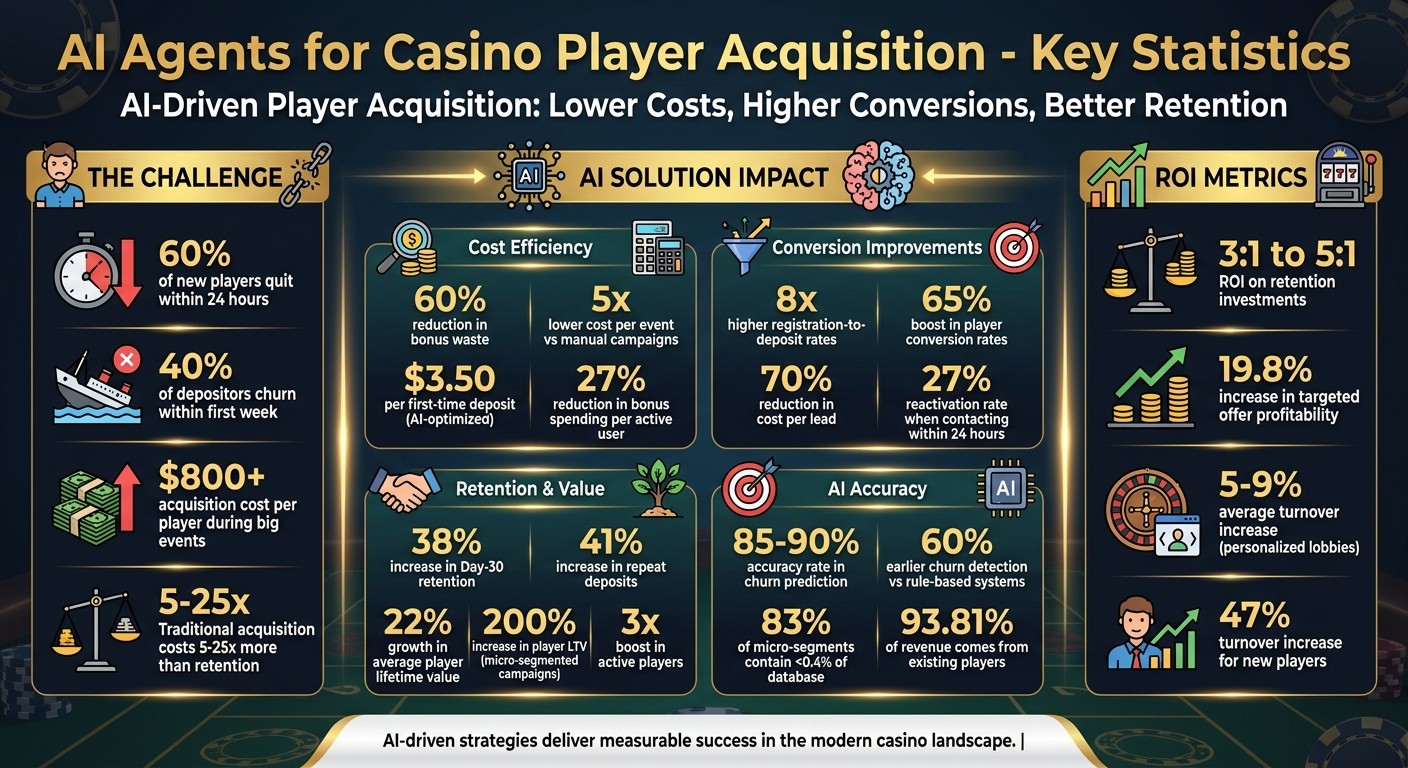
AI Impact on Casino Player Acquisition: Key Performance Metrics and Cost Savings
Key Research Findings on AI and Behavioral Data
How AI Identifies Player Patterns
AI has proven to be a game-changer in analyzing behavioral sequence data - like session frequency, bet size changes, login gaps, and game preferences - which outshines traditional demographic predictors. Gradient Boosting Machines, for instance, deliver an impressive 85–90% accuracy rate, with top-performing models achieving a ROC AUC of 0.8598. Even more striking, these models can predict player churn up to 60% earlier than rule-based systems.
In July 2025, Fast Track introduced an AI Player Churn Prediction Model that uses a seven-model stack, continuously training on live operator data. This system flags at-risk players as early as their first day of inactivity. On a similar note, Betvora, a mid-tier operator, adopted an AI-powered decision engine built on Kafka's real-time event streaming. By analyzing gameplay and deposit trends, Betvora achieved a 38% boost in Day-30 retention, a 22% increase in average player lifetime value, and a 27% reduction in bonus spending.
These tools not only enhance the precision of predictive analytics but also refine strategies for acquiring and retaining players.
Predictive Analytics for Player Acquisition
AI models can now predict a player's lifetime value within 24–72 hours of sign-up by examining factors such as session length, device type, and early market behavior. This is crucial, given that 40% of depositors churn within their first week.
A 2025 study published in Quantitative Marketing and Economics revealed that understanding player behavior around three key reference points - outcomes relative to zero, prior trip outcomes, and expected losses - can increase the profitability of targeted offers by 19.8%. Additionally, AI is shifting the focus from "propensity scoring" (identifying who is likely to deposit) to "uplift modeling" (pinpointing who will deposit specifically because of a bonus). This approach can slash bonus waste by 50–60%. Armed with these insights, operators can craft bonus strategies that are both more effective and cost-efficient.
AI Methods for Targeting Casino Players
Real-Time Player Segmentation
Gone are the days when casinos relied on outdated CRM systems to lump players into broad categories based on yesterday's data. Today, AI-driven systems analyze live behavioral signals - like sudden increases in session activity, timing of deposits, or loss-recovery behaviors - and adjust player segments instantly.
This approach uses real-time data such as session frequency, changes in bet sizes, game-switching patterns, and login habits to create precise player profiles. Compared to relying on basic demographics or simple transaction histories, this method delivers much sharper insights. For instance, machine learning models like Random Forest Classifiers have achieved 85–89% accuracy in categorizing players into the correct behavioral segments.
One standout method is RFM(D) micro-segmentation, which builds on the traditional Recency, Frequency, and Monetary framework by adding "Duration." This allows AI to group players into highly specific micro-segments, such as "Weekend Warriors" or "First-Deposit Hesitators." Advanced systems can create up to ten micro-segments, with 83% of these segments containing fewer than 0.4% of the total player database - a level of granularity only achievable through automation.
An example of this in action is FDJ United, one of Europe's leading gaming operators. They used AI-driven segmentation to slash their campaign preparation time from six weeks to just 24 hours by automating list-building and tailoring content with Telegram outreach tools. Similarly, operators like YesPlay have seen significant boosts in player engagement by adopting these techniques.
This high-precision segmentation lays the groundwork for delivering personalized offers that resonate with each player.
Personalized Promotions and Incentives
Once players are segmented, AI helps determine the best incentive for each individual. Multi-armed bandit algorithms analyze a player’s history in real time to decide whether a free bet, deposit match, or another type of reward is most likely to succeed.
The transition from propensity scoring to uplift modeling has been a game-changer. While propensity models predict who is likely to deposit, they often waste resources on loyal players who would deposit anyway. Uplift modeling, on the other hand, identifies "persuadables" - players who are likely to deposit only because of the specific bonus offered. This approach has been shown to reduce wasted bonus budgets by 50–60%.
Red Apple Technologies implemented an AI-powered decisioning engine for Betvora, a mid-tier gaming operator, using Kafka real-time event streaming. By analyzing gameplay and session data, the system triggered "Next-Best-Offer" incentives, showcasing how behavioral data can directly improve retention and optimize incentive delivery.
"We finally stopped waking up to bonus abuse spikes and last-minute retention panic. The system now handles segmentation and offer timing automatically, allowing my team to focus on strategy instead of manual campaign firefighting." - Betvora Representative
AI also drives dynamic "liquid" lobbies, which adapt game displays based on a player’s preferences for volatility and past play history. This feature enhances engagement without relying on monetary bonuses, increasing turnover by 5–9% on average and up to 47% for new players. Personalized game recommendations further amplify this effect, with players being 3x more likely to place a bet when presented with tailored suggestions instead of generic content.
Retention: The Silent Killer - Why Casinos Fail to Keep Players Engaged
Performance Metrics and Results
The advanced targeting methods discussed earlier highlight just how impactful AI can be in improving both conversion rates and cost efficiency.
Conversion Rate Increases
AI-driven optimization is a game-changer for converting registrations into first-time deposits. In March 2026, Mateo Brizi, CTO of Traffic Nomads, shared insights on the use of FTD Magnet AI in iGaming campaigns. His analysis showed that AI-powered strategies delivered conversion rates up to 8x higher than manual campaigns, accounting for 66% of high-value funnel progression from registration to deposit.
"In iGaming traffic buying, the difference between a good campaign and a profitable campaign often appears after the registration stage. That is exactly where optimization needs to happen." – Mateo Brizi, CTO, Traffic Nomads
There are other success stories as well. Carousel Casino Games in Belgium implemented Zeta's AI-based audience segmentation and scoring models, which led to a 65% boost in player conversion rates and a 70% reduction in cost per lead. Meanwhile, Betvora utilized an AI-powered personalization engine developed by Red Apple Technologies to drive expansion in the UK and MENA regions. Their results? A 41% increase in repeat deposits, 22% growth in average player lifetime value (LTV), and a 38% jump in D30 retention.
Favbet also achieved impressive outcomes by leveraging Optimove's micro-segmented AI CRM. By delivering hyper-personalized messages to niche player segments (representing less than 0.4% of their database), they saw a 200% increase in player LTV.
These improvements in conversion rates are matched by equally impressive cost reductions.
Lower Cost Per Lead
AI's ability to allocate budgets toward high-intent users has led to significant drops in acquisition costs. According to the Traffic Nomads study, campaigns powered by AI achieved a 5x reduction in cost per event compared to manual campaigns.
"The cost per event (registration or FTD) was up to 5x lower compared with manual campaigns." – Mateo Brizi, CTO, Traffic Nomads
Betvora’s AI adoption further reduced bonus spending per active user by 27%. Moreover, operators using AI for churn intervention have reported an ROI ranging from 3:1 to 5:1 on retention investments. Retention efforts, in fact, cost 5–7 times less than acquiring new players.
These metrics underline AI's ability to transform campaign performance, delivering better results while keeping costs under control.
How iGaming Operators Can Use AI Agents
Operators in the iGaming industry are now leveraging AI agents to automate and refine the process of player acquisition. While research highlights the potential of AI, the real challenge lies in applying these tools effectively. Enter automated AI agents - designed to handle tasks like lead identification and conversion with minimal manual intervention.
Automated Outreach with Enreach AI Agents
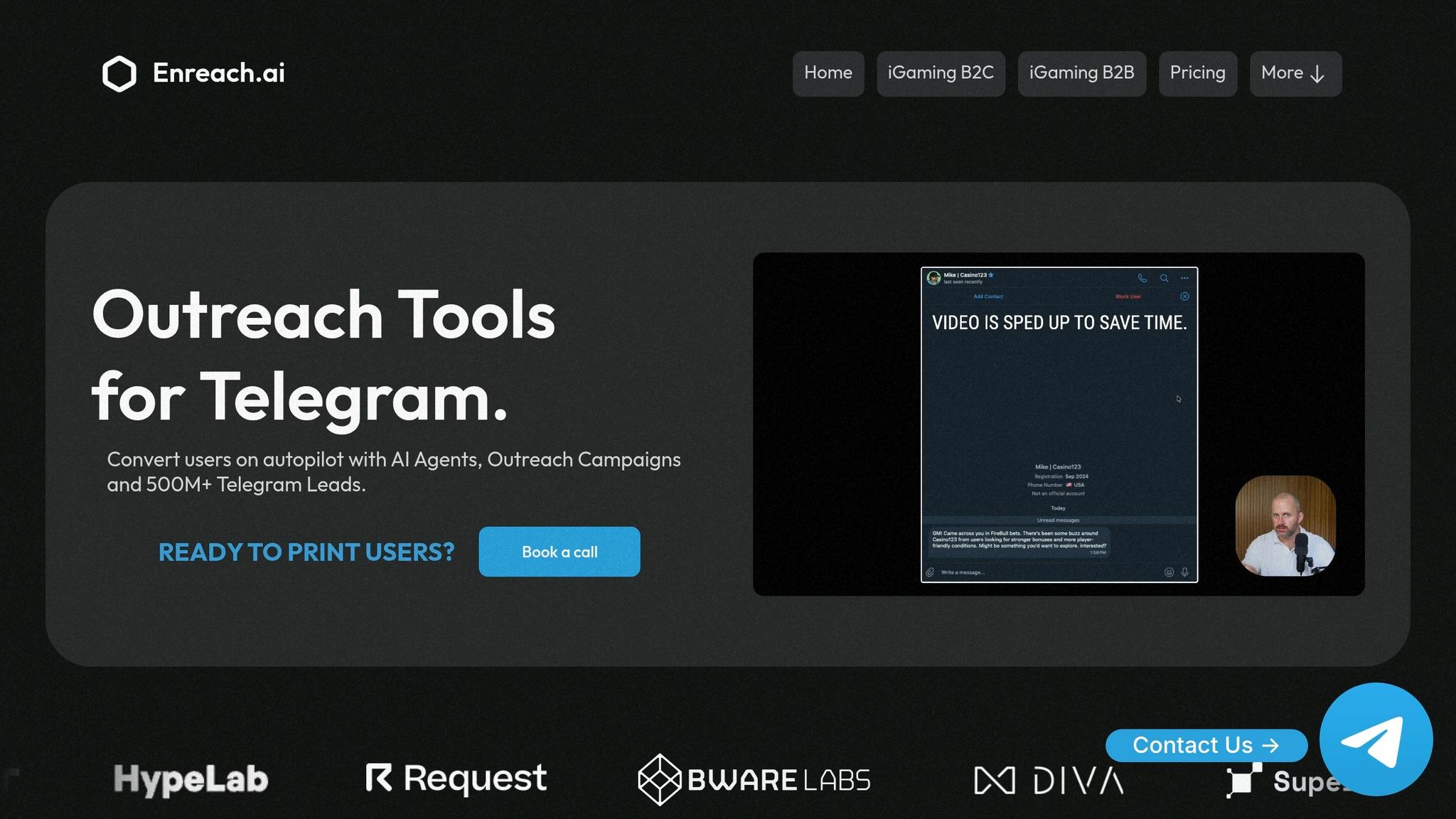
In January 2026, Walter Footman and the Enreach team introduced a Telegram-based AI agent aimed at replacing traditional iGaming marketing teams. This agent was programmed to identify and engage users from competing communities by analyzing their bios and usernames. During a test involving 25 million messages, the tool achieved an impressive 50% open rate and a 5% automated growth rate for its users.
"Now it's 5% growth and 50% open rates automatically. It's iGaming marketing that finally works." – Walter Footman, Enreach
The Enreach platform integrates AI agents with Telegram's outreach capabilities, enabling iGaming teams to attract new sign-ups and first-time deposits. It automates follow-ups - managing 4–5 interactions per lead - and simulates natural human behavior, such as staggered response times, to avoid platform bans. Supporting this technology is a team of sales, data, and outbound specialists who oversee campaigns on behalf of clients.
Increasing First-Time Deposits
AI agents simplify the journey from registration to deposit by offering round-the-clock support for common player inquiries, minimizing obstacles for new users. These tools can automate up to 85% of routine customer support tickets and handle 65% of player questions, cutting response times down to just 2 seconds.
A major advantage is their ability to provide tailored incentives based on player behavior. For instance, AI-driven systems can analyze initial interaction patterns, such as game preferences or session durations, to deliver personalized bonus offers. By identifying behavioral markers like betting habits or favored game types, operators can adjust the player experience in real time, leading to a 20% improvement in targeted marketing efficiency.
These capabilities naturally extend to advanced lead identification, particularly on platforms like Telegram.
Finding Leads on Telegram
AI-powered tools excel at identifying high-value leads by extracting data from Telegram groups associated with competing iGaming brands. These tools evaluate user bios, usernames, and activity levels to determine lead quality. Research has shown that participation in gambling-related online communities is a strong indicator of high-intensity gambling, making these groups prime hunting grounds for potential leads.
However, automation must be executed carefully. The system not only identifies leads but also handles real-time conversion, ensuring a seamless process from start to finish.
Conclusion
AI agents are reshaping how casinos approach player acquisition and retention. By using real-time, behavior-driven outreach, these tools can reduce deployment times from weeks to just hours and cut bonus waste by as much as 60%. With a staggering 93.81% of operator revenue coming from existing players rather than new ones, the real power of AI lies in its ability to convert leads within the critical first 24 hours.
Consider this: acquiring a new player can cost anywhere from 5 to 25 times more than retaining one, with acquisition costs often exceeding $800 during major events. AI-driven platforms focus on identifying "persuadable" players - those who will only deposit when given targeted incentives - helping operators avoid unnecessary spending. This approach not only increases player lifetime value but also improves retention by Day 30.
For iGaming teams ready to adopt these strategies, Enreach provides a straightforward solution. With competitive rates averaging $3.50 per first-time deposit, Enreach combines AI agents with Telegram-based outreach to automate the entire process - from identifying leads to engaging and converting them. By harnessing behavioral data, Enreach simplifies and accelerates player acquisition and retention efforts.
FAQs
What data do AI agents need to predict churn and early LTV?
AI agents use behavioral data to anticipate churn and estimate early lifetime value (LTV). This data includes patterns of user activity, engagement signals, and past interactions. By examining these factors, AI can spot trends and deliver precise predictions about how users are likely to behave.
How do uplift models reduce bonus waste versus propensity scoring?
Uplift models help operators save on bonus costs by identifying players who are at risk of leaving within a set timeframe. By focusing retention efforts on these specific players, operators can recover between 20–35% of players before they churn, reducing unnecessary spending on bonuses.
How can Enreach use Telegram outreach without getting accounts banned?
Enreach reduces the chances of Telegram account bans through automated campaigns that align with the platform’s rules. Their AI agents, trained on a vast dataset of over 30 million conversations, enable precise and respectful outreach. By filtering contacts based on factors like interest, location, language, and activity, they help ensure that engagement remains targeted and appropriate. This approach promotes effective communication while minimizing the risk of account-related problems.
Related Blog Posts
Here’s the big takeaway: Casinos are using AI to predict player behavior, personalize offers, and reduce costs. With acquisition costs exceeding $800 per player during big events, AI helps operators focus on retaining players and boosting their lifetime value.
Key Insights:
Player Drop-Off: Up to 60% of new players quit within 24 hours. AI identifies potential churn early and intervenes within hours.
Retention Impact: Contacting players within 24 hours of churn signs leads to a 27% reactivation rate.
Cost Efficiency: AI-driven targeting slashes bonus waste by up to 60% and reduces acquisition costs by 5x.
Data-Driven Success: Operators like YesPlay and Betvora reported a 3x boost in active players and a 38% increase in Day-30 retention using AI tools.
How It Works:
Real-Time Behavior Tracking: AI monitors login patterns, bet sizes, and game preferences.
Micro-Segmentation: Players are grouped into specific categories for tailored offers.
Personalized Promotions: AI decides the best incentive for each player, increasing conversions and reducing waste.
Results:
Higher Conversions: AI campaigns achieve up to 8x higher registration-to-deposit rates.
Lower Costs: Acquisition costs drop significantly, with some operators reporting $3.50 per first-time deposit.
AI tools are reshaping casino marketing by focusing on behavior-driven insights, faster campaign execution, and smarter spending. This approach ensures casinos maximize player engagement while keeping costs under control.
AI Impact on Casino Player Acquisition: Key Performance Metrics and Cost Savings
Key Research Findings on AI and Behavioral Data
How AI Identifies Player Patterns
AI has proven to be a game-changer in analyzing behavioral sequence data - like session frequency, bet size changes, login gaps, and game preferences - which outshines traditional demographic predictors. Gradient Boosting Machines, for instance, deliver an impressive 85–90% accuracy rate, with top-performing models achieving a ROC AUC of 0.8598. Even more striking, these models can predict player churn up to 60% earlier than rule-based systems.
In July 2025, Fast Track introduced an AI Player Churn Prediction Model that uses a seven-model stack, continuously training on live operator data. This system flags at-risk players as early as their first day of inactivity. On a similar note, Betvora, a mid-tier operator, adopted an AI-powered decision engine built on Kafka's real-time event streaming. By analyzing gameplay and deposit trends, Betvora achieved a 38% boost in Day-30 retention, a 22% increase in average player lifetime value, and a 27% reduction in bonus spending.
These tools not only enhance the precision of predictive analytics but also refine strategies for acquiring and retaining players.
Predictive Analytics for Player Acquisition
AI models can now predict a player's lifetime value within 24–72 hours of sign-up by examining factors such as session length, device type, and early market behavior. This is crucial, given that 40% of depositors churn within their first week.
A 2025 study published in Quantitative Marketing and Economics revealed that understanding player behavior around three key reference points - outcomes relative to zero, prior trip outcomes, and expected losses - can increase the profitability of targeted offers by 19.8%. Additionally, AI is shifting the focus from "propensity scoring" (identifying who is likely to deposit) to "uplift modeling" (pinpointing who will deposit specifically because of a bonus). This approach can slash bonus waste by 50–60%. Armed with these insights, operators can craft bonus strategies that are both more effective and cost-efficient.
AI Methods for Targeting Casino Players
Real-Time Player Segmentation
Gone are the days when casinos relied on outdated CRM systems to lump players into broad categories based on yesterday's data. Today, AI-driven systems analyze live behavioral signals - like sudden increases in session activity, timing of deposits, or loss-recovery behaviors - and adjust player segments instantly.
This approach uses real-time data such as session frequency, changes in bet sizes, game-switching patterns, and login habits to create precise player profiles. Compared to relying on basic demographics or simple transaction histories, this method delivers much sharper insights. For instance, machine learning models like Random Forest Classifiers have achieved 85–89% accuracy in categorizing players into the correct behavioral segments.
One standout method is RFM(D) micro-segmentation, which builds on the traditional Recency, Frequency, and Monetary framework by adding "Duration." This allows AI to group players into highly specific micro-segments, such as "Weekend Warriors" or "First-Deposit Hesitators." Advanced systems can create up to ten micro-segments, with 83% of these segments containing fewer than 0.4% of the total player database - a level of granularity only achievable through automation.
An example of this in action is FDJ United, one of Europe's leading gaming operators. They used AI-driven segmentation to slash their campaign preparation time from six weeks to just 24 hours by automating list-building and tailoring content with Telegram outreach tools. Similarly, operators like YesPlay have seen significant boosts in player engagement by adopting these techniques.
This high-precision segmentation lays the groundwork for delivering personalized offers that resonate with each player.
Personalized Promotions and Incentives
Once players are segmented, AI helps determine the best incentive for each individual. Multi-armed bandit algorithms analyze a player’s history in real time to decide whether a free bet, deposit match, or another type of reward is most likely to succeed.
The transition from propensity scoring to uplift modeling has been a game-changer. While propensity models predict who is likely to deposit, they often waste resources on loyal players who would deposit anyway. Uplift modeling, on the other hand, identifies "persuadables" - players who are likely to deposit only because of the specific bonus offered. This approach has been shown to reduce wasted bonus budgets by 50–60%.
Red Apple Technologies implemented an AI-powered decisioning engine for Betvora, a mid-tier gaming operator, using Kafka real-time event streaming. By analyzing gameplay and session data, the system triggered "Next-Best-Offer" incentives, showcasing how behavioral data can directly improve retention and optimize incentive delivery.
"We finally stopped waking up to bonus abuse spikes and last-minute retention panic. The system now handles segmentation and offer timing automatically, allowing my team to focus on strategy instead of manual campaign firefighting." - Betvora Representative
AI also drives dynamic "liquid" lobbies, which adapt game displays based on a player’s preferences for volatility and past play history. This feature enhances engagement without relying on monetary bonuses, increasing turnover by 5–9% on average and up to 47% for new players. Personalized game recommendations further amplify this effect, with players being 3x more likely to place a bet when presented with tailored suggestions instead of generic content.
Retention: The Silent Killer - Why Casinos Fail to Keep Players Engaged
Performance Metrics and Results
The advanced targeting methods discussed earlier highlight just how impactful AI can be in improving both conversion rates and cost efficiency.
Conversion Rate Increases
AI-driven optimization is a game-changer for converting registrations into first-time deposits. In March 2026, Mateo Brizi, CTO of Traffic Nomads, shared insights on the use of FTD Magnet AI in iGaming campaigns. His analysis showed that AI-powered strategies delivered conversion rates up to 8x higher than manual campaigns, accounting for 66% of high-value funnel progression from registration to deposit.
"In iGaming traffic buying, the difference between a good campaign and a profitable campaign often appears after the registration stage. That is exactly where optimization needs to happen." – Mateo Brizi, CTO, Traffic Nomads
There are other success stories as well. Carousel Casino Games in Belgium implemented Zeta's AI-based audience segmentation and scoring models, which led to a 65% boost in player conversion rates and a 70% reduction in cost per lead. Meanwhile, Betvora utilized an AI-powered personalization engine developed by Red Apple Technologies to drive expansion in the UK and MENA regions. Their results? A 41% increase in repeat deposits, 22% growth in average player lifetime value (LTV), and a 38% jump in D30 retention.
Favbet also achieved impressive outcomes by leveraging Optimove's micro-segmented AI CRM. By delivering hyper-personalized messages to niche player segments (representing less than 0.4% of their database), they saw a 200% increase in player LTV.
These improvements in conversion rates are matched by equally impressive cost reductions.
Lower Cost Per Lead
AI's ability to allocate budgets toward high-intent users has led to significant drops in acquisition costs. According to the Traffic Nomads study, campaigns powered by AI achieved a 5x reduction in cost per event compared to manual campaigns.
"The cost per event (registration or FTD) was up to 5x lower compared with manual campaigns." – Mateo Brizi, CTO, Traffic Nomads
Betvora’s AI adoption further reduced bonus spending per active user by 27%. Moreover, operators using AI for churn intervention have reported an ROI ranging from 3:1 to 5:1 on retention investments. Retention efforts, in fact, cost 5–7 times less than acquiring new players.
These metrics underline AI's ability to transform campaign performance, delivering better results while keeping costs under control.
How iGaming Operators Can Use AI Agents
Operators in the iGaming industry are now leveraging AI agents to automate and refine the process of player acquisition. While research highlights the potential of AI, the real challenge lies in applying these tools effectively. Enter automated AI agents - designed to handle tasks like lead identification and conversion with minimal manual intervention.
Automated Outreach with Enreach AI Agents
In January 2026, Walter Footman and the Enreach team introduced a Telegram-based AI agent aimed at replacing traditional iGaming marketing teams. This agent was programmed to identify and engage users from competing communities by analyzing their bios and usernames. During a test involving 25 million messages, the tool achieved an impressive 50% open rate and a 5% automated growth rate for its users.
"Now it's 5% growth and 50% open rates automatically. It's iGaming marketing that finally works." – Walter Footman, Enreach
The Enreach platform integrates AI agents with Telegram's outreach capabilities, enabling iGaming teams to attract new sign-ups and first-time deposits. It automates follow-ups - managing 4–5 interactions per lead - and simulates natural human behavior, such as staggered response times, to avoid platform bans. Supporting this technology is a team of sales, data, and outbound specialists who oversee campaigns on behalf of clients.
Increasing First-Time Deposits
AI agents simplify the journey from registration to deposit by offering round-the-clock support for common player inquiries, minimizing obstacles for new users. These tools can automate up to 85% of routine customer support tickets and handle 65% of player questions, cutting response times down to just 2 seconds.
A major advantage is their ability to provide tailored incentives based on player behavior. For instance, AI-driven systems can analyze initial interaction patterns, such as game preferences or session durations, to deliver personalized bonus offers. By identifying behavioral markers like betting habits or favored game types, operators can adjust the player experience in real time, leading to a 20% improvement in targeted marketing efficiency.
These capabilities naturally extend to advanced lead identification, particularly on platforms like Telegram.
Finding Leads on Telegram
AI-powered tools excel at identifying high-value leads by extracting data from Telegram groups associated with competing iGaming brands. These tools evaluate user bios, usernames, and activity levels to determine lead quality. Research has shown that participation in gambling-related online communities is a strong indicator of high-intensity gambling, making these groups prime hunting grounds for potential leads.
However, automation must be executed carefully. The system not only identifies leads but also handles real-time conversion, ensuring a seamless process from start to finish.
Conclusion
AI agents are reshaping how casinos approach player acquisition and retention. By using real-time, behavior-driven outreach, these tools can reduce deployment times from weeks to just hours and cut bonus waste by as much as 60%. With a staggering 93.81% of operator revenue coming from existing players rather than new ones, the real power of AI lies in its ability to convert leads within the critical first 24 hours.
Consider this: acquiring a new player can cost anywhere from 5 to 25 times more than retaining one, with acquisition costs often exceeding $800 during major events. AI-driven platforms focus on identifying "persuadable" players - those who will only deposit when given targeted incentives - helping operators avoid unnecessary spending. This approach not only increases player lifetime value but also improves retention by Day 30.
For iGaming teams ready to adopt these strategies, Enreach provides a straightforward solution. With competitive rates averaging $3.50 per first-time deposit, Enreach combines AI agents with Telegram-based outreach to automate the entire process - from identifying leads to engaging and converting them. By harnessing behavioral data, Enreach simplifies and accelerates player acquisition and retention efforts.
FAQs
What data do AI agents need to predict churn and early LTV?
AI agents use behavioral data to anticipate churn and estimate early lifetime value (LTV). This data includes patterns of user activity, engagement signals, and past interactions. By examining these factors, AI can spot trends and deliver precise predictions about how users are likely to behave.
How do uplift models reduce bonus waste versus propensity scoring?
Uplift models help operators save on bonus costs by identifying players who are at risk of leaving within a set timeframe. By focusing retention efforts on these specific players, operators can recover between 20–35% of players before they churn, reducing unnecessary spending on bonuses.
How can Enreach use Telegram outreach without getting accounts banned?
Enreach reduces the chances of Telegram account bans through automated campaigns that align with the platform’s rules. Their AI agents, trained on a vast dataset of over 30 million conversations, enable precise and respectful outreach. By filtering contacts based on factors like interest, location, language, and activity, they help ensure that engagement remains targeted and appropriate. This approach promotes effective communication while minimizing the risk of account-related problems.
Related Blog Posts

Optimize Your Sales with Enreach.
Optimize Your Sales with Enreach.
Get access to a 500M person Leads Database, Automated Outreach and AI Sales Agents.
Get access to a 500M person Leads Database, Automated Outreach and AI Sales Agents.
More Info