AI Sales Agents and Predictive Analytics for iGaming
AI Sales Agents and Predictive Analytics for iGaming
Sales Technology
Mar 17, 2026
Mar 17, 2026
AI sales agents and predictive analytics transform iGaming outreach—boosting conversions, cutting acquisition costs, and automating personalized engagement.
AI sales agents and predictive analytics transform iGaming outreach—boosting conversions, cutting acquisition costs, and automating personalized engagement.

AI tools are transforming the iGaming industry by improving player engagement and boosting conversions. Here's how:
AI Sales Agents: Handle lead qualification, personalized outreach, and 24/7 engagement across platforms like Telegram. They analyze user behavior to prioritize high-value leads and automate repetitive tasks, saving time and reducing costs.
Predictive Analytics: Use machine learning to forecast player behavior, identify at-risk users, and optimize outreach timing. With up to 95% accuracy, predictive models help operators focus on high-conversion opportunities and allocate resources effectively.
Together, these tools deliver measurable results:
Conversion rates increase by 79%.
Customer acquisition costs drop by 40%.
Pipeline velocity improves by 40%.
For example, Lucky Bet achieved a $3.50 cost per First Time Deposit in 2025 using these technologies. By combining predictive insights with AI-powered engagement, iGaming operators can scale campaigns, reduce churn, and improve ROI.
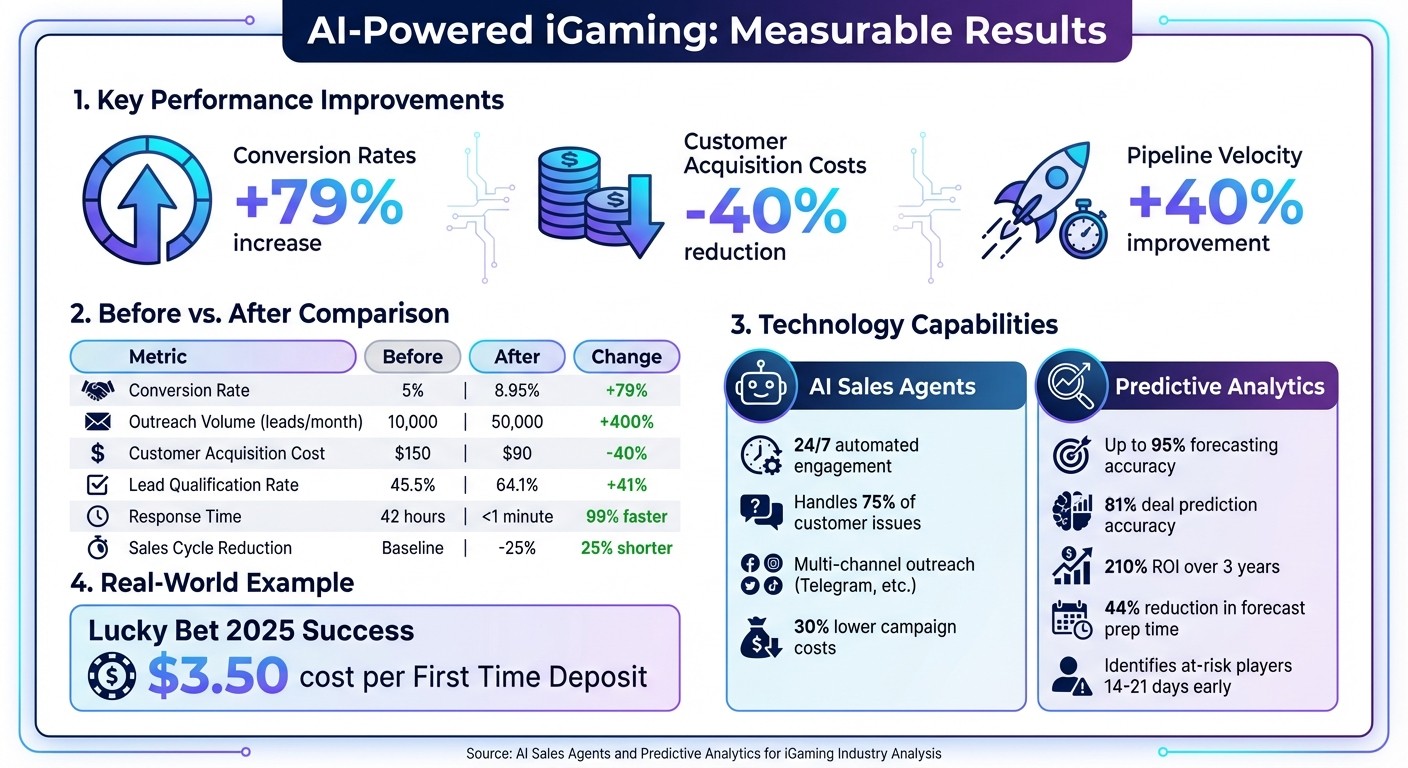
AI Sales Agents and Predictive Analytics Performance Metrics for iGaming
1. AI Sales Agents
Automation Capabilities
AI Sales Agents take on repetitive tasks like lead qualification, initial engagement, data collection, and follow-ups, freeing sales teams to channel their energy into high-value opportunities. These agents track engagement patterns in real time, analyzing how users interact with betting platforms or casino sites. By examining behavioral data - such as game preferences and betting history - they can score leads to identify who’s ready to convert and who might need more nurturing.
These agents also operate across multiple channels effortlessly. For instance, AI can sort through data and invite the top 1,000 players to VIP events in seconds, automating a process that could otherwise take days. This efficiency allows sales teams to focus on closing deals while AI handles a high volume of interactions with ease.
Data Insights and Targeting
AI Sales Agents excel at precise targeting by analyzing CRM data, behavioral trends, and player profiles. They predict purchase intent and refine recommendations far beyond basic demographics. For iGaming operators, this means pairing user profiles with look-alike preferences to deliver personalized game or betting suggestions that resonate on an individual level.
These agents also identify high-value players by examining behavior like deposit frequency and betting patterns. Outreach messages are then tailored to align with these habits. Platforms like Enreach integrate this capability with tools like Telegram, combining automated outreach with expertise from sales and data specialists to fine-tune targeting strategies.
Scalability for Outreach Campaigns
Manually scaling outreach campaigns can quickly become overwhelming, but AI Sales Agents handle thousands of conversations simultaneously. They send real-time game recommendations, manage campaigns for entire player segments, and do so without delays. This scalability is crucial for iGaming operators expanding into new titles or regions.
The benefits are striking. While manual outreach averages a 42-hour response time, AI-driven systems respond in under a minute. Lead qualification rates jump from 45.5% to 64.1%, and sales cycles shrink by about 25% [doc]. Plus, AI agents work around the clock, ensuring no lead is missed due to time zones or after-hours inquiries.
Cost-Effectiveness
AI Sales Agents lower operational costs by automating live operations, reducing fraud, and deflecting support tasks. Chatbots now handle up to 75% of customer issues, cutting support costs and allowing human agents to focus on complex cases. In the iGaming world, these agents improve ROI by deflecting Tier 1 support tickets, speeding up quality assurance, and minimizing chargebacks through better fraud detection. On average, AI-driven campaigns cost about 30% less than manual ones [doc].
Additionally, with forecasting accuracy reaching up to 95%, operators can allocate budgets more effectively, focusing on leads most likely to convert. Combining reduced costs with improved conversion rates makes AI Sales Agents a smart choice for scaling outreach without adding headcount. These advancements also create a strong foundation for integrating Predictive Analytics to further refine outreach efforts.
2. Predictive Analytics
Data Insights and Targeting
Predictive analytics dives deep into player data to uncover patterns that enhance targeting strategies. Using machine learning, players can be segmented by factors like value, intent, and behavior - even before placing their first bet. For instance, these models can classify users as either "sports-leaning" or "casino-first", tailoring offers based on recent activity or trending games.
Game recommendation systems build on this by suggesting options aligned with a player’s history. A bet builder might combine predictions, like a goalscorer and match outcome, for Champions League wagers. Similarly, wagering contribution models encourage players to explore high-margin games that meet bonus RTP requirements. Sentiment analysis adds another layer, collecting feedback across languages to help operators refine campaigns in real time. These insights allow operators to predict and meet player needs while automating actions that simplify workflows.
Automation Capabilities
Predictive analytics doesn’t just stop at insights - it powers automation for critical tasks. By monitoring live behavior, betting trends, and engagement cues, these systems can trigger retention actions such as bonus drops or quest updates without the need for manual intervention. For example, AI models can predict lifetime value (LTV) and VIP potential, helping operators allocate bonus budgets automatically. This reduces the burden of manual CRM tasks, letting teams focus on broader strategies.
Churn prediction tools can flag at-risk players up to three weeks in advance, giving operators time to deploy retention campaigns. Similarly, LTV forecasts generated within 48 hours enable quick decisions on acquisition budgets. Automated support also plays a role, speeding up response times while lowering costs. These systems scale effortlessly, managing thousands of players with the precision of personalized, one-on-one interactions.
Scalability for Outreach Campaigns
With predictive analytics, operators can extend personalization to massive player bases. Real-time insights and automation allow for customized game lobbies, bonuses, and messages to reach thousands of players simultaneously. By analyzing high-frequency data, trends can be identified early, boosting the visibility of potential "future hits" and accelerating their success. This enables operators to manage intricate, multi-segment campaigns with fewer resources.
Looking ahead, by 2026, predictive systems are expected to handle most CRM actions automatically, leaving only the most complex cases for human teams. Streaming analytics will deliver immediate retention triggers, while hyper-personalized campaigns powered by AI could boost player lifetime value by as much as 40–60% compared to generic approaches. This scalability not only broadens campaign reach but also optimizes costs.
Cost-Effectiveness
Predictive analytics also helps operators cut costs through real-time, proactive insights. Machine learning models can detect anomalies instantly, reducing chargebacks and false positives without requiring manual oversight. This allows operators to allocate budgets more effectively, focusing on high-conversion leads without increasing team size.
With forecasting accuracy reaching up to 95%, operators can prioritize resources on leads most likely to convert. By gradually reducing bonus reliance through predictive insights, operators can achieve higher lifetime value (LTV) and gross gaming revenue (GGR) without driving up acquisition costs. When paired with automated support systems, predictive analytics creates a leaner, more profitable operation that scales seamlessly without proportional increases in expenses.
AI Is Rewriting the Rules of iGaming? What AI Means for the Future of iGaming? | TECH TALKS
Strengths and Weaknesses
AI sales agents and predictive analytics both bring valuable tools to the table for scaling iGaming outreach, but they also have their own challenges that operators need to navigate. AI sales agents shine when it comes to execution. They can handle thousands of conversations simultaneously, automate follow-ups, and maintain 24/7 engagement with users. However, their success hinges on strict oversight. Gartner estimates that by the end of 2027, over 40% of AI-driven outreach projects will be scrapped due to poor goal-setting and governance. Without strong human oversight, these agents risk harming customer relationships through inappropriate messaging or missteps in communication. This highlights the importance of pairing AI execution with accurate and actionable data.
On the other hand, predictive analytics offers robust forecasting and targeting capabilities. With an accuracy rate of around 81% for deal predictions and revenue forecasts, it can significantly enhance decision-making. Additionally, AI-driven automation in this area can deliver a 210% return on investment over three years, with a payback period of less than six months. Predictive analytics also helps reduce churn by spotting at-risk players early and can cut the time spent on sales forecast preparation by 44%. However, these models depend heavily on clean and integrated data. Fragmented or poorly managed data can lead to revenue losses of up to 30% annually.
These tools complement each other rather than compete. AI sales agents thrive when supported by predictive insights, while predictive analytics needs active engagement to bring its forecasts to life. To avoid potential pitfalls, consider starting with focused 30-day pilot projects - like lead qualification or churn prevention - to test and refine these solutions before scaling.
How AI Sales Agents and Predictive Analytics Work Together
When combined, AI sales agents and predictive analytics create a powerful system for iGaming outreach, far surpassing what either tool can achieve on its own. Predictive analytics examines player behavior, betting patterns, and historical CRM data to score leads and predict which prospects are most likely to convert. These scores then guide AI sales agents, enabling them to prioritize outreach and craft tailored messages.
Here’s an example: An AI agent identifies a sports bettor with a high-intent score after they engage with odds updates. The agent then sends a customized Telegram message featuring game recommendations and promotions. This precise targeting leads to 79% higher conversion rates compared to manual methods, with predictive models achieving up to 95% accuracy in forecasting outcomes.
The results are impressive. Conversion rates jump from 5% to 8.95%, representing a 79% boost, while outreach volume scales from 10,000 to 50,000 leads per month thanks to automation. On top of that, customer acquisition costs drop by about 40%, as AI agents focus on high-value prospects and avoid wasting resources on low-priority leads.
Enreach is a standout example of this integration in action. Their system combines AI-driven lead scoring with automated Telegram outreach for iGaming promotions. Predictive scores from their leads database guide AI agents, while sales and data specialists fine-tune targeting and messaging.
"Enreach makes it easy for our BD team to hit target consistently" - Lorenzo, Head of BD
This partnership doesn’t just improve conversion rates - it also accelerates the sales cycle. Predictive analytics and AI agents flag high-intent prospects in real time, allowing human sales teams to focus on closing deals. Pipeline velocity increases by 40%, as agents escalate top leads instantly. For retention campaigns, predictive models identify at-risk players 14–21 days before churn, triggering personalized offers that previously took days to deploy.
Here’s a quick look at how these tools transform performance for iGaming operators:
Metric | Before Integration | After Integration | Improvement |
|---|---|---|---|
Conversion Rate | 5% | 8.95% | +79% |
Outreach Volume (leads/month) | 10,000 | 50,000 | +400% |
Customer Acquisition Cost (USD) | $150 | $90 | -40% |
The process is straightforward: feed clean player data - like behavior, bets, and engagement history - into predictive models for lead scoring. Then, use these scores to guide AI agents in automated Telegram outreach. Track conversion rates and customer satisfaction to refine your efforts. Enreach’s method simplifies this entire system, managing data integration and campaign optimization to turn outreach into a scalable, precision-driven operation.
Conclusion
Pairing AI sales agents with predictive analytics turns iGaming outreach into a highly effective growth strategy. The numbers speak for themselves: conversion rates can increase by up to 79%, predictive models often hit about 95% accuracy, and pipeline velocity improves by approximately 40%. These tools work together to identify high-value prospects through advanced data analysis, deliver personalized engagement at scale, and free up your sales team to focus on closing top-quality deals instead of chasing low-priority leads.
For iGaming businesses looking to scale, the next steps are straightforward. Incorporate predictive analytics into your CRM and utilize AI agents for automated Telegram outreach to engage high-intent prospects. Platforms like Enreach simplify this process by combining AI-powered lead scoring with automated messaging and offering support from experienced sales and data professionals.
Keep an eye on critical metrics like conversion rates, pipeline velocity, and forecasting accuracy. Start small with focused pilot campaigns to fine-tune your strategy using real-world data. The most successful operators are those who view AI and predictive analytics as integral parts of a unified approach.
These tools do more than validate your current efforts - they pave the way for future expansion. PwC estimates that AI could add $15.7 trillion to the global economy by 2030. By adopting these technologies now, you can scale your customer acquisition, minimize churn, and improve retention strategies.
FAQs
What data do I need to start lead scoring?
Getting started with lead scoring requires gathering key data points, such as behavioral patterns, engagement history, firmographics, and details about previous interactions with prospects. By analyzing this information, predictive analytics and AI tools can help pinpoint leads with the most potential and refine your outreach strategies for better results.
How do I keep AI outreach compliant and safe?
To maintain compliance and ensure safe AI-driven outreach, it's essential to stick to platform policies and adhere to iGaming regulations. Make sure the AI tools you use are equipped with anti-spam measures, segment your audience carefully, and send targeted messages that stay within platform restrictions.
You can also use compliance tools to keep an eye on player behavior, automate key checks like verifying sources of funds and assessing affordability, and flag any suspicious activities. By blending automation with strict adherence to legal standards, you can reduce risks while simplifying compliance processes.
How fast can I see ROI from this setup?
The timeline for seeing a return on investment (ROI) can vary based on factors like the scope of implementation and specific objectives. However, many businesses start noticing measurable results within 3 to 6 months. These results often include cost savings, quicker campaign creation, and increased lead conversion rates.
For instance, some companies have reported ROI improvements of 67% and campaign setup times cut by 70%. To ensure long-term success, tracking key metrics such as revenue growth and efficiency gains is essential for maximizing returns.
Related Blog Posts
AI tools are transforming the iGaming industry by improving player engagement and boosting conversions. Here's how:
AI Sales Agents: Handle lead qualification, personalized outreach, and 24/7 engagement across platforms like Telegram. They analyze user behavior to prioritize high-value leads and automate repetitive tasks, saving time and reducing costs.
Predictive Analytics: Use machine learning to forecast player behavior, identify at-risk users, and optimize outreach timing. With up to 95% accuracy, predictive models help operators focus on high-conversion opportunities and allocate resources effectively.
Together, these tools deliver measurable results:
Conversion rates increase by 79%.
Customer acquisition costs drop by 40%.
Pipeline velocity improves by 40%.
For example, Lucky Bet achieved a $3.50 cost per First Time Deposit in 2025 using these technologies. By combining predictive insights with AI-powered engagement, iGaming operators can scale campaigns, reduce churn, and improve ROI.
AI Sales Agents and Predictive Analytics Performance Metrics for iGaming
1. AI Sales Agents
Automation Capabilities
AI Sales Agents take on repetitive tasks like lead qualification, initial engagement, data collection, and follow-ups, freeing sales teams to channel their energy into high-value opportunities. These agents track engagement patterns in real time, analyzing how users interact with betting platforms or casino sites. By examining behavioral data - such as game preferences and betting history - they can score leads to identify who’s ready to convert and who might need more nurturing.
These agents also operate across multiple channels effortlessly. For instance, AI can sort through data and invite the top 1,000 players to VIP events in seconds, automating a process that could otherwise take days. This efficiency allows sales teams to focus on closing deals while AI handles a high volume of interactions with ease.
Data Insights and Targeting
AI Sales Agents excel at precise targeting by analyzing CRM data, behavioral trends, and player profiles. They predict purchase intent and refine recommendations far beyond basic demographics. For iGaming operators, this means pairing user profiles with look-alike preferences to deliver personalized game or betting suggestions that resonate on an individual level.
These agents also identify high-value players by examining behavior like deposit frequency and betting patterns. Outreach messages are then tailored to align with these habits. Platforms like Enreach integrate this capability with tools like Telegram, combining automated outreach with expertise from sales and data specialists to fine-tune targeting strategies.
Scalability for Outreach Campaigns
Manually scaling outreach campaigns can quickly become overwhelming, but AI Sales Agents handle thousands of conversations simultaneously. They send real-time game recommendations, manage campaigns for entire player segments, and do so without delays. This scalability is crucial for iGaming operators expanding into new titles or regions.
The benefits are striking. While manual outreach averages a 42-hour response time, AI-driven systems respond in under a minute. Lead qualification rates jump from 45.5% to 64.1%, and sales cycles shrink by about 25% [doc]. Plus, AI agents work around the clock, ensuring no lead is missed due to time zones or after-hours inquiries.
Cost-Effectiveness
AI Sales Agents lower operational costs by automating live operations, reducing fraud, and deflecting support tasks. Chatbots now handle up to 75% of customer issues, cutting support costs and allowing human agents to focus on complex cases. In the iGaming world, these agents improve ROI by deflecting Tier 1 support tickets, speeding up quality assurance, and minimizing chargebacks through better fraud detection. On average, AI-driven campaigns cost about 30% less than manual ones [doc].
Additionally, with forecasting accuracy reaching up to 95%, operators can allocate budgets more effectively, focusing on leads most likely to convert. Combining reduced costs with improved conversion rates makes AI Sales Agents a smart choice for scaling outreach without adding headcount. These advancements also create a strong foundation for integrating Predictive Analytics to further refine outreach efforts.
2. Predictive Analytics
Data Insights and Targeting
Predictive analytics dives deep into player data to uncover patterns that enhance targeting strategies. Using machine learning, players can be segmented by factors like value, intent, and behavior - even before placing their first bet. For instance, these models can classify users as either "sports-leaning" or "casino-first", tailoring offers based on recent activity or trending games.
Game recommendation systems build on this by suggesting options aligned with a player’s history. A bet builder might combine predictions, like a goalscorer and match outcome, for Champions League wagers. Similarly, wagering contribution models encourage players to explore high-margin games that meet bonus RTP requirements. Sentiment analysis adds another layer, collecting feedback across languages to help operators refine campaigns in real time. These insights allow operators to predict and meet player needs while automating actions that simplify workflows.
Automation Capabilities
Predictive analytics doesn’t just stop at insights - it powers automation for critical tasks. By monitoring live behavior, betting trends, and engagement cues, these systems can trigger retention actions such as bonus drops or quest updates without the need for manual intervention. For example, AI models can predict lifetime value (LTV) and VIP potential, helping operators allocate bonus budgets automatically. This reduces the burden of manual CRM tasks, letting teams focus on broader strategies.
Churn prediction tools can flag at-risk players up to three weeks in advance, giving operators time to deploy retention campaigns. Similarly, LTV forecasts generated within 48 hours enable quick decisions on acquisition budgets. Automated support also plays a role, speeding up response times while lowering costs. These systems scale effortlessly, managing thousands of players with the precision of personalized, one-on-one interactions.
Scalability for Outreach Campaigns
With predictive analytics, operators can extend personalization to massive player bases. Real-time insights and automation allow for customized game lobbies, bonuses, and messages to reach thousands of players simultaneously. By analyzing high-frequency data, trends can be identified early, boosting the visibility of potential "future hits" and accelerating their success. This enables operators to manage intricate, multi-segment campaigns with fewer resources.
Looking ahead, by 2026, predictive systems are expected to handle most CRM actions automatically, leaving only the most complex cases for human teams. Streaming analytics will deliver immediate retention triggers, while hyper-personalized campaigns powered by AI could boost player lifetime value by as much as 40–60% compared to generic approaches. This scalability not only broadens campaign reach but also optimizes costs.
Cost-Effectiveness
Predictive analytics also helps operators cut costs through real-time, proactive insights. Machine learning models can detect anomalies instantly, reducing chargebacks and false positives without requiring manual oversight. This allows operators to allocate budgets more effectively, focusing on high-conversion leads without increasing team size.
With forecasting accuracy reaching up to 95%, operators can prioritize resources on leads most likely to convert. By gradually reducing bonus reliance through predictive insights, operators can achieve higher lifetime value (LTV) and gross gaming revenue (GGR) without driving up acquisition costs. When paired with automated support systems, predictive analytics creates a leaner, more profitable operation that scales seamlessly without proportional increases in expenses.
AI Is Rewriting the Rules of iGaming? What AI Means for the Future of iGaming? | TECH TALKS
Strengths and Weaknesses
AI sales agents and predictive analytics both bring valuable tools to the table for scaling iGaming outreach, but they also have their own challenges that operators need to navigate. AI sales agents shine when it comes to execution. They can handle thousands of conversations simultaneously, automate follow-ups, and maintain 24/7 engagement with users. However, their success hinges on strict oversight. Gartner estimates that by the end of 2027, over 40% of AI-driven outreach projects will be scrapped due to poor goal-setting and governance. Without strong human oversight, these agents risk harming customer relationships through inappropriate messaging or missteps in communication. This highlights the importance of pairing AI execution with accurate and actionable data.
On the other hand, predictive analytics offers robust forecasting and targeting capabilities. With an accuracy rate of around 81% for deal predictions and revenue forecasts, it can significantly enhance decision-making. Additionally, AI-driven automation in this area can deliver a 210% return on investment over three years, with a payback period of less than six months. Predictive analytics also helps reduce churn by spotting at-risk players early and can cut the time spent on sales forecast preparation by 44%. However, these models depend heavily on clean and integrated data. Fragmented or poorly managed data can lead to revenue losses of up to 30% annually.
These tools complement each other rather than compete. AI sales agents thrive when supported by predictive insights, while predictive analytics needs active engagement to bring its forecasts to life. To avoid potential pitfalls, consider starting with focused 30-day pilot projects - like lead qualification or churn prevention - to test and refine these solutions before scaling.
How AI Sales Agents and Predictive Analytics Work Together
When combined, AI sales agents and predictive analytics create a powerful system for iGaming outreach, far surpassing what either tool can achieve on its own. Predictive analytics examines player behavior, betting patterns, and historical CRM data to score leads and predict which prospects are most likely to convert. These scores then guide AI sales agents, enabling them to prioritize outreach and craft tailored messages.
Here’s an example: An AI agent identifies a sports bettor with a high-intent score after they engage with odds updates. The agent then sends a customized Telegram message featuring game recommendations and promotions. This precise targeting leads to 79% higher conversion rates compared to manual methods, with predictive models achieving up to 95% accuracy in forecasting outcomes.
The results are impressive. Conversion rates jump from 5% to 8.95%, representing a 79% boost, while outreach volume scales from 10,000 to 50,000 leads per month thanks to automation. On top of that, customer acquisition costs drop by about 40%, as AI agents focus on high-value prospects and avoid wasting resources on low-priority leads.
Enreach is a standout example of this integration in action. Their system combines AI-driven lead scoring with automated Telegram outreach for iGaming promotions. Predictive scores from their leads database guide AI agents, while sales and data specialists fine-tune targeting and messaging.
"Enreach makes it easy for our BD team to hit target consistently" - Lorenzo, Head of BD
This partnership doesn’t just improve conversion rates - it also accelerates the sales cycle. Predictive analytics and AI agents flag high-intent prospects in real time, allowing human sales teams to focus on closing deals. Pipeline velocity increases by 40%, as agents escalate top leads instantly. For retention campaigns, predictive models identify at-risk players 14–21 days before churn, triggering personalized offers that previously took days to deploy.
Here’s a quick look at how these tools transform performance for iGaming operators:
Metric | Before Integration | After Integration | Improvement |
|---|---|---|---|
Conversion Rate | 5% | 8.95% | +79% |
Outreach Volume (leads/month) | 10,000 | 50,000 | +400% |
Customer Acquisition Cost (USD) | $150 | $90 | -40% |
The process is straightforward: feed clean player data - like behavior, bets, and engagement history - into predictive models for lead scoring. Then, use these scores to guide AI agents in automated Telegram outreach. Track conversion rates and customer satisfaction to refine your efforts. Enreach’s method simplifies this entire system, managing data integration and campaign optimization to turn outreach into a scalable, precision-driven operation.
Conclusion
Pairing AI sales agents with predictive analytics turns iGaming outreach into a highly effective growth strategy. The numbers speak for themselves: conversion rates can increase by up to 79%, predictive models often hit about 95% accuracy, and pipeline velocity improves by approximately 40%. These tools work together to identify high-value prospects through advanced data analysis, deliver personalized engagement at scale, and free up your sales team to focus on closing top-quality deals instead of chasing low-priority leads.
For iGaming businesses looking to scale, the next steps are straightforward. Incorporate predictive analytics into your CRM and utilize AI agents for automated Telegram outreach to engage high-intent prospects. Platforms like Enreach simplify this process by combining AI-powered lead scoring with automated messaging and offering support from experienced sales and data professionals.
Keep an eye on critical metrics like conversion rates, pipeline velocity, and forecasting accuracy. Start small with focused pilot campaigns to fine-tune your strategy using real-world data. The most successful operators are those who view AI and predictive analytics as integral parts of a unified approach.
These tools do more than validate your current efforts - they pave the way for future expansion. PwC estimates that AI could add $15.7 trillion to the global economy by 2030. By adopting these technologies now, you can scale your customer acquisition, minimize churn, and improve retention strategies.
FAQs
What data do I need to start lead scoring?
Getting started with lead scoring requires gathering key data points, such as behavioral patterns, engagement history, firmographics, and details about previous interactions with prospects. By analyzing this information, predictive analytics and AI tools can help pinpoint leads with the most potential and refine your outreach strategies for better results.
How do I keep AI outreach compliant and safe?
To maintain compliance and ensure safe AI-driven outreach, it's essential to stick to platform policies and adhere to iGaming regulations. Make sure the AI tools you use are equipped with anti-spam measures, segment your audience carefully, and send targeted messages that stay within platform restrictions.
You can also use compliance tools to keep an eye on player behavior, automate key checks like verifying sources of funds and assessing affordability, and flag any suspicious activities. By blending automation with strict adherence to legal standards, you can reduce risks while simplifying compliance processes.
How fast can I see ROI from this setup?
The timeline for seeing a return on investment (ROI) can vary based on factors like the scope of implementation and specific objectives. However, many businesses start noticing measurable results within 3 to 6 months. These results often include cost savings, quicker campaign creation, and increased lead conversion rates.
For instance, some companies have reported ROI improvements of 67% and campaign setup times cut by 70%. To ensure long-term success, tracking key metrics such as revenue growth and efficiency gains is essential for maximizing returns.
Related Blog Posts

Optimize Your Sales with Enreach.
Optimize Your Sales with Enreach.
Get access to a 500M person Leads Database, Automated Outreach and AI Sales Agents.
Get access to a 500M person Leads Database, Automated Outreach and AI Sales Agents.
More Info