Telegram Outreach Problems and Solutions
Telegram Outreach Problems and Solutions
Sales Technology
Mar 10, 2026
Mar 10, 2026
Run compliant, scalable Telegram outreach: warm up accounts, personalize messages, use AI for qualification, and avoid spam bans.
Run compliant, scalable Telegram outreach: warm up accounts, personalize messages, use AI for qualification, and avoid spam bans.

Telegram is a powerful platform for direct customer outreach, but its strict anti-spam measures present unique challenges. Businesses face issues like account restrictions, spam flags, compliance risks, scaling difficulties, and low conversion rates. Here’s a quick summary of the problems and solutions:
Account Restrictions: New accounts face strict daily messaging limits, and spam reports can quickly lead to bans.
Solution: Gradually warm up accounts, use dedicated proxies, and spread messages across multiple accounts.
Spam Flags & Poor Response Rates: Impersonal messages and rigid sending patterns trigger spam filters.
Solution: Personalize messages, randomize sending intervals, and time outreach during active hours.
Scaling Challenges: Managing multiple accounts while maintaining personalization is resource-intensive.
Solution: Use pre-warmed accounts and AI tools for remote sales lead qualification and message customization.
Low Conversion Rates: Weak profiles, poor targeting, and ineffective follow-ups hurt results.
Solution: Improve profile credibility, automate follow-ups, and track performance metrics.
With the right strategies - like account warm-up, AI-powered personalization, and compliance tools - you can overcome these hurdles and run successful Telegram outreach campaigns.
Telegram doesn’t provide a clear number for how many messages you can send per day. Instead, the platform relies on dynamic limits that depend on your account’s trust score.
The real challenge is avoiding Telegram’s anti-spam triggers. Sudden spikes in messaging activity or receiving just 3–5 spam reports can lead to account restrictions. Even a 0.3%–1% spam report rate can hurt your message deliverability within 24–72 hours. In some cases, you may encounter a "shadow ban", where your messages appear sent but never reach their recipients.
Operational errors can make things worse. Sharing the same IP address across multiple accounts increases the risk of a chain ban, where one flagged account can jeopardize all others tied to that IP. This is especially risky if you’re managing dozens of accounts to meet outreach targets.
Here’s a quick breakdown of safe messaging limits based on account age. To mimic real user behavior, delays between messages should range from 25–180 seconds, depending on the account’s maturity.
Solution: Use Warmed Accounts and Distribute Message Volume
To reduce the risk of account restrictions, focus on warming up accounts and spreading out your messaging activity.
When it comes to scaling, horizontal scaling is much safer than relying on a few accounts. For instance, sending 30 messages from 10 accounts is far less risky than sending 150 messages from just 2 accounts. Always maintain backup accounts equal to 20% of your main capacity to keep campaigns running smoothly if some accounts face issues.
To further safeguard your operations, use dedicated residential or mobile proxies in a 1:1 ratio with your accounts. Avoid datacenter proxies, as they’re more likely to be flagged. Each account should have a unique setup: its own IP address, browser profile, and randomized delays of 60–180 seconds between messages to replicate natural activity.
For added reliability, consider upgrading key accounts to Telegram Premium, which costs around $4–$5 USD per month. Premium accounts come with benefits like higher messaging limits, better media-sharing options, and a verified badge, which can increase trust among recipients. If your campaigns target high-value leads, this small investment can significantly improve both deliverability and response rates.
Problem 2: Messages Flagged as Spam and Poor Response Rates
Getting flagged as spam and dealing with poor response rates can make outreach feel like an uphill battle. These issues often stem from messages that lack a personal touch or are sent in ways that seem automated.
When recipients spot a cookie-cutter message, it feels impersonal and often gets ignored - or worse, marked as spam. This can trigger account restrictions. Beyond the content itself, how and when you send messages matters just as much. Sending messages at odd hours or in rigid, mechanical intervals can make systems flag your activity as suspicious, further harming your outreach efforts.
Here's the crux of the problem: impersonal messages feel like ads, not conversations.
Solution: Personalize Messages and Time Them Correctly
The key to better engagement lies in personalization and timing. These two elements can make your outreach feel more genuine and less like spam.
1. Personalize Every Message
Tailor your messages to each recipient. Look for details like their business focus, recent achievements, or find Web3 contacts to mention shared interests, and mention those in your message. For instance, instead of saying, "We offer marketing services", try something like, "I noticed your agency specializes in e-commerce brands - I'd love to share strategies that have worked for similar clients." Keep your opening short - two to three sentences max - and focus on offering value rather than diving into a sales pitch.
2. Randomize Your Sending Patterns
Avoid sending messages at perfectly regular intervals. Instead, introduce random delays - anywhere from 60 to 180 seconds - between messages. If you're managing multiple accounts, stagger their activity to prevent them from sending messages simultaneously, which could raise red flags.
3. Use a Conversational Tone
Make your messages feel like a dialogue, not a sales pitch. Stay away from spammy phrases like "limited time offer" or "act now", and avoid overloading your messages with emojis. Instead, ask open-ended questions that encourage a response, such as, "Are you currently handling lead generation in-house?" This approach invites genuine interaction and keeps the conversation flowing naturally.
Problem 4: Difficulty Scaling While Keeping Messages Personal
Scaling Telegram outreach presents a tough challenge: you either limit your reach with manual efforts or risk losing that personal touch with full automation. It's a trade-off between sending more messages and keeping them genuine.
Here’s the math: if each account can safely send 20 cold messages daily, reaching 60,000 prospects in a month means managing 100 accounts. Doing this manually while personalizing each message is overwhelming without hiring a large team. Hiring, however, is both expensive and time-consuming. On the flip side, relying solely on automation can hurt engagement and might even trigger spam filters.
Another headache? Sorting through thousands of contacts to find the ones who are genuinely interested. Without an efficient system, your team ends up wasting time on unqualified leads while potential high-value prospects wait too long for a response.
Solution: Use AI for Lead Qualification and Spread Volume Across Accounts
Instead of choosing between scale and personalization, you can achieve both by spreading your messaging across multiple warmed accounts and using AI to customize interactions. For example, to reach 60,000 prospects monthly, you’d need 100 accounts, each sending 20 messages per day. To help with this, Enreach offers pre-warmed accounts with three months of Telegram Premium. Pricing starts at $35 per account for orders of 100+ and drops to $28 per account for orders over 500.
AI Sales Agents can take over lead qualification and handle the early-stage conversations. These agents analyze engagement signals, answer common questions instantly, and escalate high-intent leads to your human team. Enreach’s AI Agents ($400/month for up to 5,000 messages) can juggle thousands of chats simultaneously, all while maintaining a tone that feels natural and personal - not robotic.
To improve your campaigns, track engagement rates, delivery rates, and conversions across your accounts. This data helps you fine-tune your messaging, optimize when you send messages, and focus resources on the accounts and campaigns that perform best. The Outreach Tool ($250/month for unlimited sending) simplifies everything by centralizing campaign management, so you’re not stuck logging in and out of dozens of accounts manually.
Problem 5: Low Conversion Rates and Weak Follow-Up
Getting someone to open your message is just the first step - the real challenge is turning that interest into action. Low conversion rates in Telegram outreach often stem from three key problems: an unprofessional profile, poor targeting, and ineffective follow-up strategies.
Imagine this: a prospect checks out your Telegram profile and sees an empty bio, no profile picture, or an account that looks brand new with zero activity. What’s their first thought? Probably that you’re a spammer. Even if your initial message is well-crafted, that poor first impression can destroy trust before you even get a response. Combine that with weak targeting - sending generic pitches to everyone - and you’re wasting time reaching out to people who were never interested to begin with. Then there’s follow-up. If it’s too aggressive, you scare leads away. If it’s too slow, they lose interest.
The result? You’re burning through time and resources while letting potential customers slip through the cracks. A prospect who might have converted with the right follow-up ends up moving on, simply because your system wasn’t designed to keep them engaged in a meaningful way.
Solution: Improve Profile Credibility and Automate Follow-Ups
To turn things around, you need to focus on two areas: making your profile more trustworthy and refining your follow-up process.
Start by boosting your profile’s credibility. Use a clear, professional profile picture and write a detailed bio that explains who you are and what you offer. Keep your account active and engaging - this helps set you apart from spammy accounts and builds trust right away.
For follow-ups, automation can save you time, but it has to be done thoughtfully. Create a follow-up sequence that gives your prospects enough space to breathe while keeping you on their radar. Here’s an example:
Day 1: Send an introductory message that provides value, like a tip or insight.
Day 4: Follow up with additional information or a helpful resource.
Day 10: Share a case study or success story to reinforce your credibility.
This approach keeps you relevant without overwhelming your audience. Telegram outreach tools like Enreach’s AI Agents ($400/month for up to 5,000 messages) can handle these sequences for you, adjusting tone and timing based on how prospects engage with your messages. Use metrics like open rates, reply rates, and conversion rates to monitor performance and fine-tune your campaigns as needed. With the right adjustments, you’ll turn more leads into loyal customers.
How Enreach Solves Telegram Outreach Problems
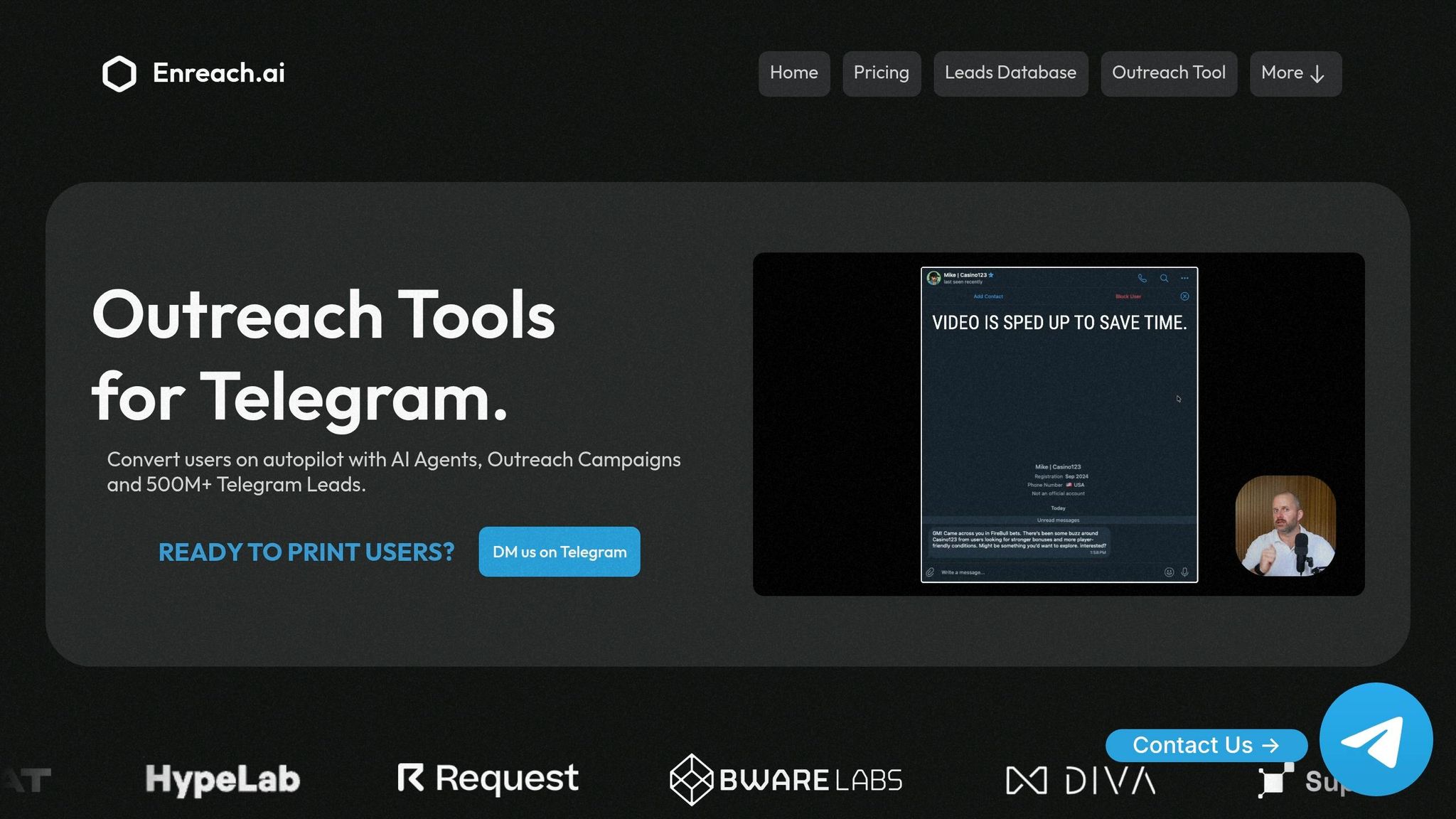
Enreach takes the strategies discussed earlier and combines them into one cohesive platform. By blending AI-driven personalization with expert human oversight, Enreach tackles the common challenges of Telegram outreach head-on. The platform’s AI Sales Agents handle large-scale personalized messaging, sending tailored messages to thousands of prospects without requiring manual effort. At a cost of $400 per month for up to 5,000 messages, the AI ensures that your outreach feels natural, with optimized tone and timing.
To navigate Telegram’s restrictions, Enreach uses multiple warmed accounts, intelligent delays, and proxy rotation. This ensures messages are not only delivered effectively but also maintain a personal touch - all while adhering to Telegram’s guidelines.
"Enreach makes it easy for our BD team to hit target consistently." – Lorenzo, Head of BD
With this seamless system in place, your team can focus on closing deals and expanding your customer base instead of worrying about outreach logistics.
FAQs
How can I tell if my Telegram account is shadowbanned?
To figure out if your Telegram account is shadowbanned, keep an eye out for a few key signs. A sudden drop in engagement, reduced visibility in search results, or limitations on your activity are common indicators. Another way to check is by using Telegram’s @SpamBot. This bot can help you verify if any restrictions have been placed on your account. If your messages aren’t reaching other users or your account seems less visible than before, it’s likely a shadowban might be the cause.
What consent language should I use for outreach compliance in the U.S.?
To ensure outreach compliance in the U.S., it's essential to use clear consent language that informs recipients about your communications and secures their explicit permission. For example, include a statement such as: "By providing your contact information, you agree to receive messages from us. Reply STOP to unsubscribe at any time."
Additionally, make sure your messaging practices:
Avoid common spam triggers.
Stay within platform-imposed limits.
Promptly honor opt-out requests.
These steps help maintain compliance and foster trust with your audience.
How many warmed Telegram accounts do I need to hit my monthly target?
To figure out how many warmed Telegram accounts you'll need, start by considering your monthly messaging target and the limits of each account after it's been warmed up. Typically, a well-warmed account can handle sending 25–50 targeted direct messages per day without running into any issues.
For instance, if your goal is to send 1,000 messages in a month, you’d require around 20–40 accounts actively sending messages daily. The exact number may vary depending on factors like your outreach volume, the quality of your accounts, and how effectively they've been warmed up.
Related Blog Posts
Telegram is a powerful platform for direct customer outreach, but its strict anti-spam measures present unique challenges. Businesses face issues like account restrictions, spam flags, compliance risks, scaling difficulties, and low conversion rates. Here’s a quick summary of the problems and solutions:
Account Restrictions: New accounts face strict daily messaging limits, and spam reports can quickly lead to bans.
Solution: Gradually warm up accounts, use dedicated proxies, and spread messages across multiple accounts.
Spam Flags & Poor Response Rates: Impersonal messages and rigid sending patterns trigger spam filters.
Solution: Personalize messages, randomize sending intervals, and time outreach during active hours.
Scaling Challenges: Managing multiple accounts while maintaining personalization is resource-intensive.
Solution: Use pre-warmed accounts and AI tools for remote sales lead qualification and message customization.
Low Conversion Rates: Weak profiles, poor targeting, and ineffective follow-ups hurt results.
Solution: Improve profile credibility, automate follow-ups, and track performance metrics.
With the right strategies - like account warm-up, AI-powered personalization, and compliance tools - you can overcome these hurdles and run successful Telegram outreach campaigns.
Telegram doesn’t provide a clear number for how many messages you can send per day. Instead, the platform relies on dynamic limits that depend on your account’s trust score.
The real challenge is avoiding Telegram’s anti-spam triggers. Sudden spikes in messaging activity or receiving just 3–5 spam reports can lead to account restrictions. Even a 0.3%–1% spam report rate can hurt your message deliverability within 24–72 hours. In some cases, you may encounter a "shadow ban", where your messages appear sent but never reach their recipients.
Operational errors can make things worse. Sharing the same IP address across multiple accounts increases the risk of a chain ban, where one flagged account can jeopardize all others tied to that IP. This is especially risky if you’re managing dozens of accounts to meet outreach targets.
Here’s a quick breakdown of safe messaging limits based on account age. To mimic real user behavior, delays between messages should range from 25–180 seconds, depending on the account’s maturity.
Solution: Use Warmed Accounts and Distribute Message Volume
To reduce the risk of account restrictions, focus on warming up accounts and spreading out your messaging activity.
When it comes to scaling, horizontal scaling is much safer than relying on a few accounts. For instance, sending 30 messages from 10 accounts is far less risky than sending 150 messages from just 2 accounts. Always maintain backup accounts equal to 20% of your main capacity to keep campaigns running smoothly if some accounts face issues.
To further safeguard your operations, use dedicated residential or mobile proxies in a 1:1 ratio with your accounts. Avoid datacenter proxies, as they’re more likely to be flagged. Each account should have a unique setup: its own IP address, browser profile, and randomized delays of 60–180 seconds between messages to replicate natural activity.
For added reliability, consider upgrading key accounts to Telegram Premium, which costs around $4–$5 USD per month. Premium accounts come with benefits like higher messaging limits, better media-sharing options, and a verified badge, which can increase trust among recipients. If your campaigns target high-value leads, this small investment can significantly improve both deliverability and response rates.
Problem 2: Messages Flagged as Spam and Poor Response Rates
Getting flagged as spam and dealing with poor response rates can make outreach feel like an uphill battle. These issues often stem from messages that lack a personal touch or are sent in ways that seem automated.
When recipients spot a cookie-cutter message, it feels impersonal and often gets ignored - or worse, marked as spam. This can trigger account restrictions. Beyond the content itself, how and when you send messages matters just as much. Sending messages at odd hours or in rigid, mechanical intervals can make systems flag your activity as suspicious, further harming your outreach efforts.
Here's the crux of the problem: impersonal messages feel like ads, not conversations.
Solution: Personalize Messages and Time Them Correctly
The key to better engagement lies in personalization and timing. These two elements can make your outreach feel more genuine and less like spam.
1. Personalize Every Message
Tailor your messages to each recipient. Look for details like their business focus, recent achievements, or find Web3 contacts to mention shared interests, and mention those in your message. For instance, instead of saying, "We offer marketing services", try something like, "I noticed your agency specializes in e-commerce brands - I'd love to share strategies that have worked for similar clients." Keep your opening short - two to three sentences max - and focus on offering value rather than diving into a sales pitch.
2. Randomize Your Sending Patterns
Avoid sending messages at perfectly regular intervals. Instead, introduce random delays - anywhere from 60 to 180 seconds - between messages. If you're managing multiple accounts, stagger their activity to prevent them from sending messages simultaneously, which could raise red flags.
3. Use a Conversational Tone
Make your messages feel like a dialogue, not a sales pitch. Stay away from spammy phrases like "limited time offer" or "act now", and avoid overloading your messages with emojis. Instead, ask open-ended questions that encourage a response, such as, "Are you currently handling lead generation in-house?" This approach invites genuine interaction and keeps the conversation flowing naturally.
Problem 4: Difficulty Scaling While Keeping Messages Personal
Scaling Telegram outreach presents a tough challenge: you either limit your reach with manual efforts or risk losing that personal touch with full automation. It's a trade-off between sending more messages and keeping them genuine.
Here’s the math: if each account can safely send 20 cold messages daily, reaching 60,000 prospects in a month means managing 100 accounts. Doing this manually while personalizing each message is overwhelming without hiring a large team. Hiring, however, is both expensive and time-consuming. On the flip side, relying solely on automation can hurt engagement and might even trigger spam filters.
Another headache? Sorting through thousands of contacts to find the ones who are genuinely interested. Without an efficient system, your team ends up wasting time on unqualified leads while potential high-value prospects wait too long for a response.
Solution: Use AI for Lead Qualification and Spread Volume Across Accounts
Instead of choosing between scale and personalization, you can achieve both by spreading your messaging across multiple warmed accounts and using AI to customize interactions. For example, to reach 60,000 prospects monthly, you’d need 100 accounts, each sending 20 messages per day. To help with this, Enreach offers pre-warmed accounts with three months of Telegram Premium. Pricing starts at $35 per account for orders of 100+ and drops to $28 per account for orders over 500.
AI Sales Agents can take over lead qualification and handle the early-stage conversations. These agents analyze engagement signals, answer common questions instantly, and escalate high-intent leads to your human team. Enreach’s AI Agents ($400/month for up to 5,000 messages) can juggle thousands of chats simultaneously, all while maintaining a tone that feels natural and personal - not robotic.
To improve your campaigns, track engagement rates, delivery rates, and conversions across your accounts. This data helps you fine-tune your messaging, optimize when you send messages, and focus resources on the accounts and campaigns that perform best. The Outreach Tool ($250/month for unlimited sending) simplifies everything by centralizing campaign management, so you’re not stuck logging in and out of dozens of accounts manually.
Problem 5: Low Conversion Rates and Weak Follow-Up
Getting someone to open your message is just the first step - the real challenge is turning that interest into action. Low conversion rates in Telegram outreach often stem from three key problems: an unprofessional profile, poor targeting, and ineffective follow-up strategies.
Imagine this: a prospect checks out your Telegram profile and sees an empty bio, no profile picture, or an account that looks brand new with zero activity. What’s their first thought? Probably that you’re a spammer. Even if your initial message is well-crafted, that poor first impression can destroy trust before you even get a response. Combine that with weak targeting - sending generic pitches to everyone - and you’re wasting time reaching out to people who were never interested to begin with. Then there’s follow-up. If it’s too aggressive, you scare leads away. If it’s too slow, they lose interest.
The result? You’re burning through time and resources while letting potential customers slip through the cracks. A prospect who might have converted with the right follow-up ends up moving on, simply because your system wasn’t designed to keep them engaged in a meaningful way.
Solution: Improve Profile Credibility and Automate Follow-Ups
To turn things around, you need to focus on two areas: making your profile more trustworthy and refining your follow-up process.
Start by boosting your profile’s credibility. Use a clear, professional profile picture and write a detailed bio that explains who you are and what you offer. Keep your account active and engaging - this helps set you apart from spammy accounts and builds trust right away.
For follow-ups, automation can save you time, but it has to be done thoughtfully. Create a follow-up sequence that gives your prospects enough space to breathe while keeping you on their radar. Here’s an example:
Day 1: Send an introductory message that provides value, like a tip or insight.
Day 4: Follow up with additional information or a helpful resource.
Day 10: Share a case study or success story to reinforce your credibility.
This approach keeps you relevant without overwhelming your audience. Telegram outreach tools like Enreach’s AI Agents ($400/month for up to 5,000 messages) can handle these sequences for you, adjusting tone and timing based on how prospects engage with your messages. Use metrics like open rates, reply rates, and conversion rates to monitor performance and fine-tune your campaigns as needed. With the right adjustments, you’ll turn more leads into loyal customers.
How Enreach Solves Telegram Outreach Problems
Enreach takes the strategies discussed earlier and combines them into one cohesive platform. By blending AI-driven personalization with expert human oversight, Enreach tackles the common challenges of Telegram outreach head-on. The platform’s AI Sales Agents handle large-scale personalized messaging, sending tailored messages to thousands of prospects without requiring manual effort. At a cost of $400 per month for up to 5,000 messages, the AI ensures that your outreach feels natural, with optimized tone and timing.
To navigate Telegram’s restrictions, Enreach uses multiple warmed accounts, intelligent delays, and proxy rotation. This ensures messages are not only delivered effectively but also maintain a personal touch - all while adhering to Telegram’s guidelines.
"Enreach makes it easy for our BD team to hit target consistently." – Lorenzo, Head of BD
With this seamless system in place, your team can focus on closing deals and expanding your customer base instead of worrying about outreach logistics.
FAQs
How can I tell if my Telegram account is shadowbanned?
To figure out if your Telegram account is shadowbanned, keep an eye out for a few key signs. A sudden drop in engagement, reduced visibility in search results, or limitations on your activity are common indicators. Another way to check is by using Telegram’s @SpamBot. This bot can help you verify if any restrictions have been placed on your account. If your messages aren’t reaching other users or your account seems less visible than before, it’s likely a shadowban might be the cause.
What consent language should I use for outreach compliance in the U.S.?
To ensure outreach compliance in the U.S., it's essential to use clear consent language that informs recipients about your communications and secures their explicit permission. For example, include a statement such as: "By providing your contact information, you agree to receive messages from us. Reply STOP to unsubscribe at any time."
Additionally, make sure your messaging practices:
Avoid common spam triggers.
Stay within platform-imposed limits.
Promptly honor opt-out requests.
These steps help maintain compliance and foster trust with your audience.
How many warmed Telegram accounts do I need to hit my monthly target?
To figure out how many warmed Telegram accounts you'll need, start by considering your monthly messaging target and the limits of each account after it's been warmed up. Typically, a well-warmed account can handle sending 25–50 targeted direct messages per day without running into any issues.
For instance, if your goal is to send 1,000 messages in a month, you’d require around 20–40 accounts actively sending messages daily. The exact number may vary depending on factors like your outreach volume, the quality of your accounts, and how effectively they've been warmed up.
Related Blog Posts

Optimize Your Sales with Enreach.
Optimize Your Sales with Enreach.
Get access to a 500M person Leads Database, Automated Outreach and AI Sales Agents.
Get access to a 500M person Leads Database, Automated Outreach and AI Sales Agents.
More Info