Case Study: Influencer Success in Telegram iGaming
Case Study: Influencer Success in Telegram iGaming
IGaming Marketing
Apr 28, 2026
Apr 28, 2026
Telegram Mini Apps and micro-influencers reduced CPC to $0.06, cut cost/FTD to $3.50, and drove 5,009 first-time deposits.
Telegram Mini Apps and micro-influencers reduced CPC to $0.06, cut cost/FTD to $3.50, and drove 5,009 first-time deposits.
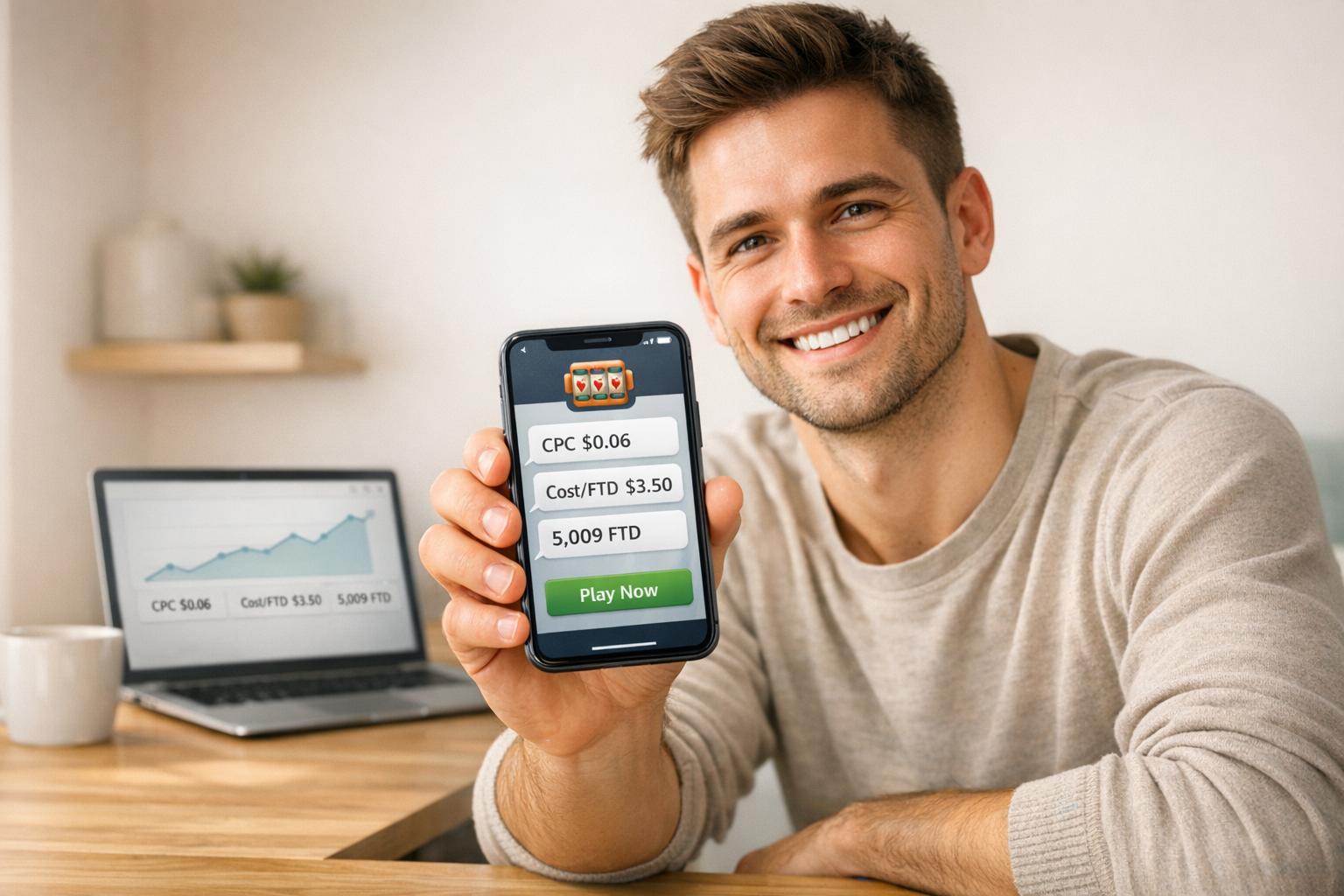
Telegram emerged as a game-changer for iGaming marketing. In December 2024, a Kazakhstan-based operator achieved a 9.863% click-through rate (CTR) - nearly 5x the industry average - and generated $7,883.64 in revenue with a $0.06 cost-per-click (CPC). By combining Telegram's Mini Apps with influencer partnerships, they reduced acquisition costs to $3.50 per first-time deposit (FTD) and boosted retention rates.
Key takeaways:
Why Telegram works for iGaming: Direct messaging, Mini Apps for gameplay and deposits, and AI tools for segmentation.
Influencer strategy: Focused on micro-influencers with high engagement, using personal video reviews over flashy ads.
Campaign results: 5,009 FTDs, 82% high-quality leads, and a 15% revenue boost within one month.
Tools and tracking: Postback integration and automated follow-ups ensured accurate performance insights.
This case highlights how Telegram's ecosystem, paired with thoughtful influencer marketing, can deliver outstanding results in the iGaming space.
Campaign Background
About the iGaming Operator
This crypto-focused iGaming platform was starting from scratch - no users, no traffic, and no established trust in the market. What made them stand out was their use of Telegram Mini Apps. These apps allowed users to seamlessly compare bonuses, register, play games, and make deposits, all within the Telegram interface. It was a bold, unconventional strategy designed to carve out a niche in a competitive industry.
Their primary objective? Attract real, active players while keeping acquisition costs manageable. They aimed to drive registrations, secure first-time deposits, and encourage ongoing gameplay. However, achieving this required tackling the significant challenge of ensuring user authenticity.
Problems Before Using Influencers
Before turning to influencers, the operator faced a major issue: the "Ghost Player" problem. While downloads were high, active gameplay was almost nonexistent. Shockingly, up to 80% of users turned out to be bots or dropped off before engaging meaningfully.
"While download numbers looked impressive on paper, something wasn't adding up. Games with thousands of 'players' felt oddly empty." – Team Lysto
Adding to their woes, they lacked a postback tracking system, which made it nearly impossible to trace conversions from ad clicks to actual deposits. On top of that, poor influencer vetting meant many partnerships failed to deliver real engagement. Retention rates plummeted as users disengaged shortly after their initial interaction.
These challenges highlighted a critical need for two things: reliable influencer endorsements and a strong tracking infrastructure. Without them, building trust and attracting real players would remain an uphill battle. This realization marked a turning point, leading the operator to shift toward partnerships with credible influencers.
How Influencers Were Selected
Selection Criteria
The operator focused on finding influencers who could bring in genuine players, prioritizing engagement quality over follower count. Their sweet spot? Micro-influencers with 10,000–50,000 followers, an Engagement-to-Reach Ratio (ETR) above 5%, and a View-to-Reach Ratio (VTR) of at least 15%. These metrics ensured they partnered with creators who had actively engaged audiences.
To maintain authenticity, they required influencers to have at least a 60% Original Content Ratio, steering clear of those who mostly repost generic material. A Top Word Analysis was also key, confirming influencers were familiar with niche-specific terms like "betting", "casino games", or "DeFi." Influencers who used Telegram outreach tools in their content were given priority since their audiences were likely comfortable with the platform.
The operator also leaned toward influencers who created "face-of-the-brand" content, such as personal videos or live streams, instead of the overused "luxury life" imagery. Additionally, they sought out influencers who had previously promoted competitors like Stake, ensuring access to an audience already familiar with iGaming products.
With these guidelines in place, the operator built a strategic partnership model designed to boost engagement.
Partnership Approach
To ensure authentic recommendations, the operator locked in multi-post agreements, typically involving 3–4 posts per influencer. For example, in late 2024, the iGaming platform Betmode collaborated with 18 influencers from the Web3 and gambling niches (often sourced via Web3 contact databases) on a $14,000 budget. This effort resulted in over 500,000 views and an average engagement rate of 2.5%.
They also introduced a hybrid incentive model, combining a base fee with performance-based bonuses tied to First-Time Deposits (FTDs). Initially, the budget was distributed evenly across the influencer pool, allowing the team to test performance. Once top-performing influencers were identified, spending was scaled up with them. This "test before scaling" approach ensured the campaign delivered strong ROI without prematurely exhausting resources.
Campaign Implementation
Content and Promotion Tactics
Influencers crafted native content designed to blend seamlessly with Telegram's interface. Instead of relying on traditional branded advertisements, they created personal video reviews that showcased the platform's interface, game options, and deposit process. These native video reviews outperformed standard ads, doubling view counts.
The campaign leaned into Telegram-specific design elements. Influencers used branded icons, vibrant characters, and native emojis to make their posts feel organic and reduce the likelihood of users overlooking them as ads.
To streamline the user experience, all registration pages opened directly within Telegram using WebViews (Mini Apps). This approach eliminated the need for external redirects, reducing potential drop-offs.
In addition to content creation, maintaining user engagement through active community management played a crucial role.
Telegram Community Management
Once engaging content attracted users, effective community management ensured they remained active. The team implemented automated onboarding flows using bots that greeted new members personally, explained how to claim bonuses, and addressed common questions about deposits and withdrawals. These personalized interactions helped users feel welcomed and reduced early churn rates.
Interactive elements, like polls asking users about their favorite games and quizzes that rewarded participation with bonus credits, kept the community lively. They also introduced "sticky buttons" near the input box - permanent navigation tools offering one-click access to start playing or check balances. To maintain consistent communication, all community replies were centralized into a single inbox using Telegram CRM tools, ensuring quick and reliable responses to user inquiries.
With engagement strategies in place, the team turned their attention to performance tracking.
Performance Tracking Methods
Tracking performance on Telegram came with challenges, but the team prioritized accurate data collection. They used postback integration to track user actions like registrations and first-time deposits, enabling optimization through smart bidding algorithms. Since Telegram’s native tracking tools can be complex, third-party analytics suites were employed to monitor the entire user journey from ad interaction to deposit.
Key metrics included click-through rates, cost-per-click (starting as low as $0.015 for push-style ads), and conversion rates from registration to deposit. Users were segmented into "Motivated" and "Non-Motivated" groups to test which audience was more responsive to specific bonus offers. This data-driven approach allowed the team to identify top-performing influencers and scale spending strategically, refining both content and community tactics along the way.
Influencer marketing in iGaming: How to avoid creators’ cheating and attract solvent audiences
Campaign Results
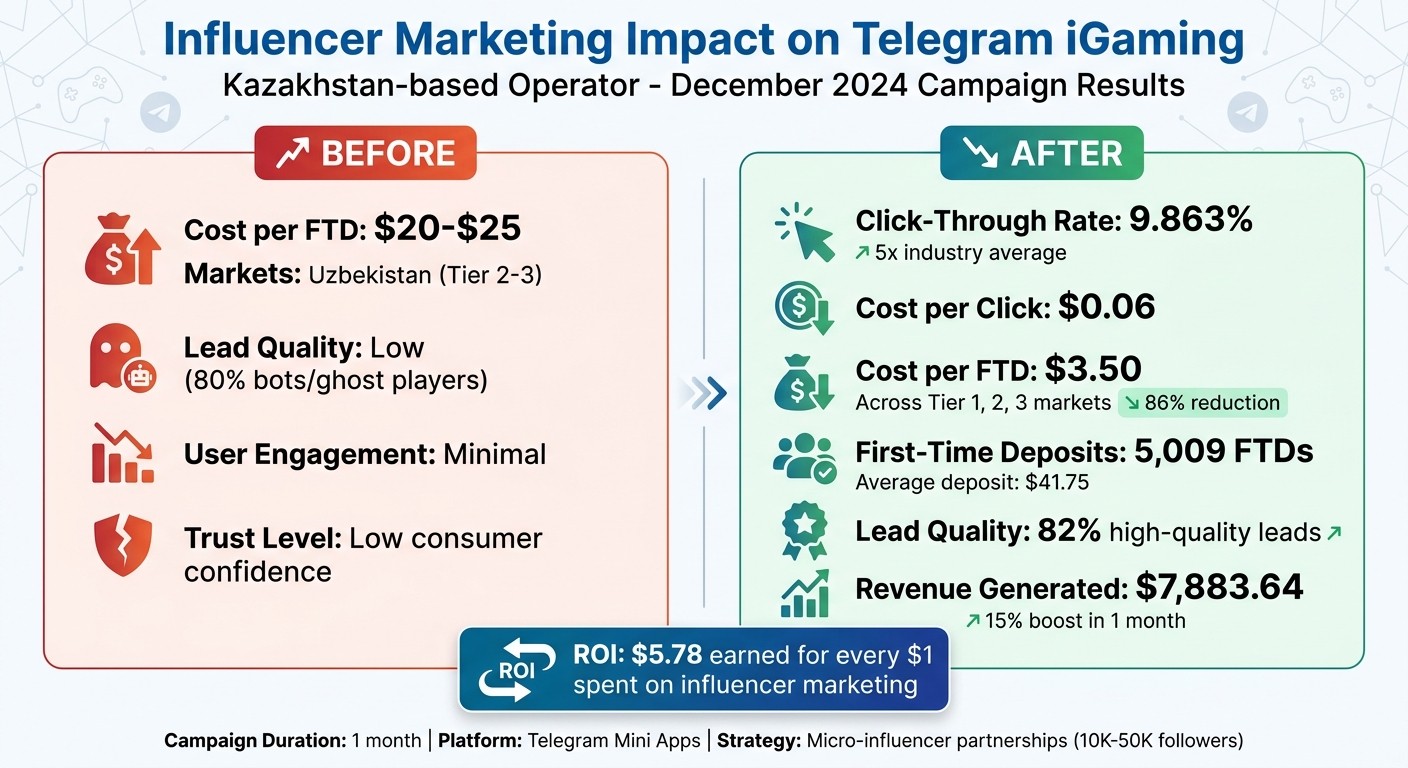
Telegram iGaming Campaign Results: Before vs After Influencer Marketing
Before and After Metrics
Before partnering with influencers, the operator faced challenges like high acquisition costs, overused marketing channels, and low consumer trust. Traditional campaigns in markets such as Uzbekistan were costing $20–$25 per first-time depositor (FTD).
After the campaign, the numbers told a completely different story. The click-through rate (CTR) jumped to an impressive 9.863%. The operator secured 5,009 first-time deposits, with an average deposit amount of $41.75. The cost per FTD dropped significantly to just $3.50, spanning Tier 1, 2, and 3 markets. Meanwhile, the cost per click (CPC) plummeted to $0.06. These results underscore the campaign's success, with influencer trust playing a critical role - 69% of consumers trust influencer recommendations more than direct brand messaging. This trust not only drove more sign-ups but also cultivated a base of engaged, long-term users.
The improved metrics laid the groundwork for robust ROI and sustainable growth.
Growth Numbers and ROI
The campaign exceeded expectations when it came to return on investment. Within a single month, it generated $7,883.64 in revenue, boosting sales by 15%. To put this into perspective, brands typically earn $5.78 for every $1 spent on influencer marketing, reinforcing the effectiveness of this strategy.
"$3.5 avg cost per FTD across tier 1, 2 and 3 markets in the first year." - Filipe, Lucky Bet
Influencer marketing didn’t just bring in leads - it brought in the right leads. 82% of the leads were reported to be of higher quality. Users acquired through these partnerships showed better retention and higher lifetime value (LTV) compared to those from traditional campaigns. The campaign’s success was further bolstered by authentic influencer endorsements, seamless integration with Telegram, and active community management. Together, these elements created a growth engine that continued to deliver results long after the campaign ended, proving the value of influencer marketing within the Telegram ecosystem.
Key Takeaways and Scaling with Enreach
What Worked and What to Avoid
The campaign's success rested on three main strategies:
Performance-based compensation for influencers: This approach replaced traditional CPM models, slashing acquisition costs by 40–60%. Every dollar spent directly contributed to real deposits.
Community-first targeting: By focusing on genuine gaming communities, the campaign avoided the "ghost player" issue, keeping inactive users to a minimum.
Integrated content formats: Combining long-form streams with Stories, pinned messages, and chat branding drove significantly higher conversions than single placements. This was reflected in strong CTR and FTD metrics.
However, there were key mistakes to avoid. Skipping postback tracking is a major misstep - it’s impossible to optimize without understanding the full user journey from click to deposit. Another common error is promoting too aggressively early on. For new Telegram channels, trust-building is critical; the first 50 posts should focus entirely on providing value before introducing promotional content. Additionally, using localized creatives with bright icons and culturally relevant messaging proved to be a game-changer for engagement.
"In Telegram gaming, authentic community connections beat clever ad campaigns every time. We're not just finding users who download - we're finding players who play." - Team Lysto
These insights laid the groundwork for scaling the campaign with automated tools.
How Enreach Supported Campaign Growth
Enreach played a pivotal role in scaling the campaign by automating user acquisition. The platform identified high-intent players by scraping competitor Telegram communities, then executed 4–5 automated follow-ups based on engagement levels. To avoid Telegram's anti-spam measures, the system mimicked human latency. This strategy achieved 50% open rates and contributed to 5% automated growth.
For the iGaming operator, Enreach's automation capabilities expanded what influencers could achieve on their own. By extracting contextual data from user bios and group activity, Enreach enabled personalized outreach at scale. Real-time tracking allowed instant adjustments to messaging and performance analysis. This streamlined approach didn’t just complement the influencer campaign - it replaced the need for manual marketing teams entirely, automating user acquisition while maintaining high-quality standards.
Conclusion
Influencer marketing on Telegram gets a major boost when combined with automation. By leveraging Enreach's advanced tools alongside the trust influencers build, the iGaming operator successfully reduced acquisition costs through performance-based partnerships - all while keeping community engagement genuine. Shifting from CPM to performance-based compensation ensured every dollar spent directly contributed to deposits.
With over 50 million Telegram messages sent, Enreach brought a wealth of expertise to the campaign. As Filipe from Lucky Bet shared, the campaign achieved an impressive average cost per FTD of $3.50. This efficiency laid the groundwork for a scalable and repeatable strategy.
The approach was straightforward: influencers fostered trust and engagement, while Enreach handled automated follow-ups and personalized messages. Their AI Agents worked tirelessly to qualify leads and manage outreach 24/7, minimizing the need for manual effort while maintaining the personal touch that turns casual players into depositing customers.
For iGaming operators aiming to replicate this success, the key lies in starting with community-driven influencers, utilizing postback tracking from the outset, and scaling efforts with automation. In Telegram's competitive iGaming space, blending authentic influence with smart automation is quickly becoming a winning strategy.
FAQs
How do I pick Telegram micro-influencers that bring real depositing players?
When selecting influencers for your campaigns, focus on those within the 10,000 to 100,000 follower range. Why? This sweet spot often delivers a more targeted and engaged audience compared to mega-influencers.
Dig deeper into their engagement metrics - don’t just look at the numbers. Pay attention to comment quality and interaction rates to gauge how actively their audience connects with their content. This can reveal whether their followers are genuinely interested or just passive viewers.
Another key factor? Look for influencers who have a proven history of successful collaborations. Those with a track record of delivering results for other brands are more likely to bring value to your campaign too.
To make the process smoother, consider using tools like Enreach. These platforms simplify outreach and help fine-tune your campaigns, increasing the likelihood of partnerships that lead to real results, such as authentic user engagement and deposits.
What tracking setup do I need to measure clicks, sign-ups, and first-time deposits in Telegram?
To monitor clicks, sign-ups, and first-time deposits on Telegram, you’ll need a system that captures user actions step by step. Start by using unique tracking links to measure clicks. Then, integrate conversion pixels or event tracking to capture sign-ups and deposits. Finally, use analytics tools to dive into user behavior and refine your strategy. Tools like Enreach can provide AI-driven outreach and expert guidance to help you fine-tune your campaign tracking.
How can Enreach automate follow-ups without triggering Telegram spam limits?
Enreach uses AI Agents trained on more than 30 million conversations to automate follow-ups on Telegram. These agents craft personalized outreach messages while staying within Telegram's spam restrictions. With features like filtering contacts based on interest, location, and activity, and managing message frequency, Enreach minimizes the risk of being flagged as spam. This system ensures follow-ups are timely, tailored, and compliant with platform rules.
Related Blog Posts
Telegram emerged as a game-changer for iGaming marketing. In December 2024, a Kazakhstan-based operator achieved a 9.863% click-through rate (CTR) - nearly 5x the industry average - and generated $7,883.64 in revenue with a $0.06 cost-per-click (CPC). By combining Telegram's Mini Apps with influencer partnerships, they reduced acquisition costs to $3.50 per first-time deposit (FTD) and boosted retention rates.
Key takeaways:
Why Telegram works for iGaming: Direct messaging, Mini Apps for gameplay and deposits, and AI tools for segmentation.
Influencer strategy: Focused on micro-influencers with high engagement, using personal video reviews over flashy ads.
Campaign results: 5,009 FTDs, 82% high-quality leads, and a 15% revenue boost within one month.
Tools and tracking: Postback integration and automated follow-ups ensured accurate performance insights.
This case highlights how Telegram's ecosystem, paired with thoughtful influencer marketing, can deliver outstanding results in the iGaming space.
Campaign Background
About the iGaming Operator
This crypto-focused iGaming platform was starting from scratch - no users, no traffic, and no established trust in the market. What made them stand out was their use of Telegram Mini Apps. These apps allowed users to seamlessly compare bonuses, register, play games, and make deposits, all within the Telegram interface. It was a bold, unconventional strategy designed to carve out a niche in a competitive industry.
Their primary objective? Attract real, active players while keeping acquisition costs manageable. They aimed to drive registrations, secure first-time deposits, and encourage ongoing gameplay. However, achieving this required tackling the significant challenge of ensuring user authenticity.
Problems Before Using Influencers
Before turning to influencers, the operator faced a major issue: the "Ghost Player" problem. While downloads were high, active gameplay was almost nonexistent. Shockingly, up to 80% of users turned out to be bots or dropped off before engaging meaningfully.
"While download numbers looked impressive on paper, something wasn't adding up. Games with thousands of 'players' felt oddly empty." – Team Lysto
Adding to their woes, they lacked a postback tracking system, which made it nearly impossible to trace conversions from ad clicks to actual deposits. On top of that, poor influencer vetting meant many partnerships failed to deliver real engagement. Retention rates plummeted as users disengaged shortly after their initial interaction.
These challenges highlighted a critical need for two things: reliable influencer endorsements and a strong tracking infrastructure. Without them, building trust and attracting real players would remain an uphill battle. This realization marked a turning point, leading the operator to shift toward partnerships with credible influencers.
How Influencers Were Selected
Selection Criteria
The operator focused on finding influencers who could bring in genuine players, prioritizing engagement quality over follower count. Their sweet spot? Micro-influencers with 10,000–50,000 followers, an Engagement-to-Reach Ratio (ETR) above 5%, and a View-to-Reach Ratio (VTR) of at least 15%. These metrics ensured they partnered with creators who had actively engaged audiences.
To maintain authenticity, they required influencers to have at least a 60% Original Content Ratio, steering clear of those who mostly repost generic material. A Top Word Analysis was also key, confirming influencers were familiar with niche-specific terms like "betting", "casino games", or "DeFi." Influencers who used Telegram outreach tools in their content were given priority since their audiences were likely comfortable with the platform.
The operator also leaned toward influencers who created "face-of-the-brand" content, such as personal videos or live streams, instead of the overused "luxury life" imagery. Additionally, they sought out influencers who had previously promoted competitors like Stake, ensuring access to an audience already familiar with iGaming products.
With these guidelines in place, the operator built a strategic partnership model designed to boost engagement.
Partnership Approach
To ensure authentic recommendations, the operator locked in multi-post agreements, typically involving 3–4 posts per influencer. For example, in late 2024, the iGaming platform Betmode collaborated with 18 influencers from the Web3 and gambling niches (often sourced via Web3 contact databases) on a $14,000 budget. This effort resulted in over 500,000 views and an average engagement rate of 2.5%.
They also introduced a hybrid incentive model, combining a base fee with performance-based bonuses tied to First-Time Deposits (FTDs). Initially, the budget was distributed evenly across the influencer pool, allowing the team to test performance. Once top-performing influencers were identified, spending was scaled up with them. This "test before scaling" approach ensured the campaign delivered strong ROI without prematurely exhausting resources.
Campaign Implementation
Content and Promotion Tactics
Influencers crafted native content designed to blend seamlessly with Telegram's interface. Instead of relying on traditional branded advertisements, they created personal video reviews that showcased the platform's interface, game options, and deposit process. These native video reviews outperformed standard ads, doubling view counts.
The campaign leaned into Telegram-specific design elements. Influencers used branded icons, vibrant characters, and native emojis to make their posts feel organic and reduce the likelihood of users overlooking them as ads.
To streamline the user experience, all registration pages opened directly within Telegram using WebViews (Mini Apps). This approach eliminated the need for external redirects, reducing potential drop-offs.
In addition to content creation, maintaining user engagement through active community management played a crucial role.
Telegram Community Management
Once engaging content attracted users, effective community management ensured they remained active. The team implemented automated onboarding flows using bots that greeted new members personally, explained how to claim bonuses, and addressed common questions about deposits and withdrawals. These personalized interactions helped users feel welcomed and reduced early churn rates.
Interactive elements, like polls asking users about their favorite games and quizzes that rewarded participation with bonus credits, kept the community lively. They also introduced "sticky buttons" near the input box - permanent navigation tools offering one-click access to start playing or check balances. To maintain consistent communication, all community replies were centralized into a single inbox using Telegram CRM tools, ensuring quick and reliable responses to user inquiries.
With engagement strategies in place, the team turned their attention to performance tracking.
Performance Tracking Methods
Tracking performance on Telegram came with challenges, but the team prioritized accurate data collection. They used postback integration to track user actions like registrations and first-time deposits, enabling optimization through smart bidding algorithms. Since Telegram’s native tracking tools can be complex, third-party analytics suites were employed to monitor the entire user journey from ad interaction to deposit.
Key metrics included click-through rates, cost-per-click (starting as low as $0.015 for push-style ads), and conversion rates from registration to deposit. Users were segmented into "Motivated" and "Non-Motivated" groups to test which audience was more responsive to specific bonus offers. This data-driven approach allowed the team to identify top-performing influencers and scale spending strategically, refining both content and community tactics along the way.
Influencer marketing in iGaming: How to avoid creators’ cheating and attract solvent audiences
Campaign Results
Telegram iGaming Campaign Results: Before vs After Influencer Marketing
Before and After Metrics
Before partnering with influencers, the operator faced challenges like high acquisition costs, overused marketing channels, and low consumer trust. Traditional campaigns in markets such as Uzbekistan were costing $20–$25 per first-time depositor (FTD).
After the campaign, the numbers told a completely different story. The click-through rate (CTR) jumped to an impressive 9.863%. The operator secured 5,009 first-time deposits, with an average deposit amount of $41.75. The cost per FTD dropped significantly to just $3.50, spanning Tier 1, 2, and 3 markets. Meanwhile, the cost per click (CPC) plummeted to $0.06. These results underscore the campaign's success, with influencer trust playing a critical role - 69% of consumers trust influencer recommendations more than direct brand messaging. This trust not only drove more sign-ups but also cultivated a base of engaged, long-term users.
The improved metrics laid the groundwork for robust ROI and sustainable growth.
Growth Numbers and ROI
The campaign exceeded expectations when it came to return on investment. Within a single month, it generated $7,883.64 in revenue, boosting sales by 15%. To put this into perspective, brands typically earn $5.78 for every $1 spent on influencer marketing, reinforcing the effectiveness of this strategy.
"$3.5 avg cost per FTD across tier 1, 2 and 3 markets in the first year." - Filipe, Lucky Bet
Influencer marketing didn’t just bring in leads - it brought in the right leads. 82% of the leads were reported to be of higher quality. Users acquired through these partnerships showed better retention and higher lifetime value (LTV) compared to those from traditional campaigns. The campaign’s success was further bolstered by authentic influencer endorsements, seamless integration with Telegram, and active community management. Together, these elements created a growth engine that continued to deliver results long after the campaign ended, proving the value of influencer marketing within the Telegram ecosystem.
Key Takeaways and Scaling with Enreach
What Worked and What to Avoid
The campaign's success rested on three main strategies:
Performance-based compensation for influencers: This approach replaced traditional CPM models, slashing acquisition costs by 40–60%. Every dollar spent directly contributed to real deposits.
Community-first targeting: By focusing on genuine gaming communities, the campaign avoided the "ghost player" issue, keeping inactive users to a minimum.
Integrated content formats: Combining long-form streams with Stories, pinned messages, and chat branding drove significantly higher conversions than single placements. This was reflected in strong CTR and FTD metrics.
However, there were key mistakes to avoid. Skipping postback tracking is a major misstep - it’s impossible to optimize without understanding the full user journey from click to deposit. Another common error is promoting too aggressively early on. For new Telegram channels, trust-building is critical; the first 50 posts should focus entirely on providing value before introducing promotional content. Additionally, using localized creatives with bright icons and culturally relevant messaging proved to be a game-changer for engagement.
"In Telegram gaming, authentic community connections beat clever ad campaigns every time. We're not just finding users who download - we're finding players who play." - Team Lysto
These insights laid the groundwork for scaling the campaign with automated tools.
How Enreach Supported Campaign Growth
Enreach played a pivotal role in scaling the campaign by automating user acquisition. The platform identified high-intent players by scraping competitor Telegram communities, then executed 4–5 automated follow-ups based on engagement levels. To avoid Telegram's anti-spam measures, the system mimicked human latency. This strategy achieved 50% open rates and contributed to 5% automated growth.
For the iGaming operator, Enreach's automation capabilities expanded what influencers could achieve on their own. By extracting contextual data from user bios and group activity, Enreach enabled personalized outreach at scale. Real-time tracking allowed instant adjustments to messaging and performance analysis. This streamlined approach didn’t just complement the influencer campaign - it replaced the need for manual marketing teams entirely, automating user acquisition while maintaining high-quality standards.
Conclusion
Influencer marketing on Telegram gets a major boost when combined with automation. By leveraging Enreach's advanced tools alongside the trust influencers build, the iGaming operator successfully reduced acquisition costs through performance-based partnerships - all while keeping community engagement genuine. Shifting from CPM to performance-based compensation ensured every dollar spent directly contributed to deposits.
With over 50 million Telegram messages sent, Enreach brought a wealth of expertise to the campaign. As Filipe from Lucky Bet shared, the campaign achieved an impressive average cost per FTD of $3.50. This efficiency laid the groundwork for a scalable and repeatable strategy.
The approach was straightforward: influencers fostered trust and engagement, while Enreach handled automated follow-ups and personalized messages. Their AI Agents worked tirelessly to qualify leads and manage outreach 24/7, minimizing the need for manual effort while maintaining the personal touch that turns casual players into depositing customers.
For iGaming operators aiming to replicate this success, the key lies in starting with community-driven influencers, utilizing postback tracking from the outset, and scaling efforts with automation. In Telegram's competitive iGaming space, blending authentic influence with smart automation is quickly becoming a winning strategy.
FAQs
How do I pick Telegram micro-influencers that bring real depositing players?
When selecting influencers for your campaigns, focus on those within the 10,000 to 100,000 follower range. Why? This sweet spot often delivers a more targeted and engaged audience compared to mega-influencers.
Dig deeper into their engagement metrics - don’t just look at the numbers. Pay attention to comment quality and interaction rates to gauge how actively their audience connects with their content. This can reveal whether their followers are genuinely interested or just passive viewers.
Another key factor? Look for influencers who have a proven history of successful collaborations. Those with a track record of delivering results for other brands are more likely to bring value to your campaign too.
To make the process smoother, consider using tools like Enreach. These platforms simplify outreach and help fine-tune your campaigns, increasing the likelihood of partnerships that lead to real results, such as authentic user engagement and deposits.
What tracking setup do I need to measure clicks, sign-ups, and first-time deposits in Telegram?
To monitor clicks, sign-ups, and first-time deposits on Telegram, you’ll need a system that captures user actions step by step. Start by using unique tracking links to measure clicks. Then, integrate conversion pixels or event tracking to capture sign-ups and deposits. Finally, use analytics tools to dive into user behavior and refine your strategy. Tools like Enreach can provide AI-driven outreach and expert guidance to help you fine-tune your campaign tracking.
How can Enreach automate follow-ups without triggering Telegram spam limits?
Enreach uses AI Agents trained on more than 30 million conversations to automate follow-ups on Telegram. These agents craft personalized outreach messages while staying within Telegram's spam restrictions. With features like filtering contacts based on interest, location, and activity, and managing message frequency, Enreach minimizes the risk of being flagged as spam. This system ensures follow-ups are timely, tailored, and compliant with platform rules.
Related Blog Posts

Optimize Your Sales with Enreach.
Optimize Your Sales with Enreach.
Get access to a 500M person Leads Database, Automated Outreach and AI Sales Agents.
Get access to a 500M person Leads Database, Automated Outreach and AI Sales Agents.
More Info