Grow iGaming Signups with Targeted Segmentation
Grow iGaming Signups with Targeted Segmentation
IGaming Marketing
Apr 21, 2026
Apr 21, 2026
Use targeted player segmentation and Telegram AI outreach to cut iGaming acquisition costs and boost signups and retention.
Use targeted player segmentation and Telegram AI outreach to cut iGaming acquisition costs and boost signups and retention.

iGaming marketers face two major challenges: high acquisition costs ($150–$500 per user) and a 70% churn rate within 30 days. The solution? Targeted segmentation. By dividing players into specific groups based on habits, preferences, and behaviors, you can send personalized offers that resonate - and reduce costs.
Key takeaways:
Telegram for outreach: Guarantees 100% reach to opt-in users with open rates exceeding 80%.
Segmentation strategies: Group players by behavior (e.g., high rollers vs. casual gamers), lifecycle stage (new signups vs. dormant users), and geography.
AI tools for precision: Platforms like Enreach AI automate segmentation and outreach, cutting first-time deposit costs to $3.50 across global markets.
Example: Lucky Bet reduced acquisition costs by leveraging AI-powered Telegram campaigns, achieving a $3.50 cost per first-time deposit in 2026. Tailored messaging matched player preferences in real time, driving signups and retention.
Targeted segmentation isn’t about sending more messages - it’s about sending the right message to the right player at the right time.
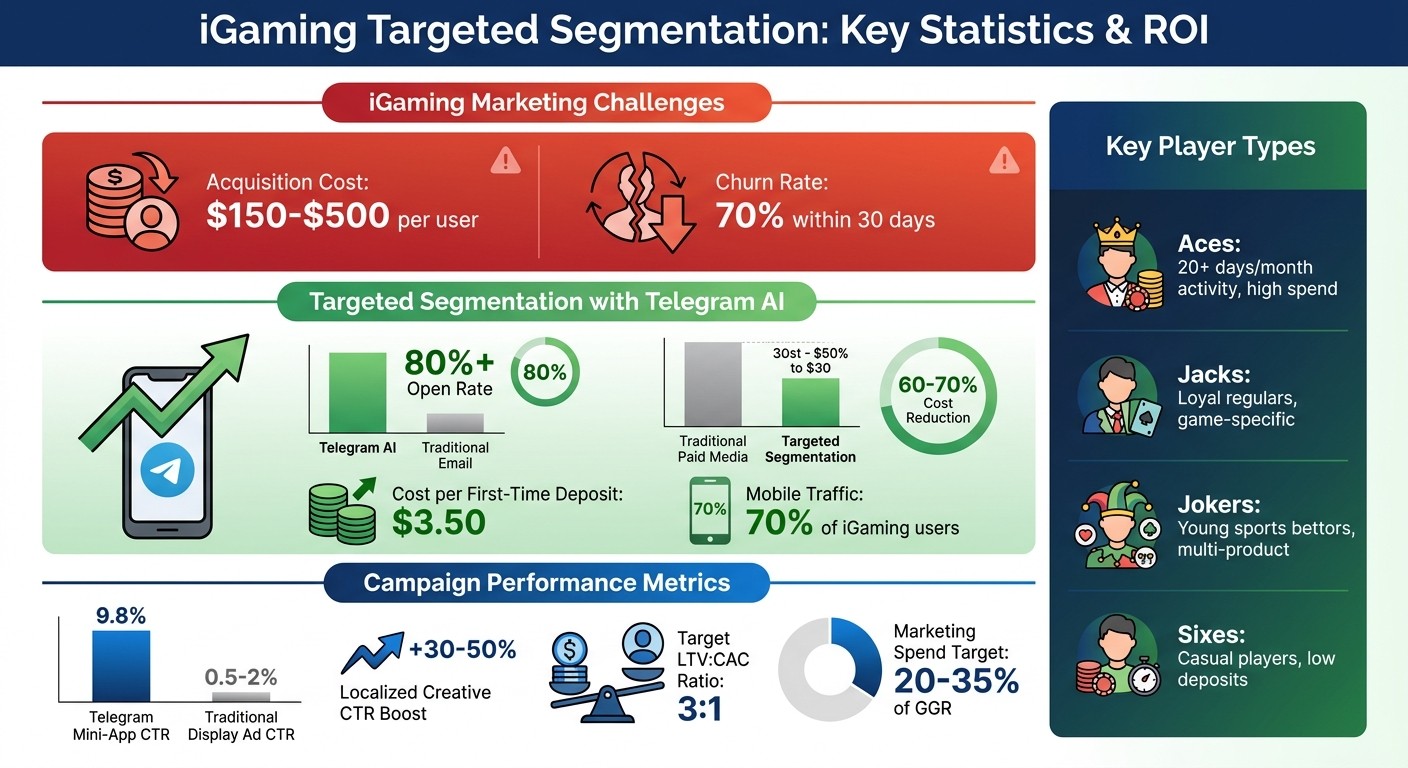
iGaming Segmentation ROI: Key Metrics and Cost Comparisons
What is Targeted Segmentation for Telegram Campaigns?
Defining Targeted Segmentation
Targeted segmentation is all about dividing your player base into smaller groups based on shared traits like play style, spending habits, or betting frequency. Instead of blasting out the same bonus offer to everyone, you tailor messages to fit each group. The idea? Deliver offers that actually resonate with the right players.
Picture it like sorting a deck of cards. The "Aces" are your high rollers - they play more than 20 days a month and spend big. The "Jacks" are your loyal regulars who stick to specific games like slots. The "Jokers"? Younger sports bettors who dabble across different products. And the "Sixes" are casual players who prefer basic casino games and rarely make deposits. Each of these groups reacts differently to incentives, so a one-size-fits-all approach wastes both time and money.
"Player segmentation is a foundation for operators' activities... it's the ultimate moneymaker and money saver." - Ihor Sudak, CRM Operation Team Lead, GR8 Tech
On Telegram, this segmentation gets even sharper. You can filter leads by interests (like Sports Betting, Casino, or Poker), language, location, and activity levels. Using AI and machine learning, these segments can update in real time. For example, if a casino player starts focusing on sports betting during events like March Madness, the system adjusts their category automatically. This kind of real-time precision ensures your offers stay relevant to what players care about most.
Why Telegram Matters for iGaming Outreach
Telegram takes targeted segmentation to the next level by offering unique perks for iGaming campaigns. First off, Telegram messages go straight to opt-in users - no algorithms throttling your reach or emails ending up in spam. This direct delivery leads to open rates of over 80%. Plus, with over 70% of iGaming traffic coming from mobile devices, Telegram's mobile-first design keeps players engaged without requiring them to jump between apps.
The platform also shines with its interactive tools. Features like buttons and Mini Apps let users register or place bets without leaving the chat. For instance, sticky "Start Playing" buttons stay visible throughout the conversation, making it easier for players to act on your offers. Campaigns that use localized creatives - like mentioning "Teen Patti" for Indian players or "Aviator" for Brazilian audiences - see click-through rates jump by 30-50% because the messaging feels personal and relevant.
When you combine Telegram's direct reach with smart segmentation, you’re not just sending out offers - you’re delivering exactly what your players are looking for, right when they want it.
The Market Research Playbook for Conquering the iGaming Industry
Segmentation Strategies That Drive iGaming Signups
Building on the basics of targeted segmentation, refining strategies around player behavior, journey stages, location, and predicted value can significantly improve outreach efforts.
Behavioral Segmentation
Behavioral segmentation focuses on grouping players based on how they interact with your platform. Techniques like RFM(D) analysis - tracking recency, frequency, monetary spend, and duration - help identify meaningful patterns.
On platforms like Telegram, behavioral data becomes even more precise. AI tools analyze messaging habits, bot activity, and response times to deliver highly personalized betting offers. This approach has driven open rates to over 80%. For example, if a player consistently clicks on sports betting links during tournaments but ignores casino promotions, the system prioritizes sports-related offers.
However, over-segmentation can backfire. Stick to proven clusters, such as "Aces" versus "Bonus Hunters", instead of creating an unmanageable number of micro-segments. For instance, "Aces" are players who engage more than 20 days per month. By focusing on this group, you can create exclusive VIP experiences tailored to their preferences. These high-value users often shift between casino games and sports betting during major events, so your segmentation must adapt dynamically.
The next step is aligning your messaging with where the player is in their journey.
Lifecycle Stage Segmentation
The stage of a player's journey determines the best way to convert them. For new signups, immediate onboarding is crucial - a welcome message paired with a 100% deposit match offer often works well. On the other hand, players who register but don’t deposit may need incentives like low-risk bonuses or demo plays to nudge them forward.
In December 2024, an iGaming partner used PropellerAds to launch a Telegram mini-app campaign in Kazakhstan. The campaign followed a clear lifecycle flow: Registration > First-Time Deposit > Retention. By incorporating branded icons and emoji-rich messaging, they achieved a 9.863% click-through rate (CTR) and generated $7,883.64 in revenue with a cost-per-click (CPC) of just $0.06.
Matching the intensity of your outreach to each stage is essential. AI agents can provide 24/7 personalized follow-ups for new leads, helping scale acquisition efforts while keeping costs manageable. For dormant users, re-engagement campaigns tied to major sporting events or exclusive bonuses can bring them back. Ultimately, lifecycle segmentation isn’t just about timing - it’s about delivering the right offer at the exact moment a player is ready to act, which reduces acquisition costs and boosts conversion rates.
Beyond behavior and lifecycle stages, local context and predicted value further enhance targeting.
Geographic and Value-Based Segmentation
Geographic segmentation is about more than just translating content - it’s about aligning promotions with local preferences, customs, and terminology. For instance, in the U.S., you’d market "slots", but in Australia, they’re called "pokies". Tailoring promotions this way can boost CTRs by 30%–50%.
In 2025, a global iGaming company expanded into Latin America using Liftoff's Product Ads. They launched 54 dynamic creatives tailored to specific matches and regions. The results? A 23% increase in incremental conversions on iOS, a 25% lower cost per acquisition (CPA), and a 28% lower cost per install (CPI).
Value-based segmentation adds another layer by prioritizing players with the highest predicted Lifetime Value (pLTV). Using RFM analysis, you can identify high-value players and allocate more resources to acquiring and retaining them. Incorporating local payment options - like UPI in India or e-wallets in Latin America - also builds trust and reduces friction during deposits. Combining geographic precision with value-based targeting minimizes wasted ad spend and maximizes returns by focusing on high-intent players.
AI-Powered Predictive Profiling
AI and machine learning elevate segmentation from reactive to predictive. Instead of waiting for players to reveal their value, predictive profiling uses data to estimate pLTV upfront, enabling proactive engagement with high-value prospects.
For example, Enreach AI agents analyze intent data - such as clicks, sign-ups, and trial plays - to identify high-intent players and initiate automated outreach. These systems work 24/7, delivering personalized betting offers tailored to each player's predicted behavior. In its first year, operator Lucky Bet used Enreach AI agents for Telegram outreach, achieving an average cost of $3.50 per First-Time Deposit across Tier 1, 2, and 3 markets.
"Look-a-like based campaigns can be further optimized by aligning ads creative messaging with the main interests of each player type cohort therefore showing the potential player that the game being advertised appeals to the reasons why they play games." - .Monks, Partner, Databricks
Predictive profiling also identifies risky patterns early. While pinpointing "Aces", the system can simultaneously flag behaviors that may require responsible gaming interventions. This dual focus protects players while keeping acquisition costs low. Telegram outreach, for instance, delivers player acquisitions at 60%–70% lower costs than traditional paid media channels.
How Enreach AI Agents Automate Segmentation
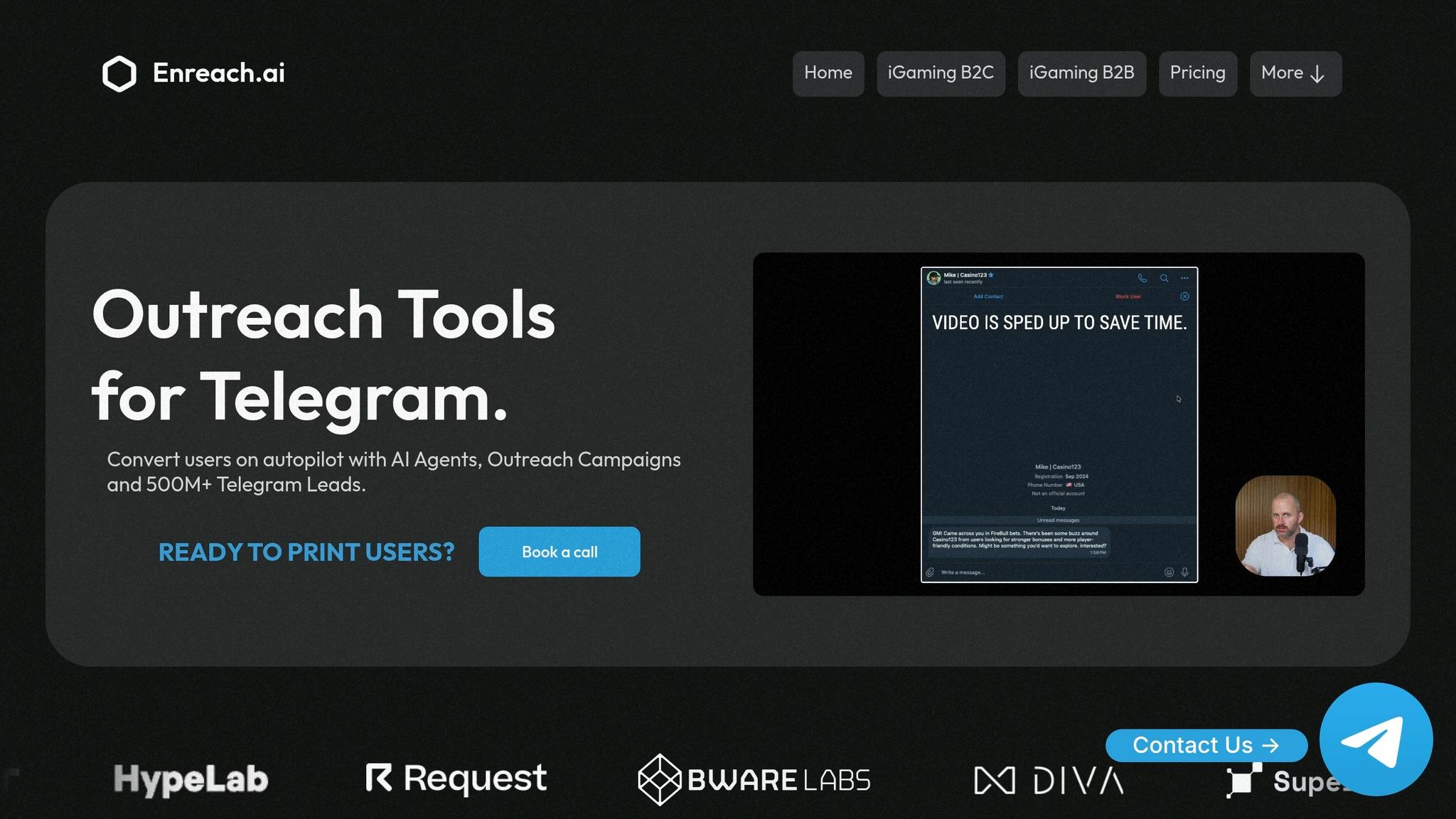
Automation connects segmentation strategies to practical outcomes. Enreach AI Agents handle audience filtering, personalize outreach, and manage campaigns around the clock. This seamless process highlights the platform's advanced capabilities.
Enreach AI Agent Features
Enreach AI Agents go beyond basic demographics to segment Telegram audiences through multi-factor filtering. They categorize users by interests - like slots, lottery, or esports - while also factoring in language preferences, geographic location, and real-time activity levels.
The platform specializes in targeting specific niches within seven iGaming categories: Sports Betting, Casino, Sweepstakes, Lottery, Esports, Bingo, and Fantasy Sports. For instance, if you're launching an esports betting feature, the AI agent taps into a proprietary database of over 500 million Telegram leads to pinpoint users who are into competitive gaming. On top of that, the agents analyze insights from over 30 million conversations, enabling them to mimic natural dialogue and automatically qualify leads and optimize sales.
Filipe from Lucky Bet shared his experience:
"$3.5 avg cost per FTD across tier 1, 2 and 3 markets in the first year"
These AI agents work autonomously, providing 24/7 lead qualification and follow-ups without the need for constant supervision.
Campaign Support from Enreach Specialists
In addition to automation, Enreach offers expert support to maximize campaign performance. A team of sales, data, and outbound specialists manages campaigns for iGaming clients. This team has successfully delivered over 50 million Telegram messages. They handle every aspect of campaigns, from filtering audiences to preventing account blocks during high-volume messaging, while fine-tuning delivery timing and message frequency to maintain high deliverability rates.
By focusing on user activity rather than just demographics, these specialists ensure your outreach reaches engaged Telegram users who are more likely to convert. This expert involvement turns segmentation into a scalable, hands-free process, driving signups and first-time deposits at predictable costs.
Lorenzo, Head of BD, highlighted the impact:
"Enreach makes it easy for our BD team to hit target consistently"
The combination of AI-driven automation and expert campaign support delivers efficient user acquisition through precise, targeted segmentation.
Tracking and Improving Campaign Performance
When it comes to campaign performance, accurate metrics are your best friend. They take the guesswork out of the equation and help you turn raw data into actionable strategies. Knowing which metrics to focus on can help you pinpoint high-performing segments while steering clear of those that drain your budget.
Metrics to Monitor
Start with acquisition metrics to gauge how well your segments engage. Keep an eye on your Click-Through Rate (CTR), registration rates, and Cost per First-Time Deposit (FTD). For Telegram campaigns, a CTR of around 9.8% for mini apps is a standout figure - far above the 0.5-2% average for traditional display ads. Aim for a Cost per FTD of about $3.50 across different market tiers.
Next, look at retention metrics to see if your segmentation holds up over time. Day 7 and Day 30 retention rates are key indicators here. If your Day 7 retention is below 20%, it means users aren’t engaging with your platform right after signing up. On the other hand, if Day 30 retention falls below 10%, it’s a sign that your retention strategies need improvement.
Finally, financial indicators are essential for measuring profitability. Focus on metrics like Return on Ad Spend (ROAS), Net Gaming Revenue (NGR) per active player, and the LTV:CAC ratio (Lifetime Value to Customer Acquisition Cost). For sustainable growth, aim for an LTV:CAC ratio of at least 3:1. Also, keep your marketing expenses between 20-35% of your Gross Gaming Revenue (GGR).
By monitoring these metrics, you can make smarter, faster adjustments to your segmentation strategy.
Refining Your Segmentation Strategy
Improving these metrics means continuously tweaking your segmentation. Use performance data to adjust your approach in real time. For example, A/B test 5-10 creatives per segment to find out which elements - like bonus amounts or time-sensitive offers - yield the highest CTR. Divide your audience into "Motivated" and "Non-Motivated" groups to see who responds better to high-value offers.
Consider adopting dynamic segmentation that evolves based on player behavior. For instance, a casino player may shift to sports betting during a major tournament. Your segmentation should adapt to reflect these changes. Use RFM(D) analysis - Recency, Frequency, Monetary, and Duration - to uncover deeper behavioral patterns.
It’s also important to evaluate segment quality by comparing the Lifetime Value (LTV) of players in each segment against your platform’s average. Use postback tracking to identify and exclude traffic sources that bring in "bonus hunters" instead of genuine players. For reactivation campaigns, reach out 7-14 days after a player’s last activity, as the likelihood of success drops significantly after 30 days.
These ongoing refinements can make your outreach more precise, cut acquisition costs, and drive more signups.
Conclusion
Targeted segmentation takes marketing from broad and generic to precise and impactful. By categorizing players - like high rollers, casual gamers, and bonus seekers - you can tailor offers that genuinely connect with each group. This strategy boosts signup rates and first-time deposits while keeping acquisition costs in check.
The numbers back this up. Personalized betting offers sent through Telegram AI agents see open rates soar past 80%. These results significantly outperform traditional channels, all while maintaining an average first-time deposit (FTD) cost of $3.50. Enreach AI agents, built on insights from over 30,000,000 conversations, make scaling this approach seamless.
The next step? Pair smart segmentation with automation. Dynamic, real-time segmentation ensures offers stay relevant as players shift interests - whether it’s from casino games to sports betting or through various lifecycle stages. Enreach’s solution tackles high acquisition costs and churn by deploying AI agents that qualify leads around the clock, manage multi-step follow-ups, and even handle account volume intelligently to avoid blocks.
FAQs
What segments should I start with for iGaming Telegram campaigns?
When planning your iGaming Telegram campaigns, honing in on specific audience segments can make all the difference in driving engagement and improving conversions. Focus on groups like new players, high-value players, and users with interests in particular areas - such as sports betting or casino games.
To fine-tune your approach, consider criteria like:
User interests: Are they more into slots, poker, or live dealer games? Tailor messages to match their preferences.
Demographics: Age, location, and other demographic factors can help you craft messages that resonate better.
Activity levels: Identify how often users engage with your platform. Are they casual players or frequent bettors?
By aligning your campaigns with these insights, you can create highly relevant content that not only grabs attention but also encourages users to take action.
How do I avoid over-segmentation while still personalizing offers?
When it comes to segmentation, it’s important to strike the right balance. If your segments are too narrow, you risk spreading your efforts too thin and losing the impact of personalization. Instead, aim for groups that are distinct but still broad enough to allow for meaningful targeting. Focus on behaviors and preferences that genuinely matter, ensuring your segments are specific but still engaging.
AI tools, such as those offered by Enreach, can be incredibly helpful here. They can fine-tune your segmentation process, keeping your personalization efforts relevant without overcomplicating or unnecessarily dividing your audience.
What data do I need to build predictive player segments with Enreach AI Agents?
To build predictive player segments with Enreach AI Agents, you'll need specific data points like user interests, language preferences, location, activity levels, and engagement patterns on Telegram. These insights allow you to craft campaigns that are better aligned with player behaviors, making it easier to attract and convert them.
Related Blog Posts
iGaming marketers face two major challenges: high acquisition costs ($150–$500 per user) and a 70% churn rate within 30 days. The solution? Targeted segmentation. By dividing players into specific groups based on habits, preferences, and behaviors, you can send personalized offers that resonate - and reduce costs.
Key takeaways:
Telegram for outreach: Guarantees 100% reach to opt-in users with open rates exceeding 80%.
Segmentation strategies: Group players by behavior (e.g., high rollers vs. casual gamers), lifecycle stage (new signups vs. dormant users), and geography.
AI tools for precision: Platforms like Enreach AI automate segmentation and outreach, cutting first-time deposit costs to $3.50 across global markets.
Example: Lucky Bet reduced acquisition costs by leveraging AI-powered Telegram campaigns, achieving a $3.50 cost per first-time deposit in 2026. Tailored messaging matched player preferences in real time, driving signups and retention.
Targeted segmentation isn’t about sending more messages - it’s about sending the right message to the right player at the right time.
iGaming Segmentation ROI: Key Metrics and Cost Comparisons
What is Targeted Segmentation for Telegram Campaigns?
Defining Targeted Segmentation
Targeted segmentation is all about dividing your player base into smaller groups based on shared traits like play style, spending habits, or betting frequency. Instead of blasting out the same bonus offer to everyone, you tailor messages to fit each group. The idea? Deliver offers that actually resonate with the right players.
Picture it like sorting a deck of cards. The "Aces" are your high rollers - they play more than 20 days a month and spend big. The "Jacks" are your loyal regulars who stick to specific games like slots. The "Jokers"? Younger sports bettors who dabble across different products. And the "Sixes" are casual players who prefer basic casino games and rarely make deposits. Each of these groups reacts differently to incentives, so a one-size-fits-all approach wastes both time and money.
"Player segmentation is a foundation for operators' activities... it's the ultimate moneymaker and money saver." - Ihor Sudak, CRM Operation Team Lead, GR8 Tech
On Telegram, this segmentation gets even sharper. You can filter leads by interests (like Sports Betting, Casino, or Poker), language, location, and activity levels. Using AI and machine learning, these segments can update in real time. For example, if a casino player starts focusing on sports betting during events like March Madness, the system adjusts their category automatically. This kind of real-time precision ensures your offers stay relevant to what players care about most.
Why Telegram Matters for iGaming Outreach
Telegram takes targeted segmentation to the next level by offering unique perks for iGaming campaigns. First off, Telegram messages go straight to opt-in users - no algorithms throttling your reach or emails ending up in spam. This direct delivery leads to open rates of over 80%. Plus, with over 70% of iGaming traffic coming from mobile devices, Telegram's mobile-first design keeps players engaged without requiring them to jump between apps.
The platform also shines with its interactive tools. Features like buttons and Mini Apps let users register or place bets without leaving the chat. For instance, sticky "Start Playing" buttons stay visible throughout the conversation, making it easier for players to act on your offers. Campaigns that use localized creatives - like mentioning "Teen Patti" for Indian players or "Aviator" for Brazilian audiences - see click-through rates jump by 30-50% because the messaging feels personal and relevant.
When you combine Telegram's direct reach with smart segmentation, you’re not just sending out offers - you’re delivering exactly what your players are looking for, right when they want it.
The Market Research Playbook for Conquering the iGaming Industry
Segmentation Strategies That Drive iGaming Signups
Building on the basics of targeted segmentation, refining strategies around player behavior, journey stages, location, and predicted value can significantly improve outreach efforts.
Behavioral Segmentation
Behavioral segmentation focuses on grouping players based on how they interact with your platform. Techniques like RFM(D) analysis - tracking recency, frequency, monetary spend, and duration - help identify meaningful patterns.
On platforms like Telegram, behavioral data becomes even more precise. AI tools analyze messaging habits, bot activity, and response times to deliver highly personalized betting offers. This approach has driven open rates to over 80%. For example, if a player consistently clicks on sports betting links during tournaments but ignores casino promotions, the system prioritizes sports-related offers.
However, over-segmentation can backfire. Stick to proven clusters, such as "Aces" versus "Bonus Hunters", instead of creating an unmanageable number of micro-segments. For instance, "Aces" are players who engage more than 20 days per month. By focusing on this group, you can create exclusive VIP experiences tailored to their preferences. These high-value users often shift between casino games and sports betting during major events, so your segmentation must adapt dynamically.
The next step is aligning your messaging with where the player is in their journey.
Lifecycle Stage Segmentation
The stage of a player's journey determines the best way to convert them. For new signups, immediate onboarding is crucial - a welcome message paired with a 100% deposit match offer often works well. On the other hand, players who register but don’t deposit may need incentives like low-risk bonuses or demo plays to nudge them forward.
In December 2024, an iGaming partner used PropellerAds to launch a Telegram mini-app campaign in Kazakhstan. The campaign followed a clear lifecycle flow: Registration > First-Time Deposit > Retention. By incorporating branded icons and emoji-rich messaging, they achieved a 9.863% click-through rate (CTR) and generated $7,883.64 in revenue with a cost-per-click (CPC) of just $0.06.
Matching the intensity of your outreach to each stage is essential. AI agents can provide 24/7 personalized follow-ups for new leads, helping scale acquisition efforts while keeping costs manageable. For dormant users, re-engagement campaigns tied to major sporting events or exclusive bonuses can bring them back. Ultimately, lifecycle segmentation isn’t just about timing - it’s about delivering the right offer at the exact moment a player is ready to act, which reduces acquisition costs and boosts conversion rates.
Beyond behavior and lifecycle stages, local context and predicted value further enhance targeting.
Geographic and Value-Based Segmentation
Geographic segmentation is about more than just translating content - it’s about aligning promotions with local preferences, customs, and terminology. For instance, in the U.S., you’d market "slots", but in Australia, they’re called "pokies". Tailoring promotions this way can boost CTRs by 30%–50%.
In 2025, a global iGaming company expanded into Latin America using Liftoff's Product Ads. They launched 54 dynamic creatives tailored to specific matches and regions. The results? A 23% increase in incremental conversions on iOS, a 25% lower cost per acquisition (CPA), and a 28% lower cost per install (CPI).
Value-based segmentation adds another layer by prioritizing players with the highest predicted Lifetime Value (pLTV). Using RFM analysis, you can identify high-value players and allocate more resources to acquiring and retaining them. Incorporating local payment options - like UPI in India or e-wallets in Latin America - also builds trust and reduces friction during deposits. Combining geographic precision with value-based targeting minimizes wasted ad spend and maximizes returns by focusing on high-intent players.
AI-Powered Predictive Profiling
AI and machine learning elevate segmentation from reactive to predictive. Instead of waiting for players to reveal their value, predictive profiling uses data to estimate pLTV upfront, enabling proactive engagement with high-value prospects.
For example, Enreach AI agents analyze intent data - such as clicks, sign-ups, and trial plays - to identify high-intent players and initiate automated outreach. These systems work 24/7, delivering personalized betting offers tailored to each player's predicted behavior. In its first year, operator Lucky Bet used Enreach AI agents for Telegram outreach, achieving an average cost of $3.50 per First-Time Deposit across Tier 1, 2, and 3 markets.
"Look-a-like based campaigns can be further optimized by aligning ads creative messaging with the main interests of each player type cohort therefore showing the potential player that the game being advertised appeals to the reasons why they play games." - .Monks, Partner, Databricks
Predictive profiling also identifies risky patterns early. While pinpointing "Aces", the system can simultaneously flag behaviors that may require responsible gaming interventions. This dual focus protects players while keeping acquisition costs low. Telegram outreach, for instance, delivers player acquisitions at 60%–70% lower costs than traditional paid media channels.
How Enreach AI Agents Automate Segmentation
Automation connects segmentation strategies to practical outcomes. Enreach AI Agents handle audience filtering, personalize outreach, and manage campaigns around the clock. This seamless process highlights the platform's advanced capabilities.
Enreach AI Agent Features
Enreach AI Agents go beyond basic demographics to segment Telegram audiences through multi-factor filtering. They categorize users by interests - like slots, lottery, or esports - while also factoring in language preferences, geographic location, and real-time activity levels.
The platform specializes in targeting specific niches within seven iGaming categories: Sports Betting, Casino, Sweepstakes, Lottery, Esports, Bingo, and Fantasy Sports. For instance, if you're launching an esports betting feature, the AI agent taps into a proprietary database of over 500 million Telegram leads to pinpoint users who are into competitive gaming. On top of that, the agents analyze insights from over 30 million conversations, enabling them to mimic natural dialogue and automatically qualify leads and optimize sales.
Filipe from Lucky Bet shared his experience:
"$3.5 avg cost per FTD across tier 1, 2 and 3 markets in the first year"
These AI agents work autonomously, providing 24/7 lead qualification and follow-ups without the need for constant supervision.
Campaign Support from Enreach Specialists
In addition to automation, Enreach offers expert support to maximize campaign performance. A team of sales, data, and outbound specialists manages campaigns for iGaming clients. This team has successfully delivered over 50 million Telegram messages. They handle every aspect of campaigns, from filtering audiences to preventing account blocks during high-volume messaging, while fine-tuning delivery timing and message frequency to maintain high deliverability rates.
By focusing on user activity rather than just demographics, these specialists ensure your outreach reaches engaged Telegram users who are more likely to convert. This expert involvement turns segmentation into a scalable, hands-free process, driving signups and first-time deposits at predictable costs.
Lorenzo, Head of BD, highlighted the impact:
"Enreach makes it easy for our BD team to hit target consistently"
The combination of AI-driven automation and expert campaign support delivers efficient user acquisition through precise, targeted segmentation.
Tracking and Improving Campaign Performance
When it comes to campaign performance, accurate metrics are your best friend. They take the guesswork out of the equation and help you turn raw data into actionable strategies. Knowing which metrics to focus on can help you pinpoint high-performing segments while steering clear of those that drain your budget.
Metrics to Monitor
Start with acquisition metrics to gauge how well your segments engage. Keep an eye on your Click-Through Rate (CTR), registration rates, and Cost per First-Time Deposit (FTD). For Telegram campaigns, a CTR of around 9.8% for mini apps is a standout figure - far above the 0.5-2% average for traditional display ads. Aim for a Cost per FTD of about $3.50 across different market tiers.
Next, look at retention metrics to see if your segmentation holds up over time. Day 7 and Day 30 retention rates are key indicators here. If your Day 7 retention is below 20%, it means users aren’t engaging with your platform right after signing up. On the other hand, if Day 30 retention falls below 10%, it’s a sign that your retention strategies need improvement.
Finally, financial indicators are essential for measuring profitability. Focus on metrics like Return on Ad Spend (ROAS), Net Gaming Revenue (NGR) per active player, and the LTV:CAC ratio (Lifetime Value to Customer Acquisition Cost). For sustainable growth, aim for an LTV:CAC ratio of at least 3:1. Also, keep your marketing expenses between 20-35% of your Gross Gaming Revenue (GGR).
By monitoring these metrics, you can make smarter, faster adjustments to your segmentation strategy.
Refining Your Segmentation Strategy
Improving these metrics means continuously tweaking your segmentation. Use performance data to adjust your approach in real time. For example, A/B test 5-10 creatives per segment to find out which elements - like bonus amounts or time-sensitive offers - yield the highest CTR. Divide your audience into "Motivated" and "Non-Motivated" groups to see who responds better to high-value offers.
Consider adopting dynamic segmentation that evolves based on player behavior. For instance, a casino player may shift to sports betting during a major tournament. Your segmentation should adapt to reflect these changes. Use RFM(D) analysis - Recency, Frequency, Monetary, and Duration - to uncover deeper behavioral patterns.
It’s also important to evaluate segment quality by comparing the Lifetime Value (LTV) of players in each segment against your platform’s average. Use postback tracking to identify and exclude traffic sources that bring in "bonus hunters" instead of genuine players. For reactivation campaigns, reach out 7-14 days after a player’s last activity, as the likelihood of success drops significantly after 30 days.
These ongoing refinements can make your outreach more precise, cut acquisition costs, and drive more signups.
Conclusion
Targeted segmentation takes marketing from broad and generic to precise and impactful. By categorizing players - like high rollers, casual gamers, and bonus seekers - you can tailor offers that genuinely connect with each group. This strategy boosts signup rates and first-time deposits while keeping acquisition costs in check.
The numbers back this up. Personalized betting offers sent through Telegram AI agents see open rates soar past 80%. These results significantly outperform traditional channels, all while maintaining an average first-time deposit (FTD) cost of $3.50. Enreach AI agents, built on insights from over 30,000,000 conversations, make scaling this approach seamless.
The next step? Pair smart segmentation with automation. Dynamic, real-time segmentation ensures offers stay relevant as players shift interests - whether it’s from casino games to sports betting or through various lifecycle stages. Enreach’s solution tackles high acquisition costs and churn by deploying AI agents that qualify leads around the clock, manage multi-step follow-ups, and even handle account volume intelligently to avoid blocks.
FAQs
What segments should I start with for iGaming Telegram campaigns?
When planning your iGaming Telegram campaigns, honing in on specific audience segments can make all the difference in driving engagement and improving conversions. Focus on groups like new players, high-value players, and users with interests in particular areas - such as sports betting or casino games.
To fine-tune your approach, consider criteria like:
User interests: Are they more into slots, poker, or live dealer games? Tailor messages to match their preferences.
Demographics: Age, location, and other demographic factors can help you craft messages that resonate better.
Activity levels: Identify how often users engage with your platform. Are they casual players or frequent bettors?
By aligning your campaigns with these insights, you can create highly relevant content that not only grabs attention but also encourages users to take action.
How do I avoid over-segmentation while still personalizing offers?
When it comes to segmentation, it’s important to strike the right balance. If your segments are too narrow, you risk spreading your efforts too thin and losing the impact of personalization. Instead, aim for groups that are distinct but still broad enough to allow for meaningful targeting. Focus on behaviors and preferences that genuinely matter, ensuring your segments are specific but still engaging.
AI tools, such as those offered by Enreach, can be incredibly helpful here. They can fine-tune your segmentation process, keeping your personalization efforts relevant without overcomplicating or unnecessarily dividing your audience.
What data do I need to build predictive player segments with Enreach AI Agents?
To build predictive player segments with Enreach AI Agents, you'll need specific data points like user interests, language preferences, location, activity levels, and engagement patterns on Telegram. These insights allow you to craft campaigns that are better aligned with player behaviors, making it easier to attract and convert them.
Related Blog Posts

Optimize Your Sales with Enreach.
Optimize Your Sales with Enreach.
Get access to a 500M person Leads Database, Automated Outreach and AI Sales Agents.
Get access to a 500M person Leads Database, Automated Outreach and AI Sales Agents.
More Info