How User Onboarding Impacts FTD Rates
How User Onboarding Impacts FTD Rates
IGaming Marketing
Apr 27, 2026
Apr 27, 2026
Cut onboarding friction, optimize mobile/KYC, and use targeted bonuses and gamification to boost first-time deposits.
Cut onboarding friction, optimize mobile/KYC, and use targeted bonuses and gamification to boost first-time deposits.
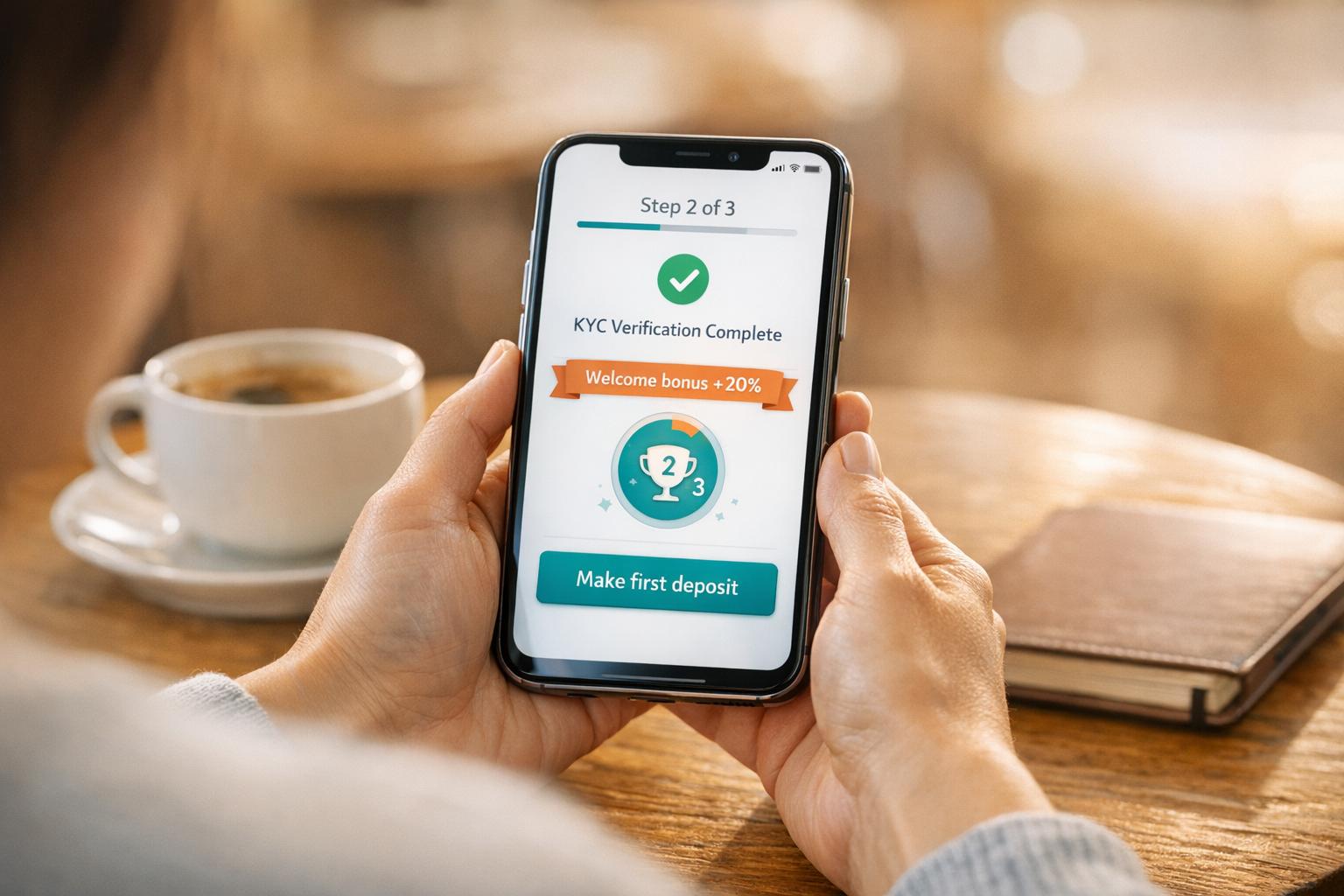
Getting users to sign up is only half the battle. Turning them into paying players - measured by first-time deposits (FTDs) - is where success lies. A smooth onboarding process can directly improve FTD rates by reducing drop-offs and encouraging deposits.
Key insights from the article:
FTD Rates Defined: FTDs represent the first deposit made by a new user. Conversion rates typically range from 3-5%, but top operators achieve 7% or more.
Onboarding Challenges: 60% of new players leave within 24 hours if the process is unclear or frustrating.
Simplified Forms: Short forms (4 fields) boost registration-to-FTD rates by 40-50%. Two-step forms maintain 50-60% completion rates.
Bonuses Matter: Lowering deposit minimums (e.g., to $1) and offering no-wagering or 200%+ deposit bonuses significantly increase FTDs.
Timing is Critical: The first 72 hours after registration are key. Automated, event-triggered messages during this window improve retention.
Mobile Optimization: With 80% of gamblers using smartphones, fast-loading pages, intuitive interfaces, and easy payment options are essential.
Gamification and Personalization: Missions, progress bars, and tailored offers keep users engaged and encourage deposits.
To improve FTD rates, focus on reducing friction, optimizing mobile experiences, and using incentives strategically. A well-designed onboarding process not only increases deposits but also builds long-term player retention.
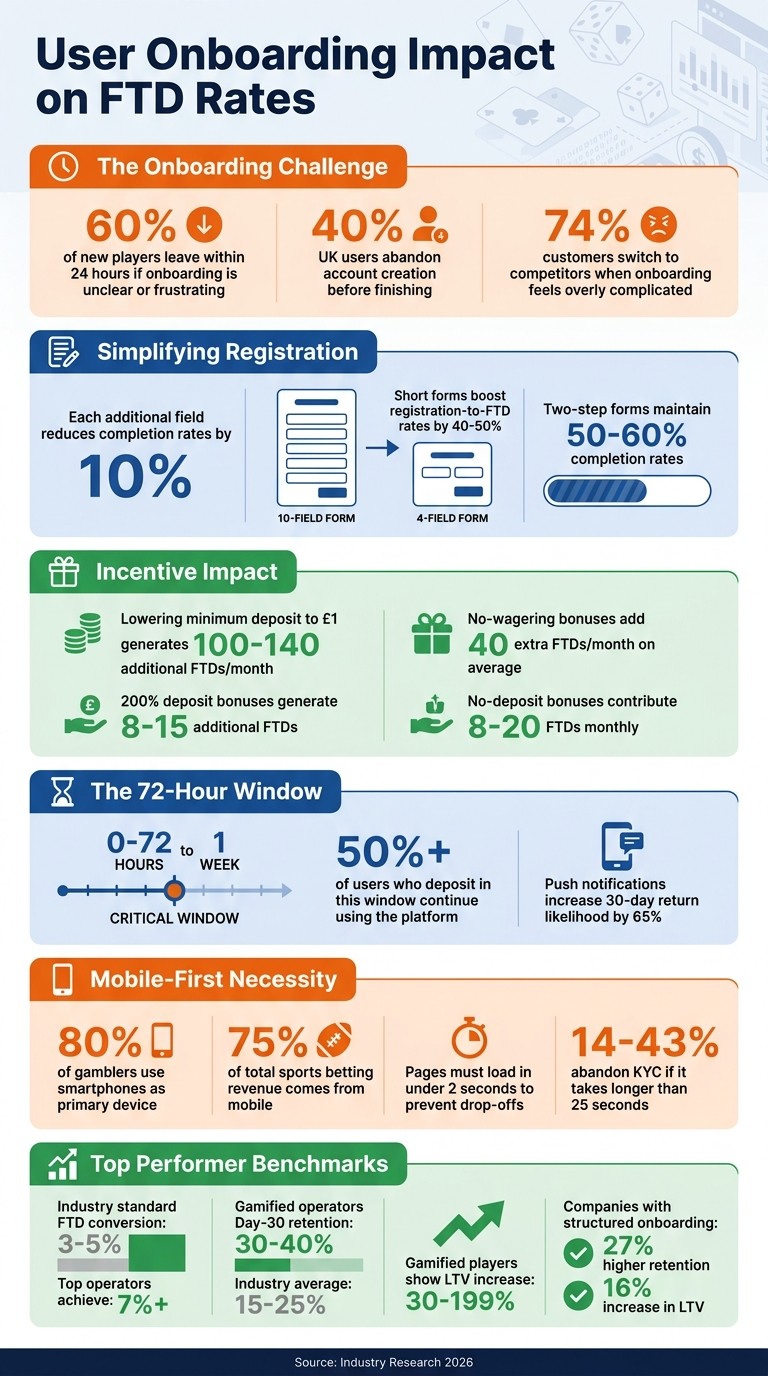
Key Statistics: How User Onboarding Impacts First-Time Deposit Rates
Onboarding Optimization: First-Time User Experience Design | Product Management Tutorial
Research Findings: Onboarding Strategies and FTD Rates
Recent research sheds light on specific strategies that can significantly improve first-time depositor (FTD) conversion rates. The takeaway? Small adjustments in registration processes, incentives, and timing can yield substantial results. Let’s break down what the data reveals about what actually works.
Simplifying Registration and Payment Processes
The numbers don’t lie: every additional field on a registration form reduces completion rates by 10%. Shorter forms - ideally with just four fields - boost registration-to-FTD ratios by an impressive 40–50% compared to forms with ten fields. Slaine Willey from SMSEdge puts it plainly:
"The difference between an operator with a 4-field registration form and one with a 10-field form can mean a 40-50% swing in your registration-to-FTD ratio."
Two-step registration forms also perform better than lengthy single-page forms, maintaining 50-60% completion rates. However, the challenge remains: 40% of UK users abandon account creation before finishing. The solution? Smarter routing and mobile-friendly design. Deep links that direct users straight to registration or bonus claim pages, instead of generic homepages, significantly reduce drop-offs.
But streamlining forms is only half the battle - targeted bonuses can take FTD rates even further.
The Impact of Bonuses and Incentives
A game-changing study by Bojoko CEO Joonas Karhu in April 2026 revealed that lowering minimum deposit limits to just £1 can generate 100-140 additional FTDs per month. Even modest reductions, like a £3 minimum, added 10-20 FTDs monthly, while a £5 threshold still brought in 3-8 FTDs. As Karhu explained:
"One of the most effective strategies to increase FTD numbers is simply to lower the deposit limits."
Another standout? No-wagering bonuses, which delivered an average of 40 extra FTDs per month. These bonuses succeed by removing the complexities that make players hesitate. Similarly, no-deposit bonuses, though less impactful, still added 8-20 FTDs monthly. Operators offering 200% deposit bonuses (instead of the standard 100%) saw 8-15 additional FTDs, while 500% bonuses achieved exceptional results. Even niche payment options like ApplePay and PayByPhone contributed 10-15 extra FTDs monthly by catering to specific user preferences.
While bonuses attract deposits, timing plays a critical role in sealing the deal.
Time-to-FTD Metrics
Timing is everything when it comes to converting new users. The first 72 hours to one week after registration is the crucial window for securing deposits. According to TrueLayer, if a user completes signup and makes their first deposit during this period, over 50% are likely to continue using the platform. However, inactivity within the first three days signals trouble - players who don’t log in quickly start drifting away.
Automated, event-triggered messages during this window outperform generic campaigns. Push notifications, for example, increase the likelihood of users returning within 30 days by 65%, though engagement rates remain modest at 4.6% on Android and 3.4% on iOS. The key is striking a balance: overloading users with bonus-focused messages can train them to wait for offers instead of engaging naturally. Moreover, platforms that fail to offer instant withdrawals risk losing up to 50% of potential users. Fast payment processing is just as critical as creating a seamless deposit experience.
Improving Mobile UX and KYC for Better FTD Rates
With most users now betting through their smartphones, mobile optimization isn't just a nice-to-have - it's a necessity. Mobile sports betting generates 75% of total sports betting revenue globally. Yet, despite this dominance, up to 60% of new players drop off within the first 24 hours. The main culprits? Poor mobile interfaces and clunky verification processes that break the user flow.
Mobile UX Best Practices
A well-optimized mobile experience can directly address this early player churn. Speed is critical - if your pages take longer than 2 seconds to load, users are likely to jump ship to competitors. But speed alone isn't enough. It's about tailoring the experience for mobile users' habits.
Sticky buttons: Placing "Claim Bonus" buttons within easy thumb reach keeps actions simple and intuitive.
Optimized visuals: Comparison tables designed for a 375px mobile width ensure everything looks clean and functional on smaller screens.
Deep links: These take users straight to mobile-friendly conversion points, cutting down on unnecessary navigation.
Some operators are taking things a step further. Superbet, for instance, introduced personalized video onboarding to engage new players. Andrei Popa, VP Online at Superbet, shared:
"The uplift in positive sentiment and motivation is fueling longer player lifecycles and higher retention rates. Seen.io has redefined our engagement strategy and personalized video is now a cornerstone of how we build loyalty."
Streamlining KYC Processes
Even with the smoothest mobile experience, a clunky Know Your Customer (KYC) process can derail everything. Identity verification is often where operators lose players - between 14% and 43% abandon the process, especially if it takes longer than 25 seconds. Players are unlikely to wait more than 10 minutes.
The solution? Automation and smarter data collection. Here's how some operators are solving this:
Progressive KYC: Stake introduced a four-level KYC structure in 2026. Features like birthday bonuses unlock as players advance through verification levels.
Automated tools: Technologies like OCR (Optical Character Recognition) extract data from ID photos, while 3D face mapping completes liveness checks in under 10 seconds.
Real-time feedback: If a document photo is blurry, the system notifies users immediately so they can fix it on the spot, instead of receiving a vague "verification failed" message hours later.
Open banking integration: This allows for one-click verification of identity, age, and account ownership without requiring manual uploads.
Using Gamification and Personalization in Onboarding
Once a seamless mobile experience and efficient KYC process are in place, the next step is to elevate the onboarding journey. Making onboarding engaging can significantly improve FTD (First-Time Deposit) rates. By combining gamification with personalization, operators can keep players hooked during those crucial first hours.
Gamified Onboarding Flows
Gamification taps into the Zeigarnik Effect, which drives users to complete unfinished tasks. By incorporating elements like progress bars, missions, or checklists tied to financial incentives (e.g., making a first deposit), players feel motivated to “close the loop”.
The data backs it up. Top-performing gamified iGaming operators see Day-30 retention rates of 30–40%, compared to the industry average of 15–25%. Additionally, gamified players show an LTV (Lifetime Value) increase ranging from 30% to an impressive 199%. A standout example is Funstage. By using the Xtremepush platform to unify loyalty and CRM systems, they introduced real-time reward triggers and saw a 199.4% boost in customer LTV, eliminating delays caused by overnight batch syncing.
Timing is everything. Charlie Mather from Xtremepush explains:
"When your player makes their first deposit and waits 24 hours for a welcome bonus, you lose Day-1 retention to a process problem, not a product problem."
Mission-based onboarding strategies, like “Bet on 3 markets tonight,” encourage immediate engagement and deposits. Players in gamified environments complete 6–10 missions per month, compared to just 2–4 for the average player. Streak mechanics, such as “Place a bet for 3 consecutive days,” also foster daily habits and act as deposit triggers without requiring costly bonuses.
While gamification ensures consistent engagement, personalization fine-tunes the experience based on individual preferences.
Personalized Offers and Communication
Personalization builds on gamification by creating experiences tailored to each player’s behavior. In 2026, 77% of banking and fintech leaders attributed improved user retention to hyper-personalization. For iGaming, this means using player data to deliver timely, relevant offers.
Take Moven, a fintech app, as an example. By sending personalized notifications that encouraged users to save or deposit at the right moments, they saw a 50% increase in desired financial actions, according to CEO Brett King. Similarly, in iGaming, if a player shows interest in live betting but hasn’t deposited, a well-timed notification offering a live-betting bonus could reduce drop-offs.
Personalization can start early. Surveys during sign-up allow players to share their motivations, enabling operators to tailor the onboarding experience and boost monetization. This is especially important for Gen Z users, 81% of whom will abandon a brand after just two or three poor digital interactions. Moreover, 40% of younger users would switch platforms for better-tailored rewards.
AI tools make personalization scalable. Platforms like Enreach (https://enreach.ai) use AI-driven analytics and automated outreach (e.g., via Telegram) to deliver contextually relevant messages. By analyzing player behavior in real time, these tools send nudges at the perfect moment to encourage deposits.
Here’s the challenge: 27% of players leave platforms due to friction in deposits, withdrawals, or rewards. By combining gamification with personalization, the onboarding process feels intuitive, rewarding, and tailored to individual needs - directly boosting first-time deposit conversion rates.
Best Practices for Maximizing FTD Conversion Rates
With gamification and personalization in place, implementing proven strategies can significantly boost first-time deposit (FTD) conversions. Consider this: 74% of customers switch to competitors when onboarding feels overly complicated, while companies with structured onboarding processes enjoy 27% higher retention rates and a 16% increase in lifetime value. These methods work together to eliminate obstacles and guide users seamlessly toward making their first deposit.
Reducing Friction in Onboarding
Excessive friction during onboarding can derail conversions. Every extra step between sign-up and deposit risks losing potential customers. Internal misalignments between marketing, sales, and product teams often exacerbate this problem. The fix? Streamline the process. Use a "Confirm, Don't Ask" approach - present users with pre-filled data for verification instead of requesting the same information again. This keeps the process smooth and reduces drop-off rates.
Take Chime, a digital banking app, as an example. In 2025, they introduced an "Onboarding Health Score" to monitor completion rates and pinpoint where users were dropping off. By simplifying complex steps and incorporating targeted guidance based on heatmap analysis, they achieved a 28% lift in account activations. Similarly, Wave, an accounting software, asked users a single question - "What would you like to do in Wave?" - to segment them and tailor their experience. This included features like automatically customizing invoice templates using uploaded brand colors. While these examples come from banking and accounting, the principles apply just as well to iGaming, where smooth onboarding is crucial for FTD success.
Interestingly, not all friction is bad. "Good" friction can actually enhance conversions when it adds value, personalizes the experience, or creates a sense of accomplishment. As Ramli John, founder of Delight Path, puts it:
"If you say onboarding is 100 steps but it's going to make your life so much easier and save you this much time, then I'm like, 'Heck yeah, let me get through those tasks as quickly as possible.'"
Using AI Agents for Automated Outreach
Reducing friction is only part of the equation. Automation can take FTD conversions even further. While email marketing typically sees click-through rates of 2–3%, direct messaging on platforms like Telegram can achieve rates as high as 18–35%. This has led many iGaming operators to adopt AI-driven outreach on platforms where users are already active.
For instance, Enreach (https://enreach.ai) uses AI Agents on Telegram to automate follow-ups and re-engage users who haven’t made their first deposit. With over 50 million Telegram messages managed, clients report an average cost per FTD of just $3.50 across Tier 1, 2, and 3 markets. Filipe from Lucky Bet achieved this cost per FTD in his first year by leveraging Enreach's AI-powered marketing tools.
These AI Agents simulate human-like conversations at scale, targeting users based on interests like sports betting or casino games. Lorenzo, Head of BD, shared:
"Enreach makes it easy for our BD team to hit target consistently."
The platform offers a comprehensive package: an outreach tool starting at $250/month, AI Agents priced at $400/month for 5,000 messages, and pre-warmed Telegram accounts capable of sending 20 cold messages daily. To reach 60,000 users monthly, operators would need 100 accounts, available in bulk for $35 each.
Incentivizing Deposits with Targeted Campaigns
Streamlined onboarding and automated messaging are powerful, but targeted incentives can seal the deal. Timing and relevance often matter more than the size of the bonus. Event-triggered offers, such as deposit match bonuses timed around major sporting events or small trial rewards like "$20 free", create urgency and drive deposits. While a standard 100% deposit match up to $500 remains effective, how the offer is delivered makes all the difference. SMS and direct messaging, with open rates of 90–98%, outperform email dramatically. Sending messages 2–4 hours before major sporting events can align perfectly with peak user intent.
Consistency is key. If affiliate content promises a specific bonus, the landing page must deliver precisely that offer to maintain trust and boost conversions. Using deep links to direct users straight to the registration or bonus claim page (instead of a generic homepage) can reduce the number of steps needed to reach an FTD.
Duolingo offers a great example of how immediate rewards can work. By introducing achievement badges and celebrating "micro-wins" for completing the first steps of a language course, they saw a 24% increase in day-one retention and made users 18% more likely to finish their first week. For iGaming, similar tactics - like instant bonus credits or gamified progress bars that celebrate each step toward the first deposit - can effectively drive conversions.
Conclusion
Onboarding isn't just about getting users to sign up - it's the gateway to turning visitors into depositing players. Up to 60% of new players drop off within the first 24 hours if the onboarding process falls short. That means the initial experience is critical for success.
To boost first-time deposit (FTD) rates, the key is removing obstacles at every stage of the process. With nearly 80% of online gamblers relying on smartphones as their primary device, designing with mobile users in mind is no longer optional. Features like fast-loading pages, real-time field validation, and social login options help keep users moving forward without frustration.
But it’s not just about the technical details. Personalization and strategic guidance can transform onboarding into a smooth and engaging experience. Tailored incentives and relevant messaging encourage players to complete their journey without unnecessary detours.
When streamlined processes work hand-in-hand with personalized interaction, the results can be game-changing. A seamless onboarding experience doesn’t just increase FTD rates - it sets the stage for stronger retention and higher lifetime value. Operators who incorporate real-time interventions can achieve click-to-FTD conversion rates of 3–5%, with top performers reaching 7% or more. By refining the onboarding process, casinos not only see immediate gains but also build a foundation for ongoing player loyalty and engagement.
FAQs
What’s the fastest way to find where users drop off before their first deposit?
To pinpoint where users abandon the process before making their first deposit, break down the onboarding funnel step by step. Pay close attention to critical stages like account creation, verification, and initial engagement. These are often where users encounter obstacles.
Consider using tools like session replays or user surveys at these key stages. They can reveal specific points of friction and provide actionable insights to refine the experience. Visualizing this data - through charts or heatmaps - can make it easier to identify problem areas and prioritize fixes efficiently.
How should I balance KYC requirements with a low-friction onboarding flow?
To meet KYC requirements without frustrating users, it's all about keeping things simple and intuitive. Start by designing straightforward verification steps that don’t feel like a hassle. Avoid overloading users with too many forms or requests all at once - this can quickly lead to drop-offs.
Instead, guide players through the process with clear instructions and a step-by-step approach. The goal is to ensure compliance while making the experience feel seamless and easy for users. A little clarity and simplicity go a long way in keeping the onboarding flow smooth.
Which onboarding messages matter most in the first 72 hours after signup?
The first 72 hours are crucial for onboarding. The most effective messages during this period offer clear guidance, timely prompts, and personalized nudges. These elements work together to keep players engaged, minimize drop-offs, and establish trust right from the start. The key is to provide support that feels helpful without overwhelming users, setting the stage for a smooth and engaging experience.
Related Blog Posts
Getting users to sign up is only half the battle. Turning them into paying players - measured by first-time deposits (FTDs) - is where success lies. A smooth onboarding process can directly improve FTD rates by reducing drop-offs and encouraging deposits.
Key insights from the article:
FTD Rates Defined: FTDs represent the first deposit made by a new user. Conversion rates typically range from 3-5%, but top operators achieve 7% or more.
Onboarding Challenges: 60% of new players leave within 24 hours if the process is unclear or frustrating.
Simplified Forms: Short forms (4 fields) boost registration-to-FTD rates by 40-50%. Two-step forms maintain 50-60% completion rates.
Bonuses Matter: Lowering deposit minimums (e.g., to $1) and offering no-wagering or 200%+ deposit bonuses significantly increase FTDs.
Timing is Critical: The first 72 hours after registration are key. Automated, event-triggered messages during this window improve retention.
Mobile Optimization: With 80% of gamblers using smartphones, fast-loading pages, intuitive interfaces, and easy payment options are essential.
Gamification and Personalization: Missions, progress bars, and tailored offers keep users engaged and encourage deposits.
To improve FTD rates, focus on reducing friction, optimizing mobile experiences, and using incentives strategically. A well-designed onboarding process not only increases deposits but also builds long-term player retention.
Key Statistics: How User Onboarding Impacts First-Time Deposit Rates
Onboarding Optimization: First-Time User Experience Design | Product Management Tutorial
Research Findings: Onboarding Strategies and FTD Rates
Recent research sheds light on specific strategies that can significantly improve first-time depositor (FTD) conversion rates. The takeaway? Small adjustments in registration processes, incentives, and timing can yield substantial results. Let’s break down what the data reveals about what actually works.
Simplifying Registration and Payment Processes
The numbers don’t lie: every additional field on a registration form reduces completion rates by 10%. Shorter forms - ideally with just four fields - boost registration-to-FTD ratios by an impressive 40–50% compared to forms with ten fields. Slaine Willey from SMSEdge puts it plainly:
"The difference between an operator with a 4-field registration form and one with a 10-field form can mean a 40-50% swing in your registration-to-FTD ratio."
Two-step registration forms also perform better than lengthy single-page forms, maintaining 50-60% completion rates. However, the challenge remains: 40% of UK users abandon account creation before finishing. The solution? Smarter routing and mobile-friendly design. Deep links that direct users straight to registration or bonus claim pages, instead of generic homepages, significantly reduce drop-offs.
But streamlining forms is only half the battle - targeted bonuses can take FTD rates even further.
The Impact of Bonuses and Incentives
A game-changing study by Bojoko CEO Joonas Karhu in April 2026 revealed that lowering minimum deposit limits to just £1 can generate 100-140 additional FTDs per month. Even modest reductions, like a £3 minimum, added 10-20 FTDs monthly, while a £5 threshold still brought in 3-8 FTDs. As Karhu explained:
"One of the most effective strategies to increase FTD numbers is simply to lower the deposit limits."
Another standout? No-wagering bonuses, which delivered an average of 40 extra FTDs per month. These bonuses succeed by removing the complexities that make players hesitate. Similarly, no-deposit bonuses, though less impactful, still added 8-20 FTDs monthly. Operators offering 200% deposit bonuses (instead of the standard 100%) saw 8-15 additional FTDs, while 500% bonuses achieved exceptional results. Even niche payment options like ApplePay and PayByPhone contributed 10-15 extra FTDs monthly by catering to specific user preferences.
While bonuses attract deposits, timing plays a critical role in sealing the deal.
Time-to-FTD Metrics
Timing is everything when it comes to converting new users. The first 72 hours to one week after registration is the crucial window for securing deposits. According to TrueLayer, if a user completes signup and makes their first deposit during this period, over 50% are likely to continue using the platform. However, inactivity within the first three days signals trouble - players who don’t log in quickly start drifting away.
Automated, event-triggered messages during this window outperform generic campaigns. Push notifications, for example, increase the likelihood of users returning within 30 days by 65%, though engagement rates remain modest at 4.6% on Android and 3.4% on iOS. The key is striking a balance: overloading users with bonus-focused messages can train them to wait for offers instead of engaging naturally. Moreover, platforms that fail to offer instant withdrawals risk losing up to 50% of potential users. Fast payment processing is just as critical as creating a seamless deposit experience.
Improving Mobile UX and KYC for Better FTD Rates
With most users now betting through their smartphones, mobile optimization isn't just a nice-to-have - it's a necessity. Mobile sports betting generates 75% of total sports betting revenue globally. Yet, despite this dominance, up to 60% of new players drop off within the first 24 hours. The main culprits? Poor mobile interfaces and clunky verification processes that break the user flow.
Mobile UX Best Practices
A well-optimized mobile experience can directly address this early player churn. Speed is critical - if your pages take longer than 2 seconds to load, users are likely to jump ship to competitors. But speed alone isn't enough. It's about tailoring the experience for mobile users' habits.
Sticky buttons: Placing "Claim Bonus" buttons within easy thumb reach keeps actions simple and intuitive.
Optimized visuals: Comparison tables designed for a 375px mobile width ensure everything looks clean and functional on smaller screens.
Deep links: These take users straight to mobile-friendly conversion points, cutting down on unnecessary navigation.
Some operators are taking things a step further. Superbet, for instance, introduced personalized video onboarding to engage new players. Andrei Popa, VP Online at Superbet, shared:
"The uplift in positive sentiment and motivation is fueling longer player lifecycles and higher retention rates. Seen.io has redefined our engagement strategy and personalized video is now a cornerstone of how we build loyalty."
Streamlining KYC Processes
Even with the smoothest mobile experience, a clunky Know Your Customer (KYC) process can derail everything. Identity verification is often where operators lose players - between 14% and 43% abandon the process, especially if it takes longer than 25 seconds. Players are unlikely to wait more than 10 minutes.
The solution? Automation and smarter data collection. Here's how some operators are solving this:
Progressive KYC: Stake introduced a four-level KYC structure in 2026. Features like birthday bonuses unlock as players advance through verification levels.
Automated tools: Technologies like OCR (Optical Character Recognition) extract data from ID photos, while 3D face mapping completes liveness checks in under 10 seconds.
Real-time feedback: If a document photo is blurry, the system notifies users immediately so they can fix it on the spot, instead of receiving a vague "verification failed" message hours later.
Open banking integration: This allows for one-click verification of identity, age, and account ownership without requiring manual uploads.
Using Gamification and Personalization in Onboarding
Once a seamless mobile experience and efficient KYC process are in place, the next step is to elevate the onboarding journey. Making onboarding engaging can significantly improve FTD (First-Time Deposit) rates. By combining gamification with personalization, operators can keep players hooked during those crucial first hours.
Gamified Onboarding Flows
Gamification taps into the Zeigarnik Effect, which drives users to complete unfinished tasks. By incorporating elements like progress bars, missions, or checklists tied to financial incentives (e.g., making a first deposit), players feel motivated to “close the loop”.
The data backs it up. Top-performing gamified iGaming operators see Day-30 retention rates of 30–40%, compared to the industry average of 15–25%. Additionally, gamified players show an LTV (Lifetime Value) increase ranging from 30% to an impressive 199%. A standout example is Funstage. By using the Xtremepush platform to unify loyalty and CRM systems, they introduced real-time reward triggers and saw a 199.4% boost in customer LTV, eliminating delays caused by overnight batch syncing.
Timing is everything. Charlie Mather from Xtremepush explains:
"When your player makes their first deposit and waits 24 hours for a welcome bonus, you lose Day-1 retention to a process problem, not a product problem."
Mission-based onboarding strategies, like “Bet on 3 markets tonight,” encourage immediate engagement and deposits. Players in gamified environments complete 6–10 missions per month, compared to just 2–4 for the average player. Streak mechanics, such as “Place a bet for 3 consecutive days,” also foster daily habits and act as deposit triggers without requiring costly bonuses.
While gamification ensures consistent engagement, personalization fine-tunes the experience based on individual preferences.
Personalized Offers and Communication
Personalization builds on gamification by creating experiences tailored to each player’s behavior. In 2026, 77% of banking and fintech leaders attributed improved user retention to hyper-personalization. For iGaming, this means using player data to deliver timely, relevant offers.
Take Moven, a fintech app, as an example. By sending personalized notifications that encouraged users to save or deposit at the right moments, they saw a 50% increase in desired financial actions, according to CEO Brett King. Similarly, in iGaming, if a player shows interest in live betting but hasn’t deposited, a well-timed notification offering a live-betting bonus could reduce drop-offs.
Personalization can start early. Surveys during sign-up allow players to share their motivations, enabling operators to tailor the onboarding experience and boost monetization. This is especially important for Gen Z users, 81% of whom will abandon a brand after just two or three poor digital interactions. Moreover, 40% of younger users would switch platforms for better-tailored rewards.
AI tools make personalization scalable. Platforms like Enreach (https://enreach.ai) use AI-driven analytics and automated outreach (e.g., via Telegram) to deliver contextually relevant messages. By analyzing player behavior in real time, these tools send nudges at the perfect moment to encourage deposits.
Here’s the challenge: 27% of players leave platforms due to friction in deposits, withdrawals, or rewards. By combining gamification with personalization, the onboarding process feels intuitive, rewarding, and tailored to individual needs - directly boosting first-time deposit conversion rates.
Best Practices for Maximizing FTD Conversion Rates
With gamification and personalization in place, implementing proven strategies can significantly boost first-time deposit (FTD) conversions. Consider this: 74% of customers switch to competitors when onboarding feels overly complicated, while companies with structured onboarding processes enjoy 27% higher retention rates and a 16% increase in lifetime value. These methods work together to eliminate obstacles and guide users seamlessly toward making their first deposit.
Reducing Friction in Onboarding
Excessive friction during onboarding can derail conversions. Every extra step between sign-up and deposit risks losing potential customers. Internal misalignments between marketing, sales, and product teams often exacerbate this problem. The fix? Streamline the process. Use a "Confirm, Don't Ask" approach - present users with pre-filled data for verification instead of requesting the same information again. This keeps the process smooth and reduces drop-off rates.
Take Chime, a digital banking app, as an example. In 2025, they introduced an "Onboarding Health Score" to monitor completion rates and pinpoint where users were dropping off. By simplifying complex steps and incorporating targeted guidance based on heatmap analysis, they achieved a 28% lift in account activations. Similarly, Wave, an accounting software, asked users a single question - "What would you like to do in Wave?" - to segment them and tailor their experience. This included features like automatically customizing invoice templates using uploaded brand colors. While these examples come from banking and accounting, the principles apply just as well to iGaming, where smooth onboarding is crucial for FTD success.
Interestingly, not all friction is bad. "Good" friction can actually enhance conversions when it adds value, personalizes the experience, or creates a sense of accomplishment. As Ramli John, founder of Delight Path, puts it:
"If you say onboarding is 100 steps but it's going to make your life so much easier and save you this much time, then I'm like, 'Heck yeah, let me get through those tasks as quickly as possible.'"
Using AI Agents for Automated Outreach
Reducing friction is only part of the equation. Automation can take FTD conversions even further. While email marketing typically sees click-through rates of 2–3%, direct messaging on platforms like Telegram can achieve rates as high as 18–35%. This has led many iGaming operators to adopt AI-driven outreach on platforms where users are already active.
For instance, Enreach (https://enreach.ai) uses AI Agents on Telegram to automate follow-ups and re-engage users who haven’t made their first deposit. With over 50 million Telegram messages managed, clients report an average cost per FTD of just $3.50 across Tier 1, 2, and 3 markets. Filipe from Lucky Bet achieved this cost per FTD in his first year by leveraging Enreach's AI-powered marketing tools.
These AI Agents simulate human-like conversations at scale, targeting users based on interests like sports betting or casino games. Lorenzo, Head of BD, shared:
"Enreach makes it easy for our BD team to hit target consistently."
The platform offers a comprehensive package: an outreach tool starting at $250/month, AI Agents priced at $400/month for 5,000 messages, and pre-warmed Telegram accounts capable of sending 20 cold messages daily. To reach 60,000 users monthly, operators would need 100 accounts, available in bulk for $35 each.
Incentivizing Deposits with Targeted Campaigns
Streamlined onboarding and automated messaging are powerful, but targeted incentives can seal the deal. Timing and relevance often matter more than the size of the bonus. Event-triggered offers, such as deposit match bonuses timed around major sporting events or small trial rewards like "$20 free", create urgency and drive deposits. While a standard 100% deposit match up to $500 remains effective, how the offer is delivered makes all the difference. SMS and direct messaging, with open rates of 90–98%, outperform email dramatically. Sending messages 2–4 hours before major sporting events can align perfectly with peak user intent.
Consistency is key. If affiliate content promises a specific bonus, the landing page must deliver precisely that offer to maintain trust and boost conversions. Using deep links to direct users straight to the registration or bonus claim page (instead of a generic homepage) can reduce the number of steps needed to reach an FTD.
Duolingo offers a great example of how immediate rewards can work. By introducing achievement badges and celebrating "micro-wins" for completing the first steps of a language course, they saw a 24% increase in day-one retention and made users 18% more likely to finish their first week. For iGaming, similar tactics - like instant bonus credits or gamified progress bars that celebrate each step toward the first deposit - can effectively drive conversions.
Conclusion
Onboarding isn't just about getting users to sign up - it's the gateway to turning visitors into depositing players. Up to 60% of new players drop off within the first 24 hours if the onboarding process falls short. That means the initial experience is critical for success.
To boost first-time deposit (FTD) rates, the key is removing obstacles at every stage of the process. With nearly 80% of online gamblers relying on smartphones as their primary device, designing with mobile users in mind is no longer optional. Features like fast-loading pages, real-time field validation, and social login options help keep users moving forward without frustration.
But it’s not just about the technical details. Personalization and strategic guidance can transform onboarding into a smooth and engaging experience. Tailored incentives and relevant messaging encourage players to complete their journey without unnecessary detours.
When streamlined processes work hand-in-hand with personalized interaction, the results can be game-changing. A seamless onboarding experience doesn’t just increase FTD rates - it sets the stage for stronger retention and higher lifetime value. Operators who incorporate real-time interventions can achieve click-to-FTD conversion rates of 3–5%, with top performers reaching 7% or more. By refining the onboarding process, casinos not only see immediate gains but also build a foundation for ongoing player loyalty and engagement.
FAQs
What’s the fastest way to find where users drop off before their first deposit?
To pinpoint where users abandon the process before making their first deposit, break down the onboarding funnel step by step. Pay close attention to critical stages like account creation, verification, and initial engagement. These are often where users encounter obstacles.
Consider using tools like session replays or user surveys at these key stages. They can reveal specific points of friction and provide actionable insights to refine the experience. Visualizing this data - through charts or heatmaps - can make it easier to identify problem areas and prioritize fixes efficiently.
How should I balance KYC requirements with a low-friction onboarding flow?
To meet KYC requirements without frustrating users, it's all about keeping things simple and intuitive. Start by designing straightforward verification steps that don’t feel like a hassle. Avoid overloading users with too many forms or requests all at once - this can quickly lead to drop-offs.
Instead, guide players through the process with clear instructions and a step-by-step approach. The goal is to ensure compliance while making the experience feel seamless and easy for users. A little clarity and simplicity go a long way in keeping the onboarding flow smooth.
Which onboarding messages matter most in the first 72 hours after signup?
The first 72 hours are crucial for onboarding. The most effective messages during this period offer clear guidance, timely prompts, and personalized nudges. These elements work together to keep players engaged, minimize drop-offs, and establish trust right from the start. The key is to provide support that feels helpful without overwhelming users, setting the stage for a smooth and engaging experience.
Related Blog Posts

Optimize Your Sales with Enreach.
Optimize Your Sales with Enreach.
Get access to a 500M person Leads Database, Automated Outreach and AI Sales Agents.
Get access to a 500M person Leads Database, Automated Outreach and AI Sales Agents.
More Info