How Gamified Tutorials Boost iGaming Sign-Ups
How Gamified Tutorials Boost iGaming Sign-Ups
IGaming Marketing
May 9, 2026
May 9, 2026
Convert onboarding into short missions with progress bars, rewards and Telegram AI flows to boost conversions, retention and deposits.
Convert onboarding into short missions with progress bars, rewards and Telegram AI flows to boost conversions, retention and deposits.
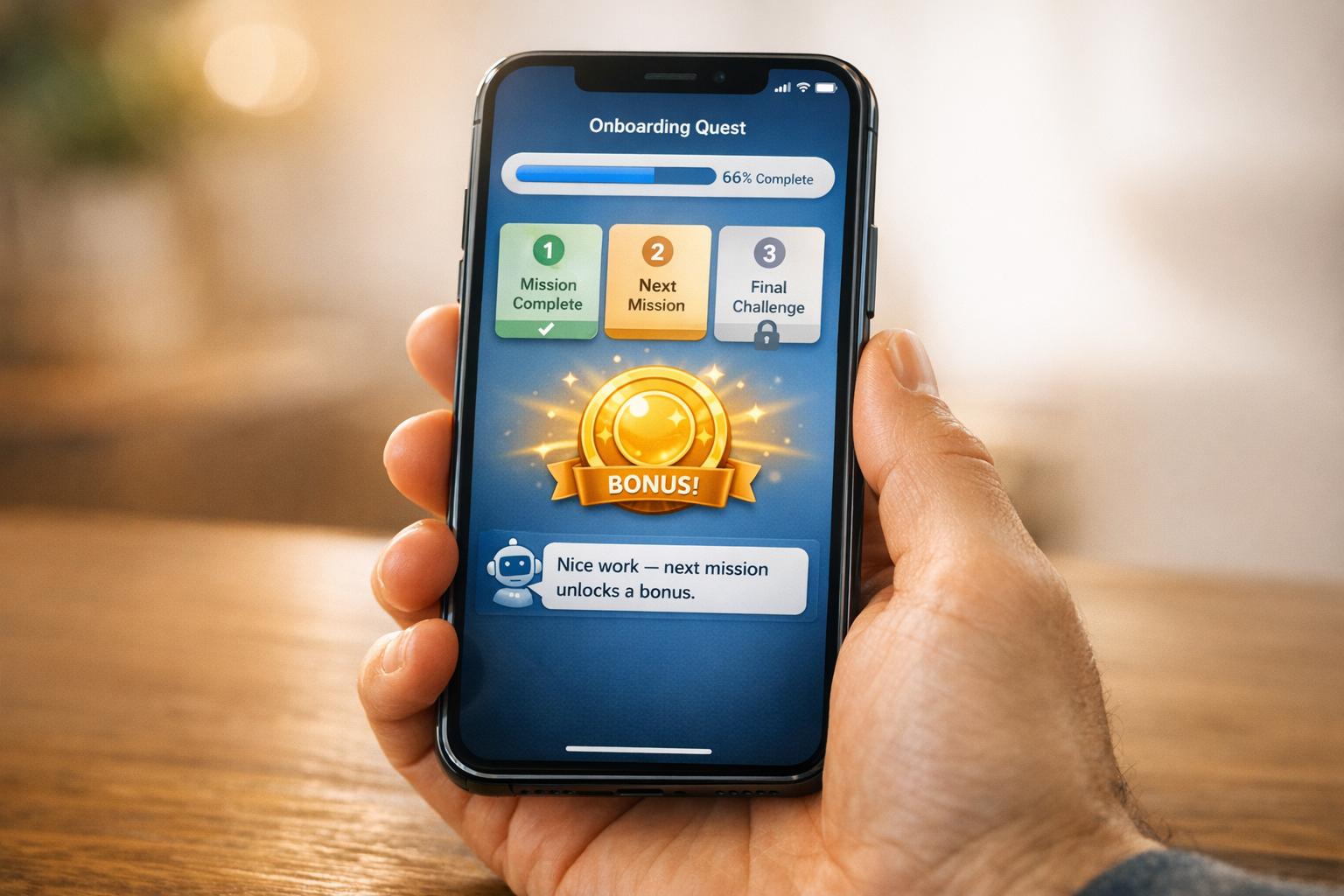
Gamified tutorials are changing how iGaming platforms attract and keep users. Here's why they work:
New Player Retention: 60% of new players leave within 24 hours. Gamified onboarding helps keep them engaged by turning registration into a fun, interactive process.
Lower Costs: Acquiring a single player costs over $800, contributing to a significant client acquisition crunch. Gamification reduces this by simplifying sign-ups and improving completion rates.
Better Engagement: Platforms using gamified tutorials see up to 15% conversion rates (compared to 3–5% for traditional methods) and higher retention, with Day-30 retention rates hitting 30–40%.
Psychological Triggers: Features like progress bars, checklists, and rewards motivate users to complete tasks, leveraging principles like the "Zeigarnik Effect."
Faster Deposits: Gamified systems guide users from sign-up to their first deposit quickly, boosting revenue potential.
Gamification transforms the onboarding process into an engaging journey, making it easier for players to sign up, stay, and start betting. Platforms that focus on user-friendly, interactive tutorials are seeing better results in a highly competitive market.
Common Onboarding Problems in iGaming
Users Abandoning the Sign-Up Process
Traditional registration forms often disrupt the flow of new users. Up to 70% of users abandon registration forms before completing them due to excessive length, confusing design, or poor mobile compatibility. Imagine arriving at a platform ready to place your first bet, only to be bombarded with what feels like an endless questionnaire. Many platforms still require users to fill out a dozen fields - asking for details like date of birth and address - before they even get a chance to explore the site.
Identity verification adds another layer of frustration. Between 14% and 43% of new players fail to complete KYC requirements during onboarding. Worse, 32% of users abandon the platform entirely if verification takes too long. Players expect quick results, but manual uploads and vague error messages can instantly sour the experience. For instance, if a submitted ID photo is blurry or the phone number format is incorrect, users need immediate feedback - not a generic error message after waiting for the form to process.
Speed is critical. Pages that take more than 3 seconds to load lose up to 40% of users, with each additional second reducing conversions by about 7%. On mobile devices, the stakes are even higher: 53% of users abandon experiences that take longer than 3 seconds to load. Payment friction is another roadblock. 49% of users will abandon a transaction if their preferred payment method isn’t available, and 62% expect payments to process instantly.
"If the registration form feels like a quiz from hell, players will bounce faster than a losing blackjack hand." - Guest Author, iGaming Future
These issues don’t just prevent users from completing the onboarding process - they also erode your platform’s ability to compete effectively.
Standing Out in a Crowded Market
Technical hiccups during onboarding don’t just frustrate users - they also make it harder for your platform to stand out in an increasingly competitive industry. With landing page bounce rates ranging from 60% to 90%, even minor friction points can push players toward competitors. Switching platforms takes just a single tap, and if your onboarding feels sluggish or confusing, users won’t hesitate to move on. First impressions are made in seconds, not minutes, and any delay or misstep can send potential players elsewhere.
The goal isn’t just to create a functional sign-up process - it’s to deliver an experience that feels faster, smoother, and more engaging than what competitors offer. 88% of users are less likely to return to a platform after a poor digital experience. A single bad onboarding attempt could mean losing a player who represents hundreds of dollars in acquisition costs. Cross-device inconsistencies make things worse: if a player begins registration on a desktop and switches to mobile, any mismatch between the two experiences can immediately erode trust. To combat these issues, dynamic onboarding approaches - like gamified tutorials - can streamline the process and make it more enjoyable. For platforms leveraging messaging apps, using a Telegram Outreach Tool can further reduce friction by engaging users where they already spend their time.
"In a crowded market, where players can easily bounce to the next website, a seamless onboarding process is your best bet for standing out and keeping players in the game." - Guest Author, iGaming Future
Addressing these challenges is the first step to turning onboarding into a competitive advantage.
How Gamified Tutorials Increase Engagement
Game Elements That Drive User Action
Gamified tutorials transform ordinary registration forms into interactive, engaging experiences by tapping into psychological triggers. For instance, progress bars utilize the "goal-gradient effect", making users feel closer to completing a task as they see their progress. This visual cue makes the remaining steps seem more achievable.
Similarly, onboarding checklists take advantage of the "Zeigarnik Effect", which highlights how people are more likely to remember and complete unfinished tasks. By marking one or two tasks as already done - like "Account Created" - users get an immediate sense of accomplishment, motivating them to continue. Studies show that gamification can boost engagement and conversion rates by up to 100%. Yet, surprisingly, only 20% of product managers have tried this method.
Other powerful tools include missions, quests, streaks, and badges, which offer instant feedback to keep users engaged. A great example is Foursquare, which grew tenfold in just five years by incorporating features like points and "Mayor" titles. For these mechanics to work, reinforcement should happen quickly - within seconds or minutes. These elements not only encourage users to take action but also simplify tasks that might otherwise feel overwhelming.
Making Difficult Steps Feel Easier
Gamification also reduces the mental effort required for complex tasks by breaking them into smaller, more manageable "levels" or "missions." This approach turns lengthy processes, like filling out forms, into a series of quick, rewarding steps. Users might earn a badge or bonus credits with every milestone, keeping them motivated to move forward.
This strategy addresses a critical issue: 80% of users abandon product tours that exceed five steps. By showing progress visually and offering rewards at key points, platforms can keep users engaged, even during more tedious steps like identity verification. A well-designed gamified system aims for mission completion rates between 40% and 70%. To achieve this, early tasks should be easy to build confidence, while later challenges can gradually become more complex.
"We remember incomplete tasks much more and are motivated to finish them." - Userpilot Team
5 Ways Onboarding Drives User Retention featuring Aarushi Raizada
Measuring the Results of Gamified Tutorials
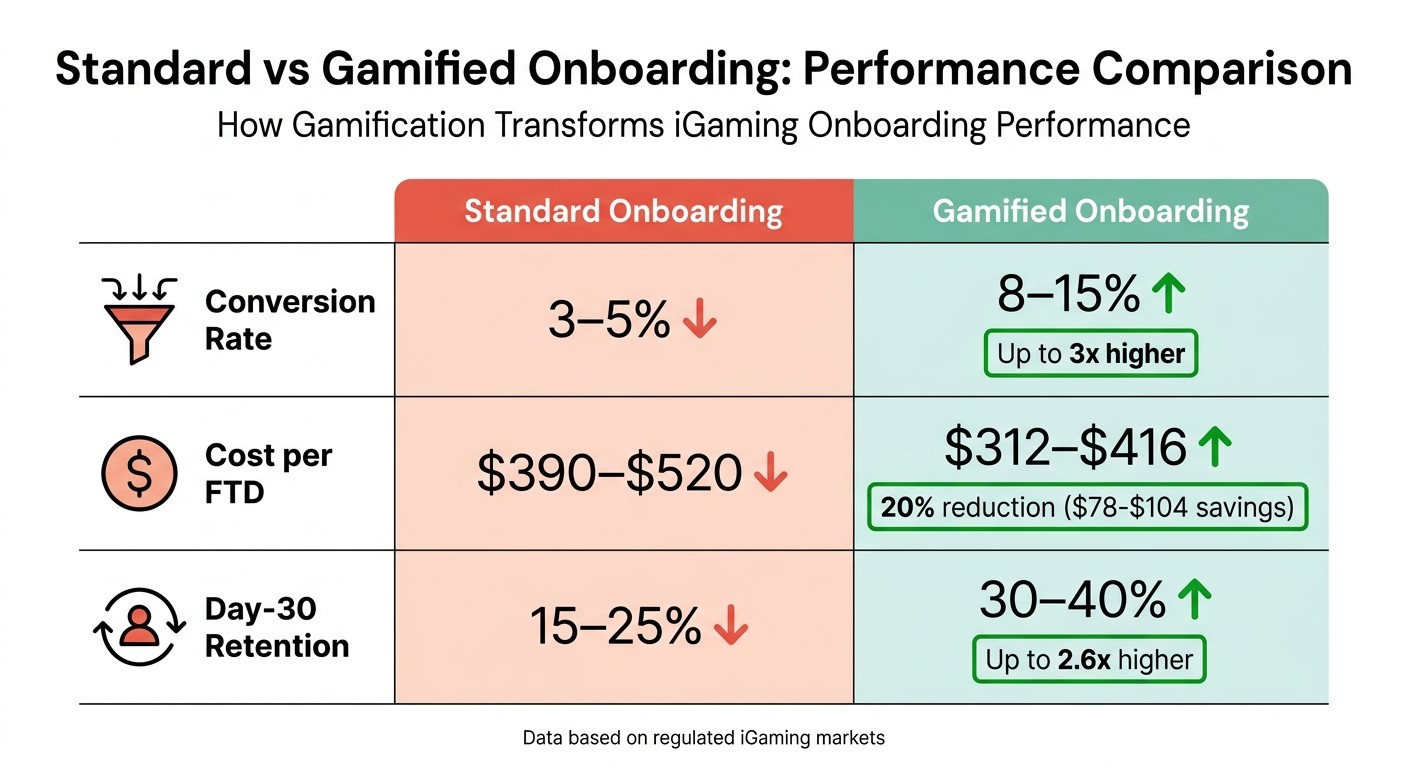
Standard vs Gamified Onboarding Performance Metrics in iGaming
Higher Sign-Up Completion Rates
Gamified tutorials can significantly improve conversion rates during the sign-up process. Typically, standard iGaming sign-up flows convert about 3% to 5% of visitors. However, when gamified elements like interactive challenges and rewards are introduced, conversion rates can climb to 8% to 15%. This boost is largely due to features like visual progress tracking, which encourage users to complete the process. In regulated markets, where the cost per first-time depositor (FTD) ranges from $390 to $520, gamification can lower acquisition costs by approximately 20%, saving between $78 and $104 per depositor.
Metric | Standard Onboarding | Gamified Onboarding |
|---|---|---|
Conversion Rate | 3–5% | 8–15% |
Cost per FTD | $390–$520 | $312–$416 |
Day-30 Retention | 15–25% | 30–40% |
Data source:
In addition to increasing sign-ups, gamified tutorials also help users progress faster toward making their first bets.
Faster Path to First Deposit
Getting users to register is just the first step - the real goal is converting that interest into revenue through first-time deposits (FTDs). Gamified tutorials help accelerate this process by maintaining momentum from sign-up to the first bet. Take Unicorn365, for example. In 2024, they revamped their onboarding process with targeted promotions and real-time analytics, achieving a 200% increase in net gaming revenue and onboarding more than 30,000 players. Their strategy included gamified prompts like bonus bets that activated only after an initial deposit was made.
Another success story comes from an operator in the Latin American market. They introduced dynamic "Product Ads" showcasing real-time betting odds and schedules. This interactive approach led to a 23% increase in incremental conversions for their iOS sports betting app while cutting the cost per acquisition by 25%. By making the onboarding process engaging and intuitive, these strategies help bridge the gap between initial interest and active participation.
Designing Effective Gamified Onboarding
Basic Design Guidelines
Creating engaging gamified tutorials starts with understanding player psychology, particularly through the lens of Self-Determination Theory, which emphasizes the need for autonomy, competence, and relatedness.
Start by introducing simple tasks, gradually increasing their complexity to keep users in their "optimal challenge zone." This aligns with Flow Theory, which ensures the difficulty of tasks matches the player's skill level. For instance, begin with straightforward actions like email verification or placing small bets instead of diving into complex parlay bets.
"The window for effective reinforcement is seconds to minutes, not hours to days. Real-time event processing captures player actions... and triggers responses... within seconds." - Xtremepush
Replace traditional linear tutorials with mission-based structures to make every step feel rewarding. Instead of generic instructions like "Complete your profile", try something more engaging, such as "New Player Challenge: Complete 5 actions this week to unlock your welcome package." Use progress bars to visually track achievements, reinforcing the sense of accomplishment. Keep the onboarding process concise - ideally between three to five steps - as research shows that longer tutorials lead to an 80% drop-off rate.
For first-time depositors, prominently display secure and regulated payment signals to build trust. Additionally, consider features like streak freezes in daily login challenges to promote responsible gaming and prevent user fatigue.
These principles should guide not only desktop onboarding but also adaptations for mobile platforms.
Optimizing for Mobile and Telegram
With more than 80% of iGaming users accessing platforms via smartphones, optimizing for mobile is no longer optional - it’s critical. For Telegram-based onboarding, Telegram Mini Apps can streamline the experience, allowing users to complete registration, tutorials, and bonus claims without leaving the chat environment.
Incorporate sticky buttons like "Start Playing" or "Claim Bonus" near the message input to keep calls-to-action visible even as users scroll. Replace long explanations with interactive buttons and short videos to quickly guide users through key actions.
For large-scale user acquisition, AI agents can provide 24/7 personalized assistance during KYC processes and first deposits. These agents boast open rates exceeding 80% and can reduce the cost per first-time deposit to around $3.50. Using simple flow builders, you can create multi-step sequences with controlled delays, ensuring users aren’t overwhelmed by a flood of messages.
Time-sensitive offers are another effective tool. A notification like "24-hour bonus expires soon", sent directly within a Telegram chat, can drive faster action compared to a generic email. Additionally, segment your tutorials based on user behavior. For example, high rollers might benefit from advanced instructions, while casual players receive a more simplified experience.
Tracking and Improving Onboarding Performance
Metrics to Monitor
Start by keeping an eye on the right numbers. The First-Time Deposit (FTD) Rate is a key metric, showing the percentage of users who make a deposit after completing onboarding steps. Pair this with the Quest Completion Rate, which measures how many players finish your gamified tutorial [14, 16].
Pay attention to friction points like Rage Clicks - these occur three times more often on gambling platforms. Industry data shows that error clicks have gone up by 11%, and bounce rates have jumped nearly 17%, signaling potential issues in your tutorial design.
Other important metrics include Day 1/Day 7 Retention and Cost-Per-Action (CPA). For example, one global iGaming company managed to cut their CPA by 25% and their Cost-Per-Install (CPI) by 28% by using well-aligned interactive ad creatives.
"Onboarding effectiveness always lies at the intersection of content and interface. Understanding what needs to be done and executing these actions - focusing on this helps the user." – Dina, Head of B2B Projects, Uplatform
Since more than 80% of iGamers access platforms on smartphones, it’s essential to break down your metrics by device type. This ensures your gamified tutorials work smoothly on both mobile and desktop [5, 9].
Once these metrics are in place, focus on improving them through continuous testing and feedback, using both numbers and user insights to guide your adjustments.
Testing and User Feedback
Metrics alone won’t give you the full picture - regular testing and user feedback are just as important. Use A/B testing to figure out which gamification elements work best. For instance, compare the effectiveness of progress bars versus badges or test shorter three-step tutorials against longer five-step ones [4, 5]. Prioritize lower-funnel conversions like First-Time Deposits over surface-level metrics like clicks [9, 11].
Tools like session replays can help you spot where users get stuck or confused during tutorials. When you identify friction points, provide real-time error feedback to guide users. For example, if a user enters a phone number incorrectly, explain the required format to prevent them from giving up.
One standout example is Unicorn365, which boosted Net Gaming Revenue by 200% by using real-time analytics to match user intent with relevant gamified promotions. These insights not only measure success but also help refine the onboarding process to make it more effective over time.
Using Enreach to Boost iGaming Sign-Ups
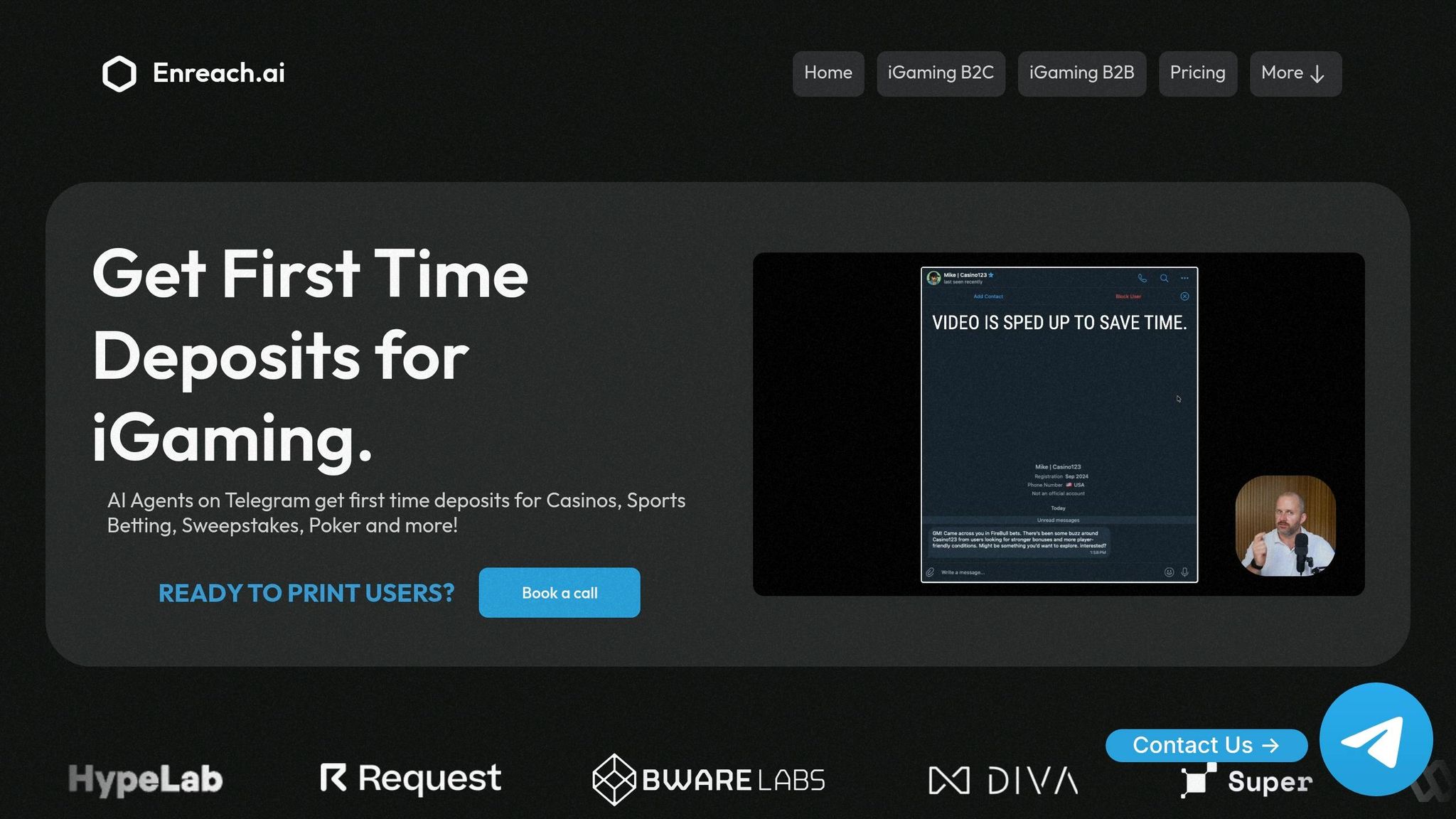
AI Agents for User Acquisition on Telegram
Enreach's AI Agents are designed to identify and qualify leads on Telegram by focusing on user interests like sports betting, casino games, and fantasy sports. These agents operate around the clock, delivering personalized, behavior-driven messages that guide users through the sign-up process - completely hands-free.
Take Lucky Bet, for instance. They achieved an average cost per First-Time Deposit (FTD) of just $3.50 using Enreach's Telegram AI Agents. In April 2026, a campaign combining Telegram Mini Apps with Enreach's automated outreach resulted in 5,009 first-time deposits and lowered the Cost Per Click (CPC) to an impressive $0.06.
"$3.5 avg cost per FTD across tier 1, 2 and 3 markets in the first year." – Filipe, Lucky Bet
These AI Agents excel at sending personalized betting offers with over 80% open rates. Campaigns leveraging these tools have sent over 50 million Telegram messages, generating valuable data to fine-tune outreach strategies. By seamlessly integrating gamified onboarding elements, Enreach ensures a smooth and engaging user experience.
Combining Gamified Tutorials with Enreach
Enreach's automated outreach becomes even more effective when paired with gamified tutorials. AI Agents can deliver interactive features - like time-sensitive challenges, point systems, and leaderboards - directly within Telegram chats, offering users an engaging onboarding experience without ever leaving the app.
Timing plays a critical role here. Deposit offers sent within 24–48 hours of sign-up, combined with 24-hour expiration windows, create urgency that drives conversions. The AI Agents also handle follow-ups, re-engaging users with tailored challenges, such as "streak bonus" offers designed to encourage continued activity.
Enreach integrates effortlessly with Telegram Mini Apps, offering a streamlined experience that includes crypto payment options. This eliminates common obstacles that might otherwise lead to user drop-offs during the sign-up process. Additionally, AI Agents can run A/B tests on gamified deposit offers to determine which incentives - like bonus structures, interactive quests, or reward systems - yield the lowest cost per FTD.
"Enreach makes it easy for our BD team to hit target consistently" – Lorenzo, Head of BD
Conclusion
Gamified tutorials take the sign-up process from being a dull, routine task to an engaging journey that motivates users to complete registration. Features like progress indicators and rewards help guide users smoothly from their first click to their first deposit. Research shows that gamification can increase engagement and conversion metrics by up to 100%, while 80% of users abandon traditional product tours that go beyond five steps. This makes gamified onboarding a powerful tool in the competitive iGaming market.
"It's no secret that a smooth, seamless user journey from landing on a site to making their first deposit is a crucial element of initial success. Onboarding effectiveness always lies at the intersection of content and interface." - Dina, Head of B2B Projects, Uplatform
Drawing from expert advice, focus on creating onboarding designs that are actionable and engaging. Keep tutorials short, focused on user actions, and packed with rewards. The key is delivering those early "quick wins" that motivate users and keep them moving through the process.
To optimize user acquisition in iGaming, start with simple mechanics like checklists with pre-filled tasks, real-time feedback during registration, and time-sensitive challenges. Experiment with different reward systems and track completion rates to refine your strategy. Pair these efforts with Enreach's AI-driven tools to further enhance results. Gamified onboarding isn’t just a nice-to-have - it’s essential for overcoming common obstacles in iGaming sign-ups. Platforms that strike the right balance between simplicity and engagement will achieve the best outcomes in attracting and retaining users.
FAQs
Which gamification elements work best for iGaming sign-ups?
Gamification in iGaming thrives on elements like points, challenges, rewards, levels, and quests. These features aren't just fun - they actively draw users in by making the experience more engaging. By incorporating these elements, platforms can simplify the onboarding process and create a sense of accomplishment, encouraging users to stick around and stay loyal over time.
How do you gamify KYC without hurting completion rates?
To make the KYC process more engaging without sacrificing completion rates, focus on simplifying it into smaller, easy-to-handle steps. Incorporate interactive features like progress bars, streaks, or mini-challenges to keep users engaged. The key is to ensure the process feels intuitive and smooth, reducing the chances of drop-offs while motivating users to complete their verification.
What metrics show a gamified tutorial is effective?
Key metrics to watch are user engagement, activation rates, and retention. For instance, integrating gamified steps often leads to a noticeable boost in activation rates, showcasing how impactful this method can be.
Related Blog Posts
Gamified tutorials are changing how iGaming platforms attract and keep users. Here's why they work:
New Player Retention: 60% of new players leave within 24 hours. Gamified onboarding helps keep them engaged by turning registration into a fun, interactive process.
Lower Costs: Acquiring a single player costs over $800, contributing to a significant client acquisition crunch. Gamification reduces this by simplifying sign-ups and improving completion rates.
Better Engagement: Platforms using gamified tutorials see up to 15% conversion rates (compared to 3–5% for traditional methods) and higher retention, with Day-30 retention rates hitting 30–40%.
Psychological Triggers: Features like progress bars, checklists, and rewards motivate users to complete tasks, leveraging principles like the "Zeigarnik Effect."
Faster Deposits: Gamified systems guide users from sign-up to their first deposit quickly, boosting revenue potential.
Gamification transforms the onboarding process into an engaging journey, making it easier for players to sign up, stay, and start betting. Platforms that focus on user-friendly, interactive tutorials are seeing better results in a highly competitive market.
Common Onboarding Problems in iGaming
Users Abandoning the Sign-Up Process
Traditional registration forms often disrupt the flow of new users. Up to 70% of users abandon registration forms before completing them due to excessive length, confusing design, or poor mobile compatibility. Imagine arriving at a platform ready to place your first bet, only to be bombarded with what feels like an endless questionnaire. Many platforms still require users to fill out a dozen fields - asking for details like date of birth and address - before they even get a chance to explore the site.
Identity verification adds another layer of frustration. Between 14% and 43% of new players fail to complete KYC requirements during onboarding. Worse, 32% of users abandon the platform entirely if verification takes too long. Players expect quick results, but manual uploads and vague error messages can instantly sour the experience. For instance, if a submitted ID photo is blurry or the phone number format is incorrect, users need immediate feedback - not a generic error message after waiting for the form to process.
Speed is critical. Pages that take more than 3 seconds to load lose up to 40% of users, with each additional second reducing conversions by about 7%. On mobile devices, the stakes are even higher: 53% of users abandon experiences that take longer than 3 seconds to load. Payment friction is another roadblock. 49% of users will abandon a transaction if their preferred payment method isn’t available, and 62% expect payments to process instantly.
"If the registration form feels like a quiz from hell, players will bounce faster than a losing blackjack hand." - Guest Author, iGaming Future
These issues don’t just prevent users from completing the onboarding process - they also erode your platform’s ability to compete effectively.
Standing Out in a Crowded Market
Technical hiccups during onboarding don’t just frustrate users - they also make it harder for your platform to stand out in an increasingly competitive industry. With landing page bounce rates ranging from 60% to 90%, even minor friction points can push players toward competitors. Switching platforms takes just a single tap, and if your onboarding feels sluggish or confusing, users won’t hesitate to move on. First impressions are made in seconds, not minutes, and any delay or misstep can send potential players elsewhere.
The goal isn’t just to create a functional sign-up process - it’s to deliver an experience that feels faster, smoother, and more engaging than what competitors offer. 88% of users are less likely to return to a platform after a poor digital experience. A single bad onboarding attempt could mean losing a player who represents hundreds of dollars in acquisition costs. Cross-device inconsistencies make things worse: if a player begins registration on a desktop and switches to mobile, any mismatch between the two experiences can immediately erode trust. To combat these issues, dynamic onboarding approaches - like gamified tutorials - can streamline the process and make it more enjoyable. For platforms leveraging messaging apps, using a Telegram Outreach Tool can further reduce friction by engaging users where they already spend their time.
"In a crowded market, where players can easily bounce to the next website, a seamless onboarding process is your best bet for standing out and keeping players in the game." - Guest Author, iGaming Future
Addressing these challenges is the first step to turning onboarding into a competitive advantage.
How Gamified Tutorials Increase Engagement
Game Elements That Drive User Action
Gamified tutorials transform ordinary registration forms into interactive, engaging experiences by tapping into psychological triggers. For instance, progress bars utilize the "goal-gradient effect", making users feel closer to completing a task as they see their progress. This visual cue makes the remaining steps seem more achievable.
Similarly, onboarding checklists take advantage of the "Zeigarnik Effect", which highlights how people are more likely to remember and complete unfinished tasks. By marking one or two tasks as already done - like "Account Created" - users get an immediate sense of accomplishment, motivating them to continue. Studies show that gamification can boost engagement and conversion rates by up to 100%. Yet, surprisingly, only 20% of product managers have tried this method.
Other powerful tools include missions, quests, streaks, and badges, which offer instant feedback to keep users engaged. A great example is Foursquare, which grew tenfold in just five years by incorporating features like points and "Mayor" titles. For these mechanics to work, reinforcement should happen quickly - within seconds or minutes. These elements not only encourage users to take action but also simplify tasks that might otherwise feel overwhelming.
Making Difficult Steps Feel Easier
Gamification also reduces the mental effort required for complex tasks by breaking them into smaller, more manageable "levels" or "missions." This approach turns lengthy processes, like filling out forms, into a series of quick, rewarding steps. Users might earn a badge or bonus credits with every milestone, keeping them motivated to move forward.
This strategy addresses a critical issue: 80% of users abandon product tours that exceed five steps. By showing progress visually and offering rewards at key points, platforms can keep users engaged, even during more tedious steps like identity verification. A well-designed gamified system aims for mission completion rates between 40% and 70%. To achieve this, early tasks should be easy to build confidence, while later challenges can gradually become more complex.
"We remember incomplete tasks much more and are motivated to finish them." - Userpilot Team
5 Ways Onboarding Drives User Retention featuring Aarushi Raizada
Measuring the Results of Gamified Tutorials
Standard vs Gamified Onboarding Performance Metrics in iGaming
Higher Sign-Up Completion Rates
Gamified tutorials can significantly improve conversion rates during the sign-up process. Typically, standard iGaming sign-up flows convert about 3% to 5% of visitors. However, when gamified elements like interactive challenges and rewards are introduced, conversion rates can climb to 8% to 15%. This boost is largely due to features like visual progress tracking, which encourage users to complete the process. In regulated markets, where the cost per first-time depositor (FTD) ranges from $390 to $520, gamification can lower acquisition costs by approximately 20%, saving between $78 and $104 per depositor.
Metric | Standard Onboarding | Gamified Onboarding |
|---|---|---|
Conversion Rate | 3–5% | 8–15% |
Cost per FTD | $390–$520 | $312–$416 |
Day-30 Retention | 15–25% | 30–40% |
Data source:
In addition to increasing sign-ups, gamified tutorials also help users progress faster toward making their first bets.
Faster Path to First Deposit
Getting users to register is just the first step - the real goal is converting that interest into revenue through first-time deposits (FTDs). Gamified tutorials help accelerate this process by maintaining momentum from sign-up to the first bet. Take Unicorn365, for example. In 2024, they revamped their onboarding process with targeted promotions and real-time analytics, achieving a 200% increase in net gaming revenue and onboarding more than 30,000 players. Their strategy included gamified prompts like bonus bets that activated only after an initial deposit was made.
Another success story comes from an operator in the Latin American market. They introduced dynamic "Product Ads" showcasing real-time betting odds and schedules. This interactive approach led to a 23% increase in incremental conversions for their iOS sports betting app while cutting the cost per acquisition by 25%. By making the onboarding process engaging and intuitive, these strategies help bridge the gap between initial interest and active participation.
Designing Effective Gamified Onboarding
Basic Design Guidelines
Creating engaging gamified tutorials starts with understanding player psychology, particularly through the lens of Self-Determination Theory, which emphasizes the need for autonomy, competence, and relatedness.
Start by introducing simple tasks, gradually increasing their complexity to keep users in their "optimal challenge zone." This aligns with Flow Theory, which ensures the difficulty of tasks matches the player's skill level. For instance, begin with straightforward actions like email verification or placing small bets instead of diving into complex parlay bets.
"The window for effective reinforcement is seconds to minutes, not hours to days. Real-time event processing captures player actions... and triggers responses... within seconds." - Xtremepush
Replace traditional linear tutorials with mission-based structures to make every step feel rewarding. Instead of generic instructions like "Complete your profile", try something more engaging, such as "New Player Challenge: Complete 5 actions this week to unlock your welcome package." Use progress bars to visually track achievements, reinforcing the sense of accomplishment. Keep the onboarding process concise - ideally between three to five steps - as research shows that longer tutorials lead to an 80% drop-off rate.
For first-time depositors, prominently display secure and regulated payment signals to build trust. Additionally, consider features like streak freezes in daily login challenges to promote responsible gaming and prevent user fatigue.
These principles should guide not only desktop onboarding but also adaptations for mobile platforms.
Optimizing for Mobile and Telegram
With more than 80% of iGaming users accessing platforms via smartphones, optimizing for mobile is no longer optional - it’s critical. For Telegram-based onboarding, Telegram Mini Apps can streamline the experience, allowing users to complete registration, tutorials, and bonus claims without leaving the chat environment.
Incorporate sticky buttons like "Start Playing" or "Claim Bonus" near the message input to keep calls-to-action visible even as users scroll. Replace long explanations with interactive buttons and short videos to quickly guide users through key actions.
For large-scale user acquisition, AI agents can provide 24/7 personalized assistance during KYC processes and first deposits. These agents boast open rates exceeding 80% and can reduce the cost per first-time deposit to around $3.50. Using simple flow builders, you can create multi-step sequences with controlled delays, ensuring users aren’t overwhelmed by a flood of messages.
Time-sensitive offers are another effective tool. A notification like "24-hour bonus expires soon", sent directly within a Telegram chat, can drive faster action compared to a generic email. Additionally, segment your tutorials based on user behavior. For example, high rollers might benefit from advanced instructions, while casual players receive a more simplified experience.
Tracking and Improving Onboarding Performance
Metrics to Monitor
Start by keeping an eye on the right numbers. The First-Time Deposit (FTD) Rate is a key metric, showing the percentage of users who make a deposit after completing onboarding steps. Pair this with the Quest Completion Rate, which measures how many players finish your gamified tutorial [14, 16].
Pay attention to friction points like Rage Clicks - these occur three times more often on gambling platforms. Industry data shows that error clicks have gone up by 11%, and bounce rates have jumped nearly 17%, signaling potential issues in your tutorial design.
Other important metrics include Day 1/Day 7 Retention and Cost-Per-Action (CPA). For example, one global iGaming company managed to cut their CPA by 25% and their Cost-Per-Install (CPI) by 28% by using well-aligned interactive ad creatives.
"Onboarding effectiveness always lies at the intersection of content and interface. Understanding what needs to be done and executing these actions - focusing on this helps the user." – Dina, Head of B2B Projects, Uplatform
Since more than 80% of iGamers access platforms on smartphones, it’s essential to break down your metrics by device type. This ensures your gamified tutorials work smoothly on both mobile and desktop [5, 9].
Once these metrics are in place, focus on improving them through continuous testing and feedback, using both numbers and user insights to guide your adjustments.
Testing and User Feedback
Metrics alone won’t give you the full picture - regular testing and user feedback are just as important. Use A/B testing to figure out which gamification elements work best. For instance, compare the effectiveness of progress bars versus badges or test shorter three-step tutorials against longer five-step ones [4, 5]. Prioritize lower-funnel conversions like First-Time Deposits over surface-level metrics like clicks [9, 11].
Tools like session replays can help you spot where users get stuck or confused during tutorials. When you identify friction points, provide real-time error feedback to guide users. For example, if a user enters a phone number incorrectly, explain the required format to prevent them from giving up.
One standout example is Unicorn365, which boosted Net Gaming Revenue by 200% by using real-time analytics to match user intent with relevant gamified promotions. These insights not only measure success but also help refine the onboarding process to make it more effective over time.
Using Enreach to Boost iGaming Sign-Ups
AI Agents for User Acquisition on Telegram
Enreach's AI Agents are designed to identify and qualify leads on Telegram by focusing on user interests like sports betting, casino games, and fantasy sports. These agents operate around the clock, delivering personalized, behavior-driven messages that guide users through the sign-up process - completely hands-free.
Take Lucky Bet, for instance. They achieved an average cost per First-Time Deposit (FTD) of just $3.50 using Enreach's Telegram AI Agents. In April 2026, a campaign combining Telegram Mini Apps with Enreach's automated outreach resulted in 5,009 first-time deposits and lowered the Cost Per Click (CPC) to an impressive $0.06.
"$3.5 avg cost per FTD across tier 1, 2 and 3 markets in the first year." – Filipe, Lucky Bet
These AI Agents excel at sending personalized betting offers with over 80% open rates. Campaigns leveraging these tools have sent over 50 million Telegram messages, generating valuable data to fine-tune outreach strategies. By seamlessly integrating gamified onboarding elements, Enreach ensures a smooth and engaging user experience.
Combining Gamified Tutorials with Enreach
Enreach's automated outreach becomes even more effective when paired with gamified tutorials. AI Agents can deliver interactive features - like time-sensitive challenges, point systems, and leaderboards - directly within Telegram chats, offering users an engaging onboarding experience without ever leaving the app.
Timing plays a critical role here. Deposit offers sent within 24–48 hours of sign-up, combined with 24-hour expiration windows, create urgency that drives conversions. The AI Agents also handle follow-ups, re-engaging users with tailored challenges, such as "streak bonus" offers designed to encourage continued activity.
Enreach integrates effortlessly with Telegram Mini Apps, offering a streamlined experience that includes crypto payment options. This eliminates common obstacles that might otherwise lead to user drop-offs during the sign-up process. Additionally, AI Agents can run A/B tests on gamified deposit offers to determine which incentives - like bonus structures, interactive quests, or reward systems - yield the lowest cost per FTD.
"Enreach makes it easy for our BD team to hit target consistently" – Lorenzo, Head of BD
Conclusion
Gamified tutorials take the sign-up process from being a dull, routine task to an engaging journey that motivates users to complete registration. Features like progress indicators and rewards help guide users smoothly from their first click to their first deposit. Research shows that gamification can increase engagement and conversion metrics by up to 100%, while 80% of users abandon traditional product tours that go beyond five steps. This makes gamified onboarding a powerful tool in the competitive iGaming market.
"It's no secret that a smooth, seamless user journey from landing on a site to making their first deposit is a crucial element of initial success. Onboarding effectiveness always lies at the intersection of content and interface." - Dina, Head of B2B Projects, Uplatform
Drawing from expert advice, focus on creating onboarding designs that are actionable and engaging. Keep tutorials short, focused on user actions, and packed with rewards. The key is delivering those early "quick wins" that motivate users and keep them moving through the process.
To optimize user acquisition in iGaming, start with simple mechanics like checklists with pre-filled tasks, real-time feedback during registration, and time-sensitive challenges. Experiment with different reward systems and track completion rates to refine your strategy. Pair these efforts with Enreach's AI-driven tools to further enhance results. Gamified onboarding isn’t just a nice-to-have - it’s essential for overcoming common obstacles in iGaming sign-ups. Platforms that strike the right balance between simplicity and engagement will achieve the best outcomes in attracting and retaining users.
FAQs
Which gamification elements work best for iGaming sign-ups?
Gamification in iGaming thrives on elements like points, challenges, rewards, levels, and quests. These features aren't just fun - they actively draw users in by making the experience more engaging. By incorporating these elements, platforms can simplify the onboarding process and create a sense of accomplishment, encouraging users to stick around and stay loyal over time.
How do you gamify KYC without hurting completion rates?
To make the KYC process more engaging without sacrificing completion rates, focus on simplifying it into smaller, easy-to-handle steps. Incorporate interactive features like progress bars, streaks, or mini-challenges to keep users engaged. The key is to ensure the process feels intuitive and smooth, reducing the chances of drop-offs while motivating users to complete their verification.
What metrics show a gamified tutorial is effective?
Key metrics to watch are user engagement, activation rates, and retention. For instance, integrating gamified steps often leads to a noticeable boost in activation rates, showcasing how impactful this method can be.
Related Blog Posts

Optimize Your Sales with Enreach.
Optimize Your Sales with Enreach.
Get access to a 500M person Leads Database, Automated Outreach and AI Sales Agents.
Get access to a 500M person Leads Database, Automated Outreach and AI Sales Agents.
More Info