How Telegram AI Agents Improve Web3 Onboarding
How Telegram AI Agents Improve Web3 Onboarding
Web3 Marketing
Feb 9, 2026
Feb 9, 2026
Telegram AI agents streamline Web3 onboarding with 24/7 personalized guidance, automated wallet and transaction help, lower costs, and higher conversions.
Telegram AI agents streamline Web3 onboarding with 24/7 personalized guidance, automated wallet and transaction help, lower costs, and higher conversions.

Telegram AI agents are changing how Web3 platforms welcome new users. They simplify complex processes like setting up wallets, understanding token standards, and handling transactions. Here's why they're effective:
24/7 Support: These agents answer technical questions, guide users step-by-step, and troubleshoot issues instantly.
Personalized Assistance: They analyze user behavior to offer tailored guidance, improving retention and reducing confusion.
Cost-Effective: At $400/month for 5,000 messages, they replace expensive sales teams while handling thousands of interactions daily.
Scalability: AI agents manage growing user bases without the need for additional staff.
For example, projects using these tools have seen engagement rates rise to 25–35% and conversions improve to 15–25%. By automating repetitive tasks, they free up human teams to focus on more complex user needs. Telegram AI agents are proving essential for making Web3 onboarding faster, easier, and more efficient.
Web3 Onboarding Challenges Explained
Web3 sales and marketing teams face a tough challenge: navigating the technical barriers that discourage non-technical users. While blockchain offers decentralization and user control, it also demands a level of technical understanding that many people lack. Toju Ometoruwa captures this well: "The complexity of Web3 technologies often acts as a barrier to entry, making it imperative to streamline the onboarding process, especially for non-technical users". This disconnect between blockchain’s promises and its accessibility creates friction at every step - whether it’s setting up a wallet or completing a first transaction. Without addressing these hurdles, user adoption remains an uphill battle.
The statistics paint a clear picture. NFT trading volume plummeted from over $5.3 billion in Q1 2024 to just $1.5 billion in Q3 2024, largely because newcomers found the process too confusing and costly. At the same time, retaining existing users is drastically cheaper - up to 25 times less expensive - than acquiring new ones. Yet many Web3 projects lose potential users before they even complete their first on-chain activity.
Technical Complexity Barriers
The first step to solving these challenges is understanding them. For new users, Web3 often feels like a maze of unfamiliar concepts. Seed phrases and private keys, for example, are far more complex than the simple password systems most people are used to. Worse, losing these keys means permanent asset loss, with no customer support or recovery options. Add fluctuating gas fees into the mix, and users face the confusing requirement of holding specific tokens just to complete transactions. Many are left wondering why they need to pay fees to send their own money.
Wallet setup is another major hurdle. It often requires downloading additional software and navigating complicated configurations. Once users manage to get through that step, they encounter even more complexity in the form of smart contract interactions. Whether they’re minting NFTs, swapping tokens, or staking assets, these actions usually involve multiple steps, cryptic error messages, and approvals. Bridging assets between blockchains adds yet another layer of difficulty, forcing users to grapple with concepts like interoperability.
Even the design of Web3 platforms can be a stumbling block. As software engineer Opeyemi Stephen puts it, "Builders build for builders who build for more builders while they all promise the next builder will bring in the users, users get left behind". Many platforms assume a high level of blockchain expertise, overwhelming newcomers with jargon like "liquidity pools", "slippage", and "rollups" without sufficient explanation. This creates an unintentional gatekeeping culture that alienates less tech-savvy users.
These technical challenges are a major reason why so many users drop off before they can fully engage with Web3.
User Drop-off Rates
Traditional onboarding methods in Web3 often create friction before delivering any value. Users are required to complete complex tasks - like securing seed phrases, switching networks, or approving transactions - before they can experience the benefits. This "wallet wall", where users can’t access content unless they connect a wallet, acts as a significant barrier. Frustrated by the process, many potential users abandon Web3 platforms and return to the familiarity of Web2 apps.
The data highlights the problem. Successful Web3 projects aim for retention rates above 80% after 30 days, but many fall far short. Conversion rates from lead to client typically range between 15% and 25%, meaning that three out of four interested users never make it past the onboarding phase. The issue is further compounded by Web3 churn. Unlike unsubscribing in Web2, Web3 users often switch wallets or simply disappear. Without AI-powered analytics to track wallet behavior and identify pain points, marketers struggle to understand where the onboarding process fails. Manual approaches simply can’t keep up with the global, round-the-clock demand.
AI solutions stand out as a way to simplify onboarding, offering personalized support that adapts to individual user needs and behaviors. By addressing these challenges, Web3 platforms can create a smoother path for users, reducing drop-off rates and boosting long-term engagement.
How Telegram AI Agents Simplify Onboarding
Telegram AI agents are transforming Web3 onboarding by making it more approachable and efficient. Instead of leaving newcomers to sift through complex documentation on their own, these agents act like digital guides - answering questions, breaking down technical jargon, and leading users step-by-step through the process.
Automated User Interaction
AI agents handle initial inquiries and guide users through multi-step onboarding processes. They’re available 24/7, answering questions about topics like gas fees, the differences between token standards (ERC-20 vs. NFTs), and blockchain protocols. These agents pull accurate information directly from whitepapers, FAQs, and other documentation, ensuring users get reliable and verified answers.
The results speak for themselves. For instance, FutureSynch used these automated onboarding tools to bring over 150 projects into the Arthera blockchain ecosystem. Another NFT marketplace implemented automated bot funnels and added 20,000 verified users to its community in just 45 days. Similarly, an early-stage DeFi protocol used automated referral campaigns to increase its Total Value Locked by $1.2 million.
Personalized Guidance Based on User Data
AI agents go beyond basic interactions by tailoring their support to each user. They ask questions about a user’s goals, wallet preferences, and technical knowledge, then guide them through the most relevant onboarding flow. By integrating with CRMs, these agents use data like project roles, engagement history, and past interactions to create customized message sequences.
This personalization also extends to blockchain activity. Agents monitor wallet behavior and transaction patterns to provide real-time, tailored assistance. For example, they adapt their tone and complexity based on a user’s chat history, continuously learning to anticipate future needs. By segmenting users by interests - whether DeFi, NFTs, or GameFi - they ensure that each person receives guidance suited to their specific focus.
Wallet and Transaction Assistance
AI agents also tackle technical challenges related to wallets and transactions, making complex tasks easier. They assist users with connecting wallets, approving transactions, and performing on-chain actions like staking, bridging, or swapping. For example, users can simply type, “swap 1 ETH for USDC on the most liquid exchange,” and the agent handles the rest - removing the need to navigate complicated decentralized exchange interfaces.
These agents also provide step-by-step support for wallet creation and seed phrase recovery (without storing sensitive information). They troubleshoot in real time, helping users with issues like pending transactions, gas fees, and token transfers. By delivering proactive security tips and scam alerts, they help users avoid common pitfalls. Using natural language processing combined with blockchain access via RPC nodes, they even provide accurate transaction status updates, clearing up confusion about “pending” states. By managing wallet connections and transaction approvals, these agents directly address common Web3 challenges, reducing drop-offs and creating a smoother onboarding experience.
Step-by-Step Guide to Implementing Telegram AI Agents
You don’t need to be a tech expert to get started with Telegram AI agents for Web3 onboarding. By combining automation with personalization, these agents can simplify the process significantly. Here’s a straightforward four-step guide to help you deploy a Telegram AI agent for efficient Web3 onboarding.
Step 1: Set Up Your AI Agent
Enreach makes it easy with a no-code setup. You won’t need any programming skills to get your AI agent up and running. The platform takes care of the technical details, including account creation and a "warming" process. This warming process is essential - it builds account activity to avoid triggering Telegram’s anti-spam filters, which could block your accounts before they even start engaging with users.
Once set up, your AI agent connects to Enreach’s database of over 500 million contacts. At $400 per month for 5,000 messages, the agent delivers 24/7 lead qualification and automated follow-ups. This approach eliminates the need for a sales development representative, which could cost upwards of $5,000 a month, making it a cost-effective solution for onboarding.
Step 2: Automate User Queries
After configuration, your AI agent can handle routine onboarding questions automatically. It works around the clock, qualifying leads, tailoring questions based on each user’s industry or role, and referencing past interactions stored in your CRM. The agent can manage thousands of conversations at once, a task that would overwhelm any manual follow-up process, which typically handles only a few dozen conversations per day per person.
The automation doesn’t stop there. It also schedules appointments directly, cutting out the endless back-and-forth that often delays onboarding by hours or even days.
Step 3: Target Telegram Outreach
Using Enreach’s tools, your AI agent can tap into Telegram’s massive user base of 240 million people. For $250 per month, the platform enables unlimited message sending, allowing you to engage with both Telegram channels and groups. Channels, which support unlimited subscribers, are perfect for broadcasting updates, while groups, accommodating up to 200,000 members, are ideal for real-time discussions and AMAs.
The targeting capabilities are highly refined. You can filter potential users based on factors like on-chain activity, language, location, or even specific token holdings. This ensures your outreach connects with people who are most likely to take an interest in your Web3 project.
Step 4: Utilize Expert Support
Enreach doesn’t just provide the tools - it also offers expert support. Their team of sales, data, and outbound specialists monitors engagement, resolves Web3-specific challenges like gas fee fluctuations or wallet connection issues, and fine-tunes workflows based on performance data. This hands-on assistance ensures your AI agent keeps improving, reducing onboarding barriers and turning more leads into active participants.
Benefits of Using Telegram AI Agents for Web3 Onboarding
Telegram AI agents bring efficiency and precision to Web3 onboarding, addressing common challenges and enhancing outcomes across the board.
Better User Retention
One of the biggest hurdles in onboarding is the technical friction that often frustrates users and causes them to drop off. AI agents tackle this issue head-on by offering 24/7 troubleshooting exactly when users need it most. Whether it's clarifying token differences, resolving transaction delays, or guiding wallet connections, these agents provide immediate answers. This level of support minimizes confusion and keeps users engaged throughout the onboarding process.
Time and Cost Savings
Efficiency isn’t just about speed - it’s about cost, too. The financial difference between human sales teams and AI agents is striking. A Web3 sales development representative typically costs around $130,000 annually, managing only 15–30 personalized messages per day during standard business hours. On the other hand, AI agents cost roughly $30 per hour, handle over 200 automated messages daily, and operate 24/7.
For example, in June 2025, the FinTech marketing agency Uptrend reported $93,000 in revenue in a single month while slashing their cost per prospect by 56%, thanks to automated Telegram campaigns..
Speed is another critical factor. A DeFi infrastructure company in the U.S. integrated Telegram with CRM automation in 2024, cutting their average lead response time from 2 hours to just 15 minutes. This change boosted their lead response rates by an impressive 300% (Source: Enreach Insights, 2025). Considering that even a 30-minute delay can reduce qualification rates by 21 times, AI agents excel at handling repetitive tasks like lead qualification, initial queries, and CRM syncing. This allows human teams to focus on building meaningful, high-value relationships.
Scalability for Growing Projects
Scalability is where AI agents truly shine. Unlike human teams that require hiring, training, and ongoing management, AI agents - trained on 30+ million sales conversations - deliver peak performance from day one. They can effortlessly handle thousands of simultaneous conversations, ensuring consistent support as your user base grows.
This ability to scale instantly eliminates the need for additional hiring or training costs, ensuring your team’s capacity keeps pace with your project’s growth. Whether your user base doubles or triples overnight, AI agents ensure that scaling up doesn’t become a bottleneck.
Manual vs. AI Agent Onboarding Comparison
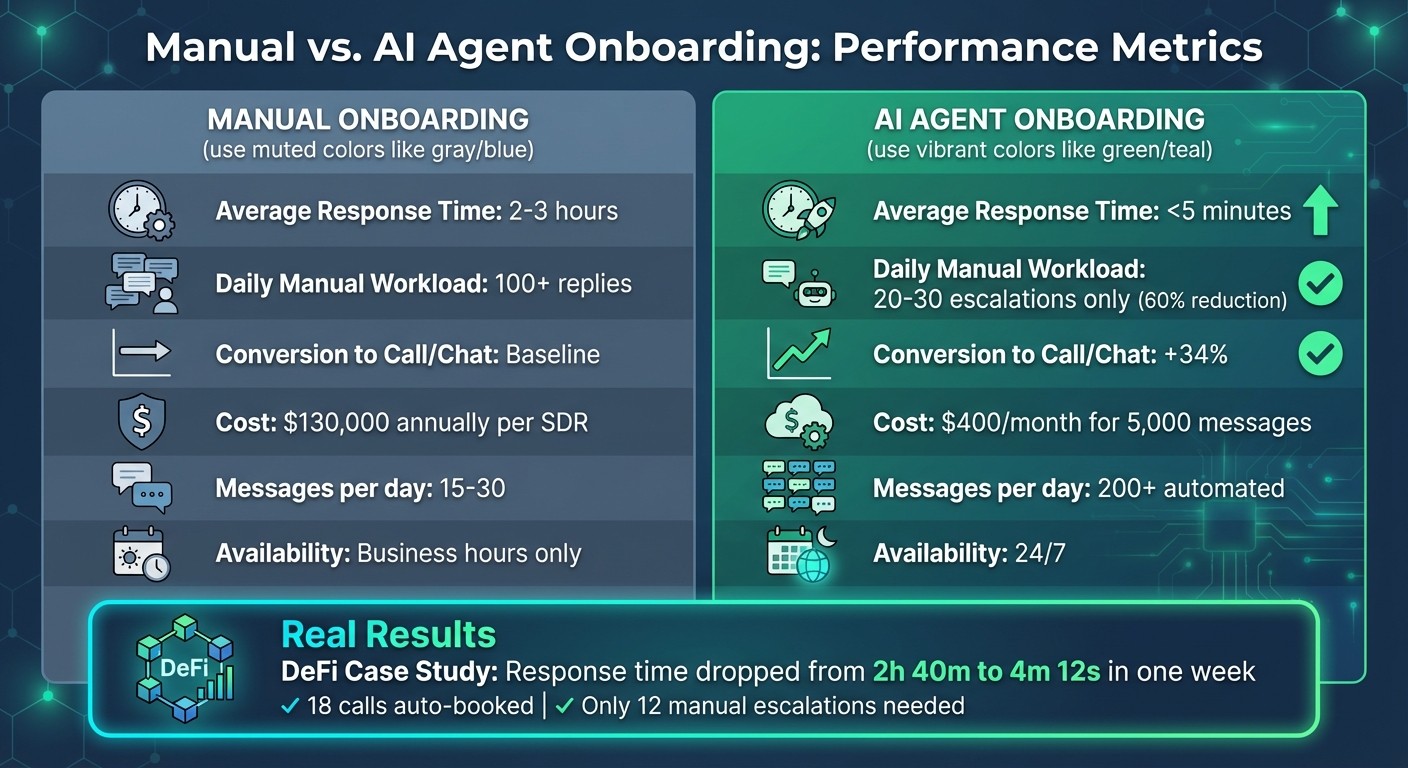
Manual vs AI Agent Web3 Onboarding Performance Comparison
When you put manual onboarding side by side with AI-powered solutions, the difference is striking. AI agents consistently outperform traditional methods across critical Web3 metrics, offering faster, more efficient, and scalable onboarding experiences.
Key Metrics for Comparison
One standout metric is response time. Manual representatives typically take 2–3 hours to respond, while AI agents can handle the same queries in under 5 minutes. This speed advantage is crucial, especially when potential users are comparing multiple projects at once - faster responses can directly drive higher conversion rates.
Another area where AI shines is workload distribution. Manual teams often tackle over 100 replies daily, addressing FAQs, wallet issues, and qualification inquiries. In contrast, AI agents reduce this workload by 60%, managing repetitive tasks and escalating only 20–30 complex cases to human experts. This hybrid model ensures users get instant answers to common questions, while human teams can focus on solving more complicated issues.
These numbers make it clear: AI agents don’t just streamline processes - they transform them. The case study below offers a practical example of these improvements in action.
Data-Backed Benefits of AI
In 2025, a DeFi infrastructure company implemented Telegram AI SDR technology to automate its outreach to founders. The results were immediate and impressive. Within just one week, their average response time dropped from 2 hours and 40 minutes to just 4 minutes and 12 seconds. This leap in efficiency led to 18 calls being automatically booked, with only 12 cases needing manual escalation (Source: Spredo Case Study, 2025).
This hybrid approach works because AI is excellent at delivering instant, accurate responses using pre-loaded product documentation and scripts. By qualifying leads upfront, AI agents free up human teams to focus on relationship-building and tackling more nuanced challenges. This balance of speed and personalization addresses the key pain points that often lead to Web3 onboarding drop-offs.
Conclusion
Integrating Telegram AI agents is reshaping the way Web3 projects approach onboarding. By cutting response times from hours to mere minutes and automating repetitive tasks, these tools tackle the common pain points that often cause users to drop off during the onboarding process. The result? Increased user engagement and improved operational efficiency.
This hybrid approach combines the strengths of AI and human expertise. AI agents manage routine tasks like answering FAQs, outreach, and lead qualification 24/7, while human experts step in to handle more complex inquiries. It’s a balance that ensures the speed and scalability of automation without losing the personal connection that fosters trust in Web3 communities.
Enreach exemplifies this model by pairing AI sales agents with expert support, making it easier for Web3 projects to adopt these solutions. As Ludovic from Request.Finance shares:
"Enreach makes it easy for our BD team to find new leads".
With AI agents capable of sending up to 5,000 messages per month for as little as $400, the platform offers an affordable way to maintain round-the-clock availability.
This shift to AI-driven onboarding isn’t just about saving time - it’s about being there when users need help the most. By leveraging on-chain triggers and blockchain data, AI agents can engage users at critical moments, like when someone connects their wallet to a dApp but doesn’t complete a transaction. This level of precise, real-time interaction was impossible with traditional methods, paving the way for scalable growth.
For Web3 teams, Telegram AI agents deliver faster responses, better retention, and reduced costs, all while freeing up resources to focus on building meaningful user relationships. By blending the efficiency of AI with the reliability of human expertise, the onboarding experience becomes both seamless and trustworthy.
FAQs
How do Telegram AI agents make Web3 onboarding more personalized?
Telegram's AI agents are transforming the Web3 onboarding experience with tailored, data-driven interactions. They analyze key details like user behavior, preferences, and engagement patterns - things like wallet activity, technical know-how, or prior interactions. Using this information, they craft personalized messages to guide users. For instance, an agent might inquire about a user's wallet preferences or investment goals, then suggest the most relevant resources or next steps.
What sets these agents apart is their ability to match Telegram's casual, concise tone, ensuring their messages feel natural and engaging. They also adapt on the fly, tracking user responses and interaction frequency to fine-tune their approach in real time. This makes the onboarding process smoother and more intuitive. By offering this level of personalization, these AI agents help users feel valued and supported, building trust while boosting conversion rates in the Web3 space.
How do Telegram AI agents simplify Web3 onboarding challenges?
Telegram AI agents are transforming Web3 onboarding by automating and personalizing outreach efforts. They handle tasks like qualifying leads, sending tailored messages, following up, and even supporting deal closures - all day, every day. This approach simplifies workflows, cuts down on manual labor, and helps businesses scale more efficiently.
In a space where trust is a cornerstone, these agents strike a balance between automation and human touch. By maintaining a personalized tone, they avoid the robotic feel often associated with automated systems. Plus, they improve targeting by filtering contacts based on criteria like company, role, or activity, ensuring every interaction feels relevant and meaningful.
With their ability to reduce workloads, deliver tailored communication, and foster trust, Telegram AI agents make onboarding new users and partners in the Web3 world smoother and more effective.
How do Telegram AI agents save costs and boost efficiency compared to traditional sales teams?
Telegram AI agents present a budget-friendly and efficient alternative to traditional sales teams. Unlike human teams, these AI agents operate 24/7, managing tasks like lead capture, follow-ups, and outreach. This round-the-clock availability significantly cuts labor costs while allowing operations to scale effortlessly. AI agents can handle hundreds of interactions daily without incurring extra expenses.
For context, traditional sales teams often come with hefty salaries, averaging about $130,000 annually. In contrast, AI agents are far more affordable, with subscriptions starting at roughly $30 per hour. Beyond cost savings, AI agents also excel in performance, offering faster response times and achieving engagement rates as high as 70% on Telegram. This makes them a powerful tool for streamlining Web3 onboarding and outreach. By automating repetitive tasks, these agents free up human teams to focus on what they do best - building genuine connections and closing deals.
Related Blog Posts
Telegram AI agents are changing how Web3 platforms welcome new users. They simplify complex processes like setting up wallets, understanding token standards, and handling transactions. Here's why they're effective:
24/7 Support: These agents answer technical questions, guide users step-by-step, and troubleshoot issues instantly.
Personalized Assistance: They analyze user behavior to offer tailored guidance, improving retention and reducing confusion.
Cost-Effective: At $400/month for 5,000 messages, they replace expensive sales teams while handling thousands of interactions daily.
Scalability: AI agents manage growing user bases without the need for additional staff.
For example, projects using these tools have seen engagement rates rise to 25–35% and conversions improve to 15–25%. By automating repetitive tasks, they free up human teams to focus on more complex user needs. Telegram AI agents are proving essential for making Web3 onboarding faster, easier, and more efficient.
Web3 Onboarding Challenges Explained
Web3 sales and marketing teams face a tough challenge: navigating the technical barriers that discourage non-technical users. While blockchain offers decentralization and user control, it also demands a level of technical understanding that many people lack. Toju Ometoruwa captures this well: "The complexity of Web3 technologies often acts as a barrier to entry, making it imperative to streamline the onboarding process, especially for non-technical users". This disconnect between blockchain’s promises and its accessibility creates friction at every step - whether it’s setting up a wallet or completing a first transaction. Without addressing these hurdles, user adoption remains an uphill battle.
The statistics paint a clear picture. NFT trading volume plummeted from over $5.3 billion in Q1 2024 to just $1.5 billion in Q3 2024, largely because newcomers found the process too confusing and costly. At the same time, retaining existing users is drastically cheaper - up to 25 times less expensive - than acquiring new ones. Yet many Web3 projects lose potential users before they even complete their first on-chain activity.
Technical Complexity Barriers
The first step to solving these challenges is understanding them. For new users, Web3 often feels like a maze of unfamiliar concepts. Seed phrases and private keys, for example, are far more complex than the simple password systems most people are used to. Worse, losing these keys means permanent asset loss, with no customer support or recovery options. Add fluctuating gas fees into the mix, and users face the confusing requirement of holding specific tokens just to complete transactions. Many are left wondering why they need to pay fees to send their own money.
Wallet setup is another major hurdle. It often requires downloading additional software and navigating complicated configurations. Once users manage to get through that step, they encounter even more complexity in the form of smart contract interactions. Whether they’re minting NFTs, swapping tokens, or staking assets, these actions usually involve multiple steps, cryptic error messages, and approvals. Bridging assets between blockchains adds yet another layer of difficulty, forcing users to grapple with concepts like interoperability.
Even the design of Web3 platforms can be a stumbling block. As software engineer Opeyemi Stephen puts it, "Builders build for builders who build for more builders while they all promise the next builder will bring in the users, users get left behind". Many platforms assume a high level of blockchain expertise, overwhelming newcomers with jargon like "liquidity pools", "slippage", and "rollups" without sufficient explanation. This creates an unintentional gatekeeping culture that alienates less tech-savvy users.
These technical challenges are a major reason why so many users drop off before they can fully engage with Web3.
User Drop-off Rates
Traditional onboarding methods in Web3 often create friction before delivering any value. Users are required to complete complex tasks - like securing seed phrases, switching networks, or approving transactions - before they can experience the benefits. This "wallet wall", where users can’t access content unless they connect a wallet, acts as a significant barrier. Frustrated by the process, many potential users abandon Web3 platforms and return to the familiarity of Web2 apps.
The data highlights the problem. Successful Web3 projects aim for retention rates above 80% after 30 days, but many fall far short. Conversion rates from lead to client typically range between 15% and 25%, meaning that three out of four interested users never make it past the onboarding phase. The issue is further compounded by Web3 churn. Unlike unsubscribing in Web2, Web3 users often switch wallets or simply disappear. Without AI-powered analytics to track wallet behavior and identify pain points, marketers struggle to understand where the onboarding process fails. Manual approaches simply can’t keep up with the global, round-the-clock demand.
AI solutions stand out as a way to simplify onboarding, offering personalized support that adapts to individual user needs and behaviors. By addressing these challenges, Web3 platforms can create a smoother path for users, reducing drop-off rates and boosting long-term engagement.
How Telegram AI Agents Simplify Onboarding
Telegram AI agents are transforming Web3 onboarding by making it more approachable and efficient. Instead of leaving newcomers to sift through complex documentation on their own, these agents act like digital guides - answering questions, breaking down technical jargon, and leading users step-by-step through the process.
Automated User Interaction
AI agents handle initial inquiries and guide users through multi-step onboarding processes. They’re available 24/7, answering questions about topics like gas fees, the differences between token standards (ERC-20 vs. NFTs), and blockchain protocols. These agents pull accurate information directly from whitepapers, FAQs, and other documentation, ensuring users get reliable and verified answers.
The results speak for themselves. For instance, FutureSynch used these automated onboarding tools to bring over 150 projects into the Arthera blockchain ecosystem. Another NFT marketplace implemented automated bot funnels and added 20,000 verified users to its community in just 45 days. Similarly, an early-stage DeFi protocol used automated referral campaigns to increase its Total Value Locked by $1.2 million.
Personalized Guidance Based on User Data
AI agents go beyond basic interactions by tailoring their support to each user. They ask questions about a user’s goals, wallet preferences, and technical knowledge, then guide them through the most relevant onboarding flow. By integrating with CRMs, these agents use data like project roles, engagement history, and past interactions to create customized message sequences.
This personalization also extends to blockchain activity. Agents monitor wallet behavior and transaction patterns to provide real-time, tailored assistance. For example, they adapt their tone and complexity based on a user’s chat history, continuously learning to anticipate future needs. By segmenting users by interests - whether DeFi, NFTs, or GameFi - they ensure that each person receives guidance suited to their specific focus.
Wallet and Transaction Assistance
AI agents also tackle technical challenges related to wallets and transactions, making complex tasks easier. They assist users with connecting wallets, approving transactions, and performing on-chain actions like staking, bridging, or swapping. For example, users can simply type, “swap 1 ETH for USDC on the most liquid exchange,” and the agent handles the rest - removing the need to navigate complicated decentralized exchange interfaces.
These agents also provide step-by-step support for wallet creation and seed phrase recovery (without storing sensitive information). They troubleshoot in real time, helping users with issues like pending transactions, gas fees, and token transfers. By delivering proactive security tips and scam alerts, they help users avoid common pitfalls. Using natural language processing combined with blockchain access via RPC nodes, they even provide accurate transaction status updates, clearing up confusion about “pending” states. By managing wallet connections and transaction approvals, these agents directly address common Web3 challenges, reducing drop-offs and creating a smoother onboarding experience.
Step-by-Step Guide to Implementing Telegram AI Agents
You don’t need to be a tech expert to get started with Telegram AI agents for Web3 onboarding. By combining automation with personalization, these agents can simplify the process significantly. Here’s a straightforward four-step guide to help you deploy a Telegram AI agent for efficient Web3 onboarding.
Step 1: Set Up Your AI Agent
Enreach makes it easy with a no-code setup. You won’t need any programming skills to get your AI agent up and running. The platform takes care of the technical details, including account creation and a "warming" process. This warming process is essential - it builds account activity to avoid triggering Telegram’s anti-spam filters, which could block your accounts before they even start engaging with users.
Once set up, your AI agent connects to Enreach’s database of over 500 million contacts. At $400 per month for 5,000 messages, the agent delivers 24/7 lead qualification and automated follow-ups. This approach eliminates the need for a sales development representative, which could cost upwards of $5,000 a month, making it a cost-effective solution for onboarding.
Step 2: Automate User Queries
After configuration, your AI agent can handle routine onboarding questions automatically. It works around the clock, qualifying leads, tailoring questions based on each user’s industry or role, and referencing past interactions stored in your CRM. The agent can manage thousands of conversations at once, a task that would overwhelm any manual follow-up process, which typically handles only a few dozen conversations per day per person.
The automation doesn’t stop there. It also schedules appointments directly, cutting out the endless back-and-forth that often delays onboarding by hours or even days.
Step 3: Target Telegram Outreach
Using Enreach’s tools, your AI agent can tap into Telegram’s massive user base of 240 million people. For $250 per month, the platform enables unlimited message sending, allowing you to engage with both Telegram channels and groups. Channels, which support unlimited subscribers, are perfect for broadcasting updates, while groups, accommodating up to 200,000 members, are ideal for real-time discussions and AMAs.
The targeting capabilities are highly refined. You can filter potential users based on factors like on-chain activity, language, location, or even specific token holdings. This ensures your outreach connects with people who are most likely to take an interest in your Web3 project.
Step 4: Utilize Expert Support
Enreach doesn’t just provide the tools - it also offers expert support. Their team of sales, data, and outbound specialists monitors engagement, resolves Web3-specific challenges like gas fee fluctuations or wallet connection issues, and fine-tunes workflows based on performance data. This hands-on assistance ensures your AI agent keeps improving, reducing onboarding barriers and turning more leads into active participants.
Benefits of Using Telegram AI Agents for Web3 Onboarding
Telegram AI agents bring efficiency and precision to Web3 onboarding, addressing common challenges and enhancing outcomes across the board.
Better User Retention
One of the biggest hurdles in onboarding is the technical friction that often frustrates users and causes them to drop off. AI agents tackle this issue head-on by offering 24/7 troubleshooting exactly when users need it most. Whether it's clarifying token differences, resolving transaction delays, or guiding wallet connections, these agents provide immediate answers. This level of support minimizes confusion and keeps users engaged throughout the onboarding process.
Time and Cost Savings
Efficiency isn’t just about speed - it’s about cost, too. The financial difference between human sales teams and AI agents is striking. A Web3 sales development representative typically costs around $130,000 annually, managing only 15–30 personalized messages per day during standard business hours. On the other hand, AI agents cost roughly $30 per hour, handle over 200 automated messages daily, and operate 24/7.
For example, in June 2025, the FinTech marketing agency Uptrend reported $93,000 in revenue in a single month while slashing their cost per prospect by 56%, thanks to automated Telegram campaigns..
Speed is another critical factor. A DeFi infrastructure company in the U.S. integrated Telegram with CRM automation in 2024, cutting their average lead response time from 2 hours to just 15 minutes. This change boosted their lead response rates by an impressive 300% (Source: Enreach Insights, 2025). Considering that even a 30-minute delay can reduce qualification rates by 21 times, AI agents excel at handling repetitive tasks like lead qualification, initial queries, and CRM syncing. This allows human teams to focus on building meaningful, high-value relationships.
Scalability for Growing Projects
Scalability is where AI agents truly shine. Unlike human teams that require hiring, training, and ongoing management, AI agents - trained on 30+ million sales conversations - deliver peak performance from day one. They can effortlessly handle thousands of simultaneous conversations, ensuring consistent support as your user base grows.
This ability to scale instantly eliminates the need for additional hiring or training costs, ensuring your team’s capacity keeps pace with your project’s growth. Whether your user base doubles or triples overnight, AI agents ensure that scaling up doesn’t become a bottleneck.
Manual vs. AI Agent Onboarding Comparison
Manual vs AI Agent Web3 Onboarding Performance Comparison
When you put manual onboarding side by side with AI-powered solutions, the difference is striking. AI agents consistently outperform traditional methods across critical Web3 metrics, offering faster, more efficient, and scalable onboarding experiences.
Key Metrics for Comparison
One standout metric is response time. Manual representatives typically take 2–3 hours to respond, while AI agents can handle the same queries in under 5 minutes. This speed advantage is crucial, especially when potential users are comparing multiple projects at once - faster responses can directly drive higher conversion rates.
Another area where AI shines is workload distribution. Manual teams often tackle over 100 replies daily, addressing FAQs, wallet issues, and qualification inquiries. In contrast, AI agents reduce this workload by 60%, managing repetitive tasks and escalating only 20–30 complex cases to human experts. This hybrid model ensures users get instant answers to common questions, while human teams can focus on solving more complicated issues.
These numbers make it clear: AI agents don’t just streamline processes - they transform them. The case study below offers a practical example of these improvements in action.
Data-Backed Benefits of AI
In 2025, a DeFi infrastructure company implemented Telegram AI SDR technology to automate its outreach to founders. The results were immediate and impressive. Within just one week, their average response time dropped from 2 hours and 40 minutes to just 4 minutes and 12 seconds. This leap in efficiency led to 18 calls being automatically booked, with only 12 cases needing manual escalation (Source: Spredo Case Study, 2025).
This hybrid approach works because AI is excellent at delivering instant, accurate responses using pre-loaded product documentation and scripts. By qualifying leads upfront, AI agents free up human teams to focus on relationship-building and tackling more nuanced challenges. This balance of speed and personalization addresses the key pain points that often lead to Web3 onboarding drop-offs.
Conclusion
Integrating Telegram AI agents is reshaping the way Web3 projects approach onboarding. By cutting response times from hours to mere minutes and automating repetitive tasks, these tools tackle the common pain points that often cause users to drop off during the onboarding process. The result? Increased user engagement and improved operational efficiency.
This hybrid approach combines the strengths of AI and human expertise. AI agents manage routine tasks like answering FAQs, outreach, and lead qualification 24/7, while human experts step in to handle more complex inquiries. It’s a balance that ensures the speed and scalability of automation without losing the personal connection that fosters trust in Web3 communities.
Enreach exemplifies this model by pairing AI sales agents with expert support, making it easier for Web3 projects to adopt these solutions. As Ludovic from Request.Finance shares:
"Enreach makes it easy for our BD team to find new leads".
With AI agents capable of sending up to 5,000 messages per month for as little as $400, the platform offers an affordable way to maintain round-the-clock availability.
This shift to AI-driven onboarding isn’t just about saving time - it’s about being there when users need help the most. By leveraging on-chain triggers and blockchain data, AI agents can engage users at critical moments, like when someone connects their wallet to a dApp but doesn’t complete a transaction. This level of precise, real-time interaction was impossible with traditional methods, paving the way for scalable growth.
For Web3 teams, Telegram AI agents deliver faster responses, better retention, and reduced costs, all while freeing up resources to focus on building meaningful user relationships. By blending the efficiency of AI with the reliability of human expertise, the onboarding experience becomes both seamless and trustworthy.
FAQs
How do Telegram AI agents make Web3 onboarding more personalized?
Telegram's AI agents are transforming the Web3 onboarding experience with tailored, data-driven interactions. They analyze key details like user behavior, preferences, and engagement patterns - things like wallet activity, technical know-how, or prior interactions. Using this information, they craft personalized messages to guide users. For instance, an agent might inquire about a user's wallet preferences or investment goals, then suggest the most relevant resources or next steps.
What sets these agents apart is their ability to match Telegram's casual, concise tone, ensuring their messages feel natural and engaging. They also adapt on the fly, tracking user responses and interaction frequency to fine-tune their approach in real time. This makes the onboarding process smoother and more intuitive. By offering this level of personalization, these AI agents help users feel valued and supported, building trust while boosting conversion rates in the Web3 space.
How do Telegram AI agents simplify Web3 onboarding challenges?
Telegram AI agents are transforming Web3 onboarding by automating and personalizing outreach efforts. They handle tasks like qualifying leads, sending tailored messages, following up, and even supporting deal closures - all day, every day. This approach simplifies workflows, cuts down on manual labor, and helps businesses scale more efficiently.
In a space where trust is a cornerstone, these agents strike a balance between automation and human touch. By maintaining a personalized tone, they avoid the robotic feel often associated with automated systems. Plus, they improve targeting by filtering contacts based on criteria like company, role, or activity, ensuring every interaction feels relevant and meaningful.
With their ability to reduce workloads, deliver tailored communication, and foster trust, Telegram AI agents make onboarding new users and partners in the Web3 world smoother and more effective.
How do Telegram AI agents save costs and boost efficiency compared to traditional sales teams?
Telegram AI agents present a budget-friendly and efficient alternative to traditional sales teams. Unlike human teams, these AI agents operate 24/7, managing tasks like lead capture, follow-ups, and outreach. This round-the-clock availability significantly cuts labor costs while allowing operations to scale effortlessly. AI agents can handle hundreds of interactions daily without incurring extra expenses.
For context, traditional sales teams often come with hefty salaries, averaging about $130,000 annually. In contrast, AI agents are far more affordable, with subscriptions starting at roughly $30 per hour. Beyond cost savings, AI agents also excel in performance, offering faster response times and achieving engagement rates as high as 70% on Telegram. This makes them a powerful tool for streamlining Web3 onboarding and outreach. By automating repetitive tasks, these agents free up human teams to focus on what they do best - building genuine connections and closing deals.
Related Blog Posts

Optimize Your Sales with Enreach.
Optimize Your Sales with Enreach.
Get access to a 500M person Leads Database, Automated Outreach and AI Sales Agents.
Get access to a 500M person Leads Database, Automated Outreach and AI Sales Agents.
More Info